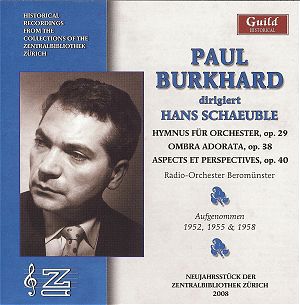
Here’s a curiosity. An historical re-issue of the work of a musician
is usually of the Heifetz plays Bach, or Furtwängler conducts (yet another performance
of) Beethoven Choral Symphony variety. This disk contains
performances by a conductor few will have heard of, conducting
music by a composer even fewer music-lovers will have heard of.
So
what is of the most importance here? The composer of the conductor?
I think we start with the composer, for without him there
would be no conductor.
Hans Schaeuble was born in 1906 in Arosa. He attended school
in Lausanne where performances of the Orchestre de la Suisse
Romande under Ernest Ansermet gave him the urge to devote
himself entirely to music. He studied in Leipzig, moving to
Berlin in 1931 where he achieved his earliest successes as
a composer and gained a publishing contract. In 1939 he returned
to his native Switzerland, but when the danger of a German
invasion of his homeland receded, he returned to Berlin, 1941-1942.
Schaeuble later suffered repeated reproaches for having been
supposedly too well-disposed towards the Third Reich - which
he never was. Schaeuble's pre-war successes were not repeated
post-war. He became increasingly hostile towards the music
of his younger contemporaries, composed less and less, and
at the end of his life spent his time making repeated revisions
of his earlier works.
There’s some fine music on this disk. Hymnus is a very
strong piece – written in a very short time on his return
to Zürich from Berlin. It is a closely argued symphonic movement -
I don’t see the two movement structure the notes refer to
- preceded by a short prayer derived from one of his own songs.
It is terse and argumentative, always moving forwards, striving
for fuller and further explanation of its material. The music
rests at its conclusion, ending in repose. It needs it.
Ombra
adorata – Kleine Sinfonie für orchester is a four movement work, again
starting with a short, broad, opening section of some 90 seconds
duration before plunging into a fierce allegro utilizing a
twelve note row - but that shouldn’t worry anyone. This work
deals with the “shadow” of previous epochs: “… the inheritance
we admire, but in whose shadow we stand, is meant” wrote the
composer. The slow movement is a real song-like piece, chromatic
in language, intense and thickly textured. The finale is playful
and diatonic. Now there’s a rush through many of the compositional
trends of the first 50 years of the 20th century.
Neither
of these works fell foul of Schaeuble’s
revisions in later life so these are his first and only thoughts.
And most interesting thoughts they are, too.
Aspects
and Perspectives – Divertimento für orchester – which exists in three versions,
the original 1958 score, heard here, and revisions from 1959
and 1978 – was intended to be “a more or less abstract ballet
of a symphonic and dance-like content” (Schaeuble’s
diary 30 May 1954). In 1957 he noted that the piece, originally
titled Jeux, was “neither Jeux, Divertimento nor a
ballet” and he described it as “peculiar” and an “isolated
case”. This is another tersely argued symphonic movement,
though without the bite or fire of Hymnus. It ever
so slightly outstays its welcome.
The
Piano Concerto, which exists in three versions, of
which we hear the first, is in one movement within which are
four clearly defined sections, with a cadenza - not a cadence
as the notes claim – this is simply a mistranslation from
the German language notes - near the end. This music is more
austere than the other works, with a sparer, less colourful,
orchestration. The construction, however, is stronger, more
classical, less abstract, and thus it is easier to follow
the musical argument.
Paul Burkhard was born in 1911 and commenced studies at the Zürich Conservatory at the age of 7!
As a composer he became known for his operettas, but also wrote
chamber works, incidental and ballet music, orchestral pieces
and children’s operas. His most famous composition was the song
Oh mein Papa, written in 1939, and recorded by, amongst others, Alan Breeze,
Billy Cotton, Connie Francis, Eddie Calvert and his Golden Trumpet,
Eddie Fisher, The Everly Brothers, Harry James, Ray Anthony &
his Orchestra, Russ Morgan & his Orchestra and The Beverley
Sisters. He started his conducting career at
the Berner Stadttheater in 1942, moving to the Radio-Orchester,
Beromünster two years later. He died in
1977.
The recordings all derive from Swiss Radio and the sound has been expertly
remastered by Peter Reynolds; it is clear and places orchestra
and soloist is a realistic sound-space with little reverberation.
There’s a very strange edit at 05:15 of the first movement
of the Symphony but this was probably on the original
material. The performances are, I am sure, very committed
– as they all derive from during the composer’s lifetime we
may assume that he was in attendance at the rehearsals.
An unusual disk to be sure, but one from which I derived a lot of pleasure.
Well worth investigating.
Bob
Briggs