Discussion of the distinctive characteristics of Otto Klemperer’s
conducting tends to focus on the final phase of his long career,
when many of his interpretations appeared to mirror his impassive
– if not positively stern - facial expression and his physical
immobility.
In
fact, his best-known and most widely circulated recordings
– made with the Philharmonia and New Philharmonia orchestras
in the 1950s and 1960s – almost invariably attract such adjectives
as “forceful”, “unwavering”, “solid” and “craggy” (the word
“granite” appears with almost monotonous regularity).
But
that seriously distorts Klemperer’s overall achievement in
the recording studios. Many of his early 1950s Vox discs,
for instance, exhibit a far less monolithic “style”. And the
interpretations preserved on this new Naxos Historical issue
offer surprising and conclusive proof of the individuality
and subtlety of his interpretations of core repertoire at
an even earlier stage of his career.
Klemperer’s
image in the late 1920s was that of a progressive modernist.
Appointed Chief Conductor of the Kroll Opera in Berlin in
the very year that most of these recordings were set down
and remaining in that post until 1931, Klemperer famously
outraged the Nazi Party’s cultural panjandrums by focusing
on works by such culturally – and often racially – suspect
composers as Hindemith (Neues vom Tage, 1929), Schoenberg
(Begleitmusik zu einer Lichtspielszene, 1930) and Kurt
Weill.
And
yet these Brahms and Wagner recordings, expertly restored
to fine effect by Mark Obert-Thorn, show him to have been,
at the same time, an entirely sympathetic and often quite
surprisingly flexible interpreter of such late 19th
century Romantic repertoire.
From
the very opening of the Brahms symphony, we are in for a surprise,
for the timpanist’s strokes - far from driving all before
them in the usual relentless and dominating fashion - are,
while remaining the music’s key propulsive driver, far more
integrated into the full orchestral mix than we generally
expect.
Of
course, it might be argued that a single such instance might
well be due to the inadequacies of late 1920s recording technology
(even though modern restoration techniques have shown conclusively
that many surviving masters have far more detail embedded
in them than used to be assumed.) But further listening reveals
that the C minor symphony’s opening is of an exact pattern
with Klemperer’s conception of the whole work, with showy
dramatics consistently eschewed in favour of lightness of
touch, frequent fleetness of foot – especially in the finale
- and orchestral transparency that allows the score’s finer
detail to shine through. And what lovingly-presented detail
there is! Just listen, for instance, to the sweetly seductive
solo violin in the slow movement (from about 6:56 onwards),
geműtlich almost in the manner of a Viennese café
player and making a noticeably more striking contribution
that usual.
This
is, in fact, an interpretation which might be said to draw
out the similarities to Brahms’s second symphony, rather than
following the usual practice of emphasising the contrasts:
Klemperer revealed not as granite, but as chalk. As such,
I enjoyed it immensely.
The
performance of the Academic Festival Overture exhibits many
of the same qualities. This is a piece that can easily sound
somewhat episodic, but Klemperer moulds its various elements
together into a coherent and musically convincing whole in
which, for once, Gaudeamus Igitur does not sound like
it has simply been tacked onto the end for dramatic effect.
The
Tristan Prelude is something of a disappointment – but only
compared to the exceptional music-making found on this disc’s
other tracks. Though just as well played, here Klemperer’s
interpretation lacks individuality. The recording by the same
orchestra under the much-underrated Max von Schillings, also
made in 1927 (and available on Preiser Mono 90267), is, to
my ears, a far more involving experience.
That
leaves us with an exquisitely shaped, well-balanced and beautifully
paced performance of the Siegfried Idyll that not only demonstrates,
once again, Klemperer’s fine musicianship but also showcases
the Berlin orchestra’s qualities to perfection.
Today we tend to remember
the Weimar Republic’s more avant garde contributions to
the arts. This disc performs an important function of reminding
us that, even in an era marked by prolonged economic crisis and
political instability, the German musical tradition was still
being maintained at the highest levels. Indeed, having listened
to this disc, many might argue that such superb and responsive
musicianship puts to shame a good number of well known orchestras
making recordings today.
Rob Maynard
























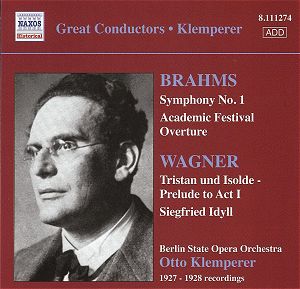
 Berlin State
Opera Orchestra/Otto Klemperer
Berlin State
Opera Orchestra/Otto Klemperer 
