Bolcom is not, thank
goodness, an easy composer to pin
down, stylistically speaking. And
that is a good reason for always approaching
a recording/performance of his work
with eagerness, in anticipation of
a few surprises and unexpected pleasures.
It’s not just that he has – naturally
enough – developed and changed over
the years as a composer, but also
that there isn’t a single trajectory
to that development, any clear beginning
or (at least tentative) ‘ending’;
changes of direction and idiom occur
between works - and are sometimes
later reversed - and, at times, even
within individual works.
Something of Bolcom’s
exhilarating (at least I find it so)
diversity is illustrated on this survey
(billed as his ‘Complete Works for
Cello’) of his writing for cello,
part of the engaging ongoing series
of Naxos discs devoted to his music.
Capriccio is in four
movements. The first – allegro con
spirito – is said by Bolcom himself
to have affinities with Milhaud, which
seems fair enough; the second – molto
adagio espressivo – is a beautiful
movement, some three and a half minutes
in length, an elegiac reflection on
pleasures lost; Bolcom describes the
third movement as "rather-Brahmsian":
it is full of beguiling melodies and
an ambiguous sad charm; how very different
the final movement is! This, the longest
movement of this delightful piece,
is entitled – in full – ‘Gingando
(Brazilian Tango Tempo), ‘Tombeau
de Ernesto Nazareth’. It’s a quite
ravishing piece; ‘gingando’, I am
told by Portuguese-speaking friends,
implies a rather sexy kind of hip
shaking on the dance floor; what one
friend described as "joyful,
sensuous waddling!" If that’s
right, then this movement of Bolcom’s
Capriccio seems to capture just that
kind of joy and playful sensuality.
Pizzicato passages for the cello are
particularly delightful. I feel sure
that Ernesto Nazareth would have valued
this tribute. Taken whole, Capriccio
is a work which perfectly illustrates
Bolcom’s creative eclecticism.
Capriccio was premiered
in 1988. More than twenty-five years
earlier, Bolcom had been trying out
a very different idiom. The single
movement of Décalage shows
a Bolcom responding to – and skilfully
borrowing – some of the devices of
then contemporary European music:
Boulez is the name Bolcom mentions
in his notes to this CD. But for all
the apparent rigidities of the compositional
methods involved - Bolcom himself
now seems a little vague as to what
exactly they were! - for all the brusqueness
of much in the phrasing, there are
tonal passages and a sense of instrumental
dialogue that some of Bolcom’s models
wouldn’t have allowed themselves.
This is not, though, much more than
an oddity of relatively little lasting
interest. For once Bolcom doesn’t
really seem to have found one of his
adopted manners particularly fruitful.
Dark Music is not
perhaps a major work either, but it
is a striking one. It explores and
articulates a mood of quiet despair;
mostly played pianissimo, the unexpected
instrumental combination of cello
and timpani produces some very unusual
and haunting textures, with microtones
and glissandos often to the fore.
It has an emotional substance – even
if that emotion is a narrow and rather
specialised one - Bolcom himself talks
of it in terms of "emotional
anomie and dissociation" – which
gives it a dramatic, disturbing power
absent from Décalage. Is there
anything else by Bolcom quite like
this?
Alongside Capriccio,
the two most substantial works here
are the Cello Sonata and the Cello
Suite No.1; does Bolcom have more
such works in mind? The Sonata pays
more obvious homage to the ‘classical’
tradition than any of the other pieces
gathered here, in its three movements
(allegro-adagio-allegro) and some
of its melodic and harmonic language.
In the opening allegro there is, at
times, a slight air of the over-cultivated,
the excessively polite, that is perhaps
ironic – a gentle, affectionate mockery
of the Schubert-Brahms tradition out
of which the Sonata ultimately grows
or at least of its later derivatives;
the central andante, though, is free
of any suspicion of the ironic, built
as it is of both a charming theme
of serene gravity in E-major and some
tense and quasi-tragic music. This
is a rich, emotionally complex movement
which, while it doesn’t - at least
I don’t think so - explicitly imitate
any ‘romantic’ models, finds a thoroughly
twentieth-century way of tackling
some of the same experiences and ideas.
The closing movement is a relatively
brief rondo, hectically passionate
but perhaps not quite, in this performance
at any rate, on a par with its two
predecessors. Even so, this Sonata
is a substantial, valuable and rewarding
piece.
The Suite for solo
cello is not, perhaps, quite so convincing,
but is well worth hearing. Again Bolcom’s
stylistic diversity is to the fore.
The music began as incidental music
for a 1995 production of Arthur Miller’s
tragedy Broken Glass. The Bachian
echoes and allusions in movements
such as the ‘Alla sarabanda’ which
closes the work and the brief ‘Badinerie’
which is at its centre, are perhaps
no more than we should expect from
Bolcom. As a whole the suite is perhaps
too homogenous – too consistently
dark in mood and low in register –
to be entirely satisfactory. Given
the comparison with Bark which the
form – and some of the musical allusions
– imply, any comparison is likely
to leave one feeling that this suite
is too short on, too far from, dance
rhythms. But it has a genuine, if
narrow, power.
Bolcom is never less
than a composer of high competence
and intelligence. At his best he is
much more than that and, some at least,
of the work on this disc shows him
at something like his best. Given
that, and given that both performances
- Norman Fischer’s work is superb
throughout - and recorded sound are
of a high standard, admirers of Bolcom
will surely want to snap up this disc.
Glyn Pursglove
See also review by Dominy
Clements
























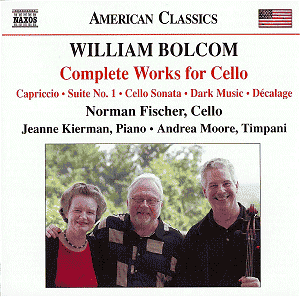

 Norman Fischer (cello); Jeanne Kierman
(piano)1; Andrea Moore (timpani)2
Norman Fischer (cello); Jeanne Kierman
(piano)1; Andrea Moore (timpani)2