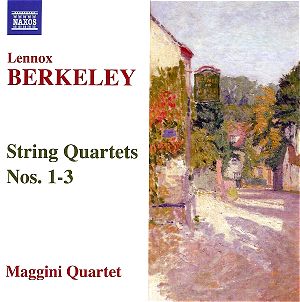
This is a disc that I have long been awaiting, for I have known
Berkeley’s string quartets from tapes of broadcasts for many long
years and deplored that nobody seemed interested in recording
them. True, the Second String Quartet was tackled fairly recently
and released in one of the Berkeley père et fils discs
issued by Chandos (CHAN 10364), but the other two remained ignored
till now. They form an excellent coupling for they clearly demonstrate
that Berkeley’s style progressed over the years while preserving
typical hallmarks, most prominent among these being contrapuntal
mastery, elegance and lucid musical argument.
Though an early
work, the String Quartet No.1 Op.6 completed
in 1935 is somewhat more advanced stylistically in that the
music is indebted to the idiom of its time. Richard Whitehouse
suggests “the presence of Bartók”, which may not be evident
to all but which is certainly reflected in the rather more
stringent, at times acerbic harmonies pervading the music.
What comes clearly through, is the almost classical poise
of much of the music - a typical Berkeley hallmark. Berkeley’s
First Quartet is in four movements, with a short lively Scherzo
placed third. The biting rhythms of the first movement are
offset by a tender slow movement that has its sharper edges.
The quicksilver Scherzo moves along at great speed and not
without tension but it tiptoes away into silence. The concluding
movement is a theme and six contrasting and substantial variations.
The last of these provides a slow, elegiac close. The First
Quartet is an ambitious, accomplished work in which Berkeley’s
contrapuntal mastery is evident throughout. I find it entirely
convincing and most rewarding.
The String
Quartet No.2 Op.15, completed in 1941, shows how Berkeley
progressed over the years. Influences have now been absorbed
and the end result is pure Berkeley. The first movement displays
a good deal of energy and the dialogue between the two strongly
contrasted subjects is handled with considerable assurance
and vigour. The beautiful slow movement contains some of the
finest music that Berkeley ever penned and provides the perfect
foil to the other movements’ energetic, athletic writing.
The third movement opens with a nervous gesture suggesting
a powerful release of energy; but, for all its boisterousness,
the music carries an uneasy feeling that is hardly dispelled
in the final coda. A magnificent work and one of his unquestionable
and unquestioned masterpieces. There is not much to choose
between the Maggini’s and the Chilingirian’s readings of this
work. The Chilingirian are marginally quicker than the Maggini,
and their reading has a greater urgency. Both ensembles play
superbly and have the full measure of this marvellous work.
The String
Quartet No.3 Op.76 was completed nearly thirty years
after its predecessor, at the end of a decade in which Berkeley
composed his opera Castaway Op.68 (I hope that
Richard Hickox will soon record it), the large-scale Magnificat
Op.71 for chorus and orchestra (a work crying out
for recording) and the masterly Symphony No.3 Op.74,
one of his greatest achievements only to be surpassed by the
Symphony No.4 Op.94. At about
that time, too, Berkeley, in much the same way as many other
composers, toyed with twelve-tone music although he did so
in a highly non-dogmatic personal way. In his last string
quartet, Berkeley returned to a more traditional structure
in four movements with a short nervous Scherzo placed second.
Much as in the Second Quartet, the third movement Lento stands
out as the emotional core. The final movement opens with forceful
energy as if willing to dispel any possible ambiguity experienced
in the course of the preceding movements. A brief recollection
of the slow movement tends to belie any attempt at a clear
resolution. This is then brushed aside by a restatement of
the opening material rushing the movement to its somewhat
dismissive conclusion. A beautiful product of Berkeley’s full
maturity.
The Maggini, again,
deserve full marks for their superb readings of these beautiful
and hugely rewarding works. I do not know where we would be
without them. This is a splendid release on all counts and
my Bargain of the Month.
Hubert Culot

























 Maggini Quartet

