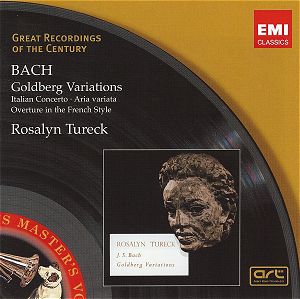
It’s not that long ago since a very similar programme appeared
in Philips’ Great Pianists of the Twentieth Century series. That
two disc set [456 979 2] had the Goldberg Variations, the Italian
Concerto and the French Overture; the difference between it and
this EMI GROC lies in the substitution by EMI of the Four Duets
BWV802-805 by the Aria variata in A minor BWV 989. Otherwise things
are identical.
The Goldberg Variations
was recorded in London in 1957 and is the second of the many
traversals left by Tureck – six altogether, at the last count,
have survived. Tureck was an extraordinary Bach player, a
musician of exceptional control, intellectual concentration
and forensic probity. The famous slowness of her performances
derives from an almost microscopic examination of the score,
a process by which the harmonic corpuscles of the music are
laid bare. In a way this kind of playing is as radical as
Gould’s almost contemporaneous exploration of Bach; their
means are mutually exclusive, utterly dissimilar and irreconcilable
except in the immensity of the undertaking. Theirs was not
the only way; at the same time that Gould and Tureck were
setting down their Goldberg Variations the Scottish pianist
James Friskin was also recording it; Friskin, the husband
of composer and violist Rebecca Clarke, represented an altogether
older consensus and his playing sounds utterly different from
their twin extremes. Fine playing though in its own tradition
and overlooked.
Tureck was the Galen or William Harvey
of Bach playing – a musician who studied the structure of
the body and subjected it to the minutest examination. Her
performance therefore lasts an astounding ninety-four minutes
and the opening Aria alone lasts over six minutes. The result
is a reading that is necessarily ponderous in the extreme,
long on contrapuntal explication but without any sense of
dance or movement. There is almost a sense of defiance about
this kind of approach, a noble stasis that rejects frippery
– or assumptions of frippery – in favour of a marmoreal, granitic
monolith of a performance. True, many of the voicings are
refined and Tureck’s musicianship can never be questioned;
but at every turn one is confronted by a sense of the music
that runs counter, ironically, to the body’s natural sense
of motion. The forensic scientist has frozen counterpoint
and in doing so has robbed the music of its true direction.
The Italian Concerto begins and ends with
grandly rolled chords. It’s slow too but not suffocatingly
so; there’s more of a sense of direction, less of a sense
of an imposed, rational, schematic intellectualism at work.
It is still sufficiently slow to generate a defined retardation
of the rhythmic impetus of the music, though the slow movement
benefits most from this kind of clarity and exposure – penetratingly
done. The Aria variata is heard in Tureck’s own edition. It
tempts her rather less to excess and it helps that each variation
is concise. The opening variation for example, though an Adagio,
has a surety of line that appeals ratter than congeals. The
French Overture though is reminiscent rather more of Tureck’s
way with the Goldberg Variations. One feels the greater the
intellectual challenge the more extreme her responses. I think
it would be fair to say that there is a greater sense of fluidity
in the performance than there ever was in the Goldbergs but
the static, caught-in-aspic tendency all too forseeably saps
the music making of momentum.
In the case of
the Goldberg Variations Tureck’s most impressive legacy is
contained in her VAI recording – altogether more human and
directional. As for transfers you should go for the Philips.
This EMI GROC has been done in by their noise reduction system.
It’s calamitous for 1930s recordings and, though not as extreme,
not much cop for 1950s discs either. The Studio 3 acoustic
has been sucked out; listen to this EMI version and tell me
if you can hear any room ambience at all. You can’t – so go
for the Philips if you want Tureck’s astonishing edifice on
your shelves.
Jonathan Woolf

























 Rosalyn Tureck
(piano)
Rosalyn Tureck
(piano) 
