Editorial Board
MusicWeb International
Founding Editor Rob Barnett Editor in Chief
John Quinn Contributing Editor Ralph Moore Webmaster
David Barker Postmaster
Jonathan Woolf MusicWeb Founder Len Mullenger
Johann
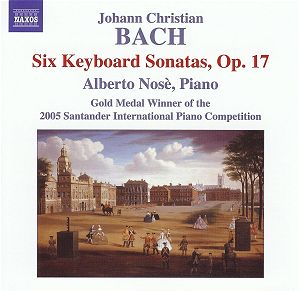
Christian BACH (1735–1782)
Sonata in G major, Op. 17, No. 1 [12:18]
Sonata in C minor, Op. 17, No. 2 [14:37]
Sonata in E flat major, Op. 17, No. 3 [12:28]
Sonata in G major, Op. 17, No. 4 [9:06]
Sonata in A major, Op. 17, No. 5 [9:56]
Sonata in B flat major, Op. 17, No. 6 [21:03] Alberto Nosè (piano)
rec. Potton Hall, Westleton, Suffolk, UK, 21-22 October 2006 NAXOS 8.570361 [79:28]
London-Bach, as he has been called, was the youngest of Johann
Sebastian Bach’s sons. He was fifteen when his father passed
away and then moved to Berlin, where his half-brother Carl Philipp
Emanuel was harpsichordist to Frederick the Great. Young
Johann Christian studied with his brother and it was during
this time he wrote his first concertos. In 1754 he moved
to Italy where he was successful as an opera composer and
it was in this capacity that he was called to London where
he settled. In London he met the young Mozart and was greatly
influenced by him as a composer. The six sonatas Op. 17,
first published in Paris in 1774 as Op. 12, clearly show
his compositional style. It is easy to hear similarities
between the two composers, especially the earlier Mozart
sonatas. Bach’s sonatas are good representatives of the gallant
style with sweet melodics and the care-free and easygoing
flow of the music.
Of these six sonatas only two are written in the traditional three
movements and the brevity of most of them rather implies
that they might have been labelled sonatinas instead. The
exception is No. 6, which is on a much grander scale, elaborated
and with deeper development of the thematic material. It
is also technically the most demanding. Sonata No. 2 is the
other three-movement piece and it also stands out as it is
the only one in a minor key, which automatically lends it
a more ‘serious’ character.
All the sonatas are highly entertaining and I don’t use that word
in any pejorative sense. They are well constructed and fairly
simple. Dr. Burney wrote about Bach’s keyboard compositions
that they were ‘such as ladies can execute with little trouble’.
But simplicity doesn’t exclude musical finesse, even though
music of this kind shouldn’t be over-interpreted.
Alberto Nosè is a young Italian, who has a long list of prizes in
prestigious piano competitions worldwide, most recently First
Prize, Gold Medal and Sony Audience Prize in Santander 2005.
The year before that I heard him in Florence where I found
him better suited to Scriabin’s and Szymanowski’s late Romantic-to-Impressionist
sound-world than Schumann’s more sweeping Romanticism. Half
a century further back in history he reaps laurels through
his clarity, his rhythmic poise and his light touch. He has
a formidable technique, to which his prizes are testimony
and which I also noted in Florence. He has ample opportunity
to demonstrate this in Sonata No. 6, where the rousing finale
in particular requires fluent finger-work. He sticks rather
strictly to the basic tempos of each movement and keeps the
dynamics within a rather limited scope, bearing in mind that
these sonatas were composed for harpsichord or fortepiano.
In other words he lets the music speak and puts himself in
the background. I can’t think of better advocacy for Johann
Christian Bach. Next time I would be happy to hear him in
Scriabin or Szymanowski but I am afraid that Naxos have already
dealt with both composers.
The recording has great clarity without being too analytical.
Göran Forsling
Please support our advertisers below by clicking on the logos for further information.























 Alberto Nosè (piano)
