Editorial Board
MusicWeb International
Founding Editor Rob Barnett Editor in Chief
John Quinn Contributing Editor Ralph Moore Webmaster
David Barker Postmaster
Jonathan Woolf MusicWeb Founder Len Mullenger
Johann
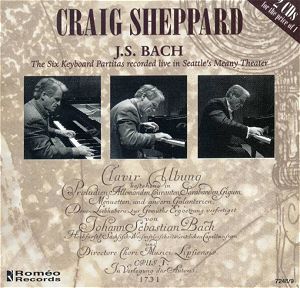
Sebastian BACH (1685-1750) The Klavierubung Part 1 - The Six Partitas (1725-31)
Partita no. 1 in B flat major, BWV 825
Partita no. 2 in C minor, BWV 826 [18:18]
Partita no. 3 in A minor, BWV 827 [17:55]
Partita no. 4 in D major, BWV 828 [31:34]
Partita no. 5 in G major, BWV 829 [21:02]
Partita no. 6 in E minor, BWV 830 [31:33] Craig Sheppard (piano)
rec. Meany Theatre, Seattle, undated ROMÉO
RECORDS 7248-49 [68:07 + 70:45]
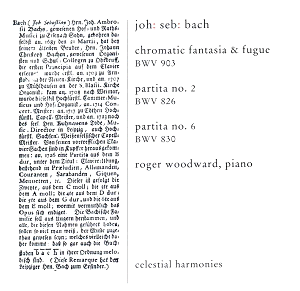
Johann Sebastian
BACH (1685-1750)
Partita no. 2 in C minor, BWV 826 [21:40]
Partita no. 6 in E minor, BWV 830 [34:19]
Chromatic Fantasia and Fugue BWV 903 (1720) [13:52] Roger Woodward
(piano)
rec. Wörthsee, Bavaria, January 2007 CELESTIAL
HARMONIES 13280-2 [70:34]
Craig
Sheppard and Roger Woodward are contemporaries but their
approach to Bach could not be more different. Sheppard
is full of clarity, rooted in the dance, allowing voicings
to animate and course through his playing; he is aware
of the latest textual studies and has written a rather
absorbing booklet note that alludes to the interpretative
thickets through which a performer seeks his own sense
of the truthfulness of the music. Woodward’s notes consist
entirely of the biographical – there is nothing of Bach
or his approach to it. His playing is not kindled by Sheppard’s
kind of aesthetic; for Woodward, despite his daunting modernist
credentials, is a Bachian Romantic.
I’ve
chosen to reflect on the two Partitas that Woodward plays
and to follow the ways in which both men respond to the
daunting challenges before them. The Second Partita is
a study in contrasts; the sense of improvisatory and romanticised
freedom immediately established by Woodward in the Sinfonia
is juxtaposed starkly against Sheppard’s architecturally
surefooted control of the movement as a whole. If Woodward’s
romanticism is rhetorical Sheppard’s clarity is analytical;
the first isn’t overbearing, the second isn’t cool. But
one could say that Woodward comes surprisingly close to
Stokowskian grandeur in his responses. As one has noted
before in Sheppard’s Bach performances – this one, as ever,
live at the Meany Theatre, he is compellingly attentive
to ornaments, to dynamics, balanced voicings and much else.
It gives his performances fleetness and vitality. Woodward
is more lateral, less inclined to probing accents and bass
voicings.
It
should be clear by now which kind of performance will appeal.
Even when their tempos are similar it’s the crisply articulated
incision of Sheppard that brings out the dance in the music.
Woodward prefers romanticised character building – try
the Rondeaux which is a controlled character study in his
hands. For Sheppard the attraction lies in its crispness,
its pellucid colouration, its warmly distributed melos.
This absolute control of rhythm is most evident in the
Capriccio finale of the Second Partita. The dextrous range
of colours that Sheppard evokes is allied to a superb sense
of accenting that gives the music impetus without appearing
rushed. The precision of his articulation is frequently
spellbinding – probing musicianship. Though there is only
fifteen seconds between them the differences are absolute,
Woodward’s horizontal eloquence emerging from an altogether
different tradition, a richly contoured, but more essentially
static, dance-denying one.
The
Sixth Partita reprises the qualities both men bring to
the music. Once again Woodward prefers a reflective, quasi-improvisational
Toccata, his rubati and accelerandi reflecting these tastes. He
bathes the music in warmer, rounded colours and with an
inward, introspective feel. Their responses to the Air
are striking, Sheppard takes 1:39, Woodward 2:08. But that
is not the real story. Woodward is clearly more static
and prefers affectionate warmth of sonority. Sheppard by
contrast is crisp and aerated; the characteristics of the
piece are entirely opposed. Woodward, in short, shows in
the Sarabande that he is majestic where Sheppard is fluid.
The rather stark romanticism of Woodward’s concluding Gigue
is again contrasted with Sheppard’s culminatory, razor
sharp, drive.
Two
final things. Firstly, Woodward’s Chromatic Fantasia and
Fugue is of a piece with the other performances; a strong
sense of metrical freedom allied to sonorous warmth and
a Fuga that is controlled and assured. And secondly Sheppard’s
remaining four Partitas are entirely reflective of the
two under discussion here.
The
two performances then are widely divergent. Their interpretative
lineage however is evident. Woodward’s are readings of
serious-minded warmth, somewhat slow, rather static, even
stoic. Sheppard’s are performances of filigree light and
clarity, borne crisply and with vital imagination. My own
preference is pretty clear I should think, but others may
not agree.
Jonathan
Woolf
Please support our advertisers below by clicking on the logos for further information.

























 Craig Sheppard (piano)

