Zwölf Lieder, Op. 35 nach Gedichten
von Justinus Kerner [30:55]
1.
Lust der Sturmnacht [1:23]
2.
„Stirb, Lieb’ und Freud’!"
[6:23]
3.
Wanderlied [2:49]
4.
Erstes Grün [1:56]
5.
Sehnsucht nach der Waldgegend
[2:21]
6.
Auf das Trinkglas eines verstorbenen
Freundes [3:34]
7.
Wanderung [1:10]
8.
Stille Liebe [2:57]
9.
Frage [1:16]
10.
Stille Tränen [2:51]
11.
„Wer machte dich so krank?"
[2:04]
12.
Alte Laute [2:12]’
Fünf Lieder und Gesänge, Op.
127
[10:15]
12. 1.
Sängers Trost (Kerner)
[2:15]
13. 2.
Dein Angesicht (Heine)
[2:31]
14. 3.
Es leuchtet meine Liebe
(Heine) [1:54]
15. 4.
Mein altes Ross (Strachwitz)
[2:39]
16. 5.
Schlusslied des Narren
(Shakespeare) [0:56]
Vier Gesänge, Op. 142 [8:51]
18. 1.
Trost im Gesang (Kerner)
[1:55]
19. 2.
Lehn’ deine Wang’ (Heine)
[0:47]
20. 3.
Mädchen-Schwermut
(Bernhardt) [2:29]
21. 4.
Mein Wagen rollet langsam
(Heine) [3:39]
Jugend-Lieder nach Kerner, WoO21 and
10 [11:17]
22.
Im Herbste [1:16]
23.
Kurzes Erwachen [2:07]
24.
An Anna I [3:58]
25.
Gesanges Erwachen [2:08]
26.
An Anna II [1:49]
Justinus Andreas
Christian Kerner (1786–1862) may not
be amongst the most important German
poets but he was regarded as one of
the most inspired of the Swabian school.
His house became ‘a mecca for literary
pilgrims’ after he had settled in
Weinsberg where he spent the last
half of his life as a practising physician.
Besides his poetic activities he wrote
several books on medical topics, among
other things about animal magnetism.
A frequent guest in his home was Nikolaus
Lenau and another – though hardly
for literary merits – the dethroned
Swedish king Gustav IV Adolf. Kerner’s
poetry often deals with natural phenomena.
His poems are deeply melancholy but
also quite frequently permeated with
humour, reminiscent of folk-song.
The young Robert
Schumann got to know some of Kerner’s
recently published poems in 1828 and
inspired by them he set five of them
to music in June and July that year,
when he was eighteen. In this he was
encouraged by Agnes Carus, a doctor’s
wife whom he used to accompany in
songs and with whom he fell in love.
These songs were not published during
his lifetime. Three of them were included
in a supplementary volume of the Schumann
Complete Edition, edited by Brahms
in 1893. Some of his other early compositions
didn’t reach the general public until
well into the 20th century.
These songs are certainly interesting
as germinal material for one of the
most important collections of German
art-song.
Schumann returned
to Kerner in his maturity as a song-writer
in 1839/40 with the Twelve Lieder
Op. 35, dedicated to the poet. ‘Kerner’s
poems attracted me most of all for
their mysterious heavenly power …’
he wrote to the Kapellmeister Gottlieb
Wiedebein, whose settings of some
Goethe and Jean Paul poems were early
inspirations for him. The Twelve songs
are not exactly a cycle in the sense
that Dichterliebe, Frauenliebe
und –Leben and the Liederkreis
are but Schumann anyway managed
to find a tonal language that makes
them belong together. The level of
inspiration was constantly high during
this Lieder period and even though
the Kerner songs are not heard very
often, they are well worth the attention
of the Schumann lover who has heard
Dichterliebe, Die beiden Grenadiere
and other of his ‘greatest hits’ and
wants to explore further. The march-like
Wanderlied (tr. 3) and Stille
Tränen (tr. 10) are immediately
attractive and the rest of the songs
will surely become favourites, once
heard. The Opp. 127 and 142 groups
were also composed in the ‘Year of
Song’ but not published until later,
Op. 142 posthumously. They contain
only one Kerner setting each, but
there is much else of interest among
them.
A good Lieder singer
must be able to narrate a story or
visualize the poet’s description of
a landscape or a situation, to express
feelings. A beautiful singing voice
isn’t out of place either but expressivity
is more important than beauty. Dramatic
opera singers can sometimes be splendid
Lieder singers but sometimes they
crush the little intimate song between
shining Wagnerian shields. I often
prefer a smaller-voiced lyric tenor
with flexible voice and ease in the
pianissimo singing. Hans Jörg
Mammel, who was a new name to me,
although he is obviously well represented
in the record catalogues, fits in
neither of these two camps. He has
a bright, powerful voice and would
certainly like to be a lirico spinto,
singing Rodolfo, The Duke of Mantua,
maybe Max in Der Freischütz.
His metallic top notes point in that
direction. But he also sings pianissimo
with honeyed tone, though it isn’t
quite clear whether he sings some
notes with head-voice or resorts to
falsetto. Anyway he sometimes comes
dangerously close to being mistaken
for a crooner. At the other end of
the spectrum he tends to overdo things,
to press the voice unduly. Even though
there is a certain thrill in his singing
he becomes clumsy too often. In Sängers
Trost (tr. 13) the tone is pinched
and Es leuchtet meine Liebe
(tr. 15) is hooty. There is enthusiasm
a-plenty but he hasn’t yet settled
as a Lieder singer. Too much of this
feels – well, immature isn’t quite
the word but certainly it is sprawling.
This doesn’t mean
that there aren’t good things here.
Erstes Grün (tr. 4) is
balanced and he keeps the voice in
check. Sehnsucht nach der Waldgegend
(tr. 5) isn’t bad either. In Stille
Tränen (tr 10) he has good
intentions but the voice production
is too uneven. Alte Laute (tr
12) is among the best efforts, marred
just occasionally by some bad intonation.
Of the Op. 127 songs the short Shakespeare
setting Schlusslied des Narren
(from Twelfth Night) (tr.17)
is really good. Bernhardt’s Mädchen-Schwermut
(tr 20) from Op. 142 is nuanced and
balanced. He also scales down and
sings simply and unaffectedly in Kurzes
Erwachen (tr 23) from the early
Kerner songs.
Uta Hielscher, who
has been the pianist on all the issues
in this series so far, once again
shows that she is an excellent accompanist.
She is especially successful in the
strangely limping stop-and-go accompaniment
to the Heine setting Mein Wagen
rollet langsam (tr 21) which also
has an unusually long postlude.
The recording cannot
be faulted and there are good informative
notes by Gerhard Dietel, but the texts
have to be downloaded from the internet.
There are some good
things here but as a whole this disc
cannot be recommended. The best alternative
is Thomas Hampson with Geoffrey Parsons
at the piano (review).
They include only the Kerner songs
from Op. 127 and 142 but on the other
hand they give us the Fünf
Lieder Op. 40, settings of Hans
Christian Andersen in German translation
by Adalbert Chamisso. This is Lieder
singing of a kind that very few artists,
historical or present day, can challenge.
The disc, recorded in 1989, was re-released
a couple of years ago at mid-price.
Göran Forsling
























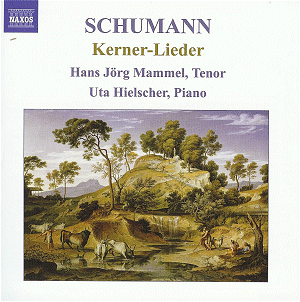

 Hans Jörg Mammel (tenor), Uta Hielscher
(piano)
Hans Jörg Mammel (tenor), Uta Hielscher
(piano) 
