Site
Map
More
Reviews
How
to find a review
Classical CD Review Archive
Book
Reviews
Film
Music Reviews
Jazz
CD Reviews
Nostalgia
Comment
Norman
Lebrecht Weekly
Arthur
Butterworth Writes
Phil
Scowcroft's Garlands
Classical
blogs
Reviewers
Logs
Announcements
Don't
Go Here!
Community
Bulletin
Board
Web
Ring
Reviewers
Helpers
invited!
Resources
How
Did I Miss That?
British
Composers
British
Light Music Composers
Other
composers
Indexes
Label
Masterwork
Discographies
On-line
Music
[Download sites]
Themed
Review pages
Our
Classic Classics
Online
books
MWI
Classical
Encyclopaedia
Gilder
Dictionary of
Composers
MWI
Pop
Encyclopedia
Other
Complete
Books
Programme
Notes
British
Music Society
Performers
The
BBC Proms
Musical
WWW pages
Classical
Music Online
Recording
Companies and Retailers
Agents
and Marketing
Publishers
Non-Classical
Web pages
Orchestra
Web Sites
Newsgroups
Web
News sites etc
Editorial
Board
Classical Editor
Rob Barnett
Seen & Heard
Editor and Webmaster
Bill Kenny
MusicWeb Webmaster
Len Mullenger
Assistant Webmasters
Patrick Waller
David Barker
PotPourri
A
pot-pourri of articles
MW
Listening Room
MW
Office
Helping
MusicWeb
Advice
to Windows Vista users
Questionnaire
Site
History
What
they say about us
What
we say about us!
Where
to get help on the Internet
CD
orders By Special Request
Graphics
archive
Currency
Converter
Dictionary
Magazines
Newsfeed
Web Ring
Translation Service
Rules
for potential reviewers :-)
Do
Not Go Here!
April Fools
|

 |
 |
|
alternatively
Crotchet
AmazonUK
AmazonUS
|
Ralph
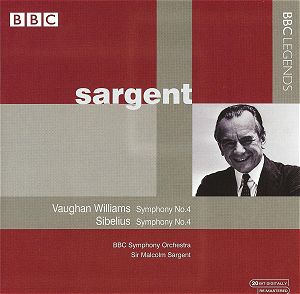
VAUGHAN WILLIAMS (1872-1958)
Symphony No. 4 in F minor (1933) [31:26]
Jean SIBELIUS (1865-1957)
Symphony No. 4 in A minor (1910) [35:18]
BBC Symphony
Orchestra/Sir Malcolm Sargent
rec. Royal Albert Hall, 16 August 1963 (RVW); 2 September
1965. Stereo. ADD
BBC LEGENDS BBCL42372 [67:43]  |
|
|
Here are
two individualistic, angry or brooding fourth symphonies.
They are conducted by Malcolm Sargent whose reputation glowed
brightly through his association with the Promenade concerts
and the great choral festivals of the 1940s and 1950. For
a long while he was venerated and rather like Kathleen Ferrier
was counted among the saintly Elect - beyond criticism. However
his following and his popularity faded in the wake of his
death. Extra-musical factors also played their part in disenchantment
including his ruthlessly dry-eyed approach to orchestral
musicians. In this he was not alone.
In the
present disc we get a chance to reassess Sargent in two Proms
performances preserved in broadcast stereo. It’s very much
to his credit. We hear him in symphonies each of which represented
a crashing gear-change for their composers. Sibelius 4 can
still seem a difficult pill to swallow. Its emotional distancing,
cold and even shivering dissonance are such a contrast with
the first two symphonies and even with the benevolent classical
pantheism of the Third. As for the Vaughan Williams one has
only to compare it with its neighbours: the lamenting beauty
of The Pastoral with its trumpets echoing across devastated
battlefields and the seraphic Bunyanesque paragraphs of the
Fifth Symphony.
The RVW Fourth
is given as furious a first movement as you are likely to
have heard - white hot goaded and driven in the manner of the
composer's famous 1930s recording with the same orchestra.
There is repose but where the score indicates extremes of
speed Sargent applies them with a will. I confess that it
is exhilarating if not quite as white hot as the Mitropoulos
version. As for Sargent’s Sibelius he recorded the Second
and Fifth Symphonies, Pohjola's Daughter and other popular
shorter pieces variously with the BBCSO and the Vienna PO
for EMI Classics. They are or were available on an EMI Seraphim
double. His Fourth is, by contrast with the RVW4, a slowly
savoured performance which in the first movement brings out
the soulful side of the music. In fact this memorably different
approach pays dividends when the grander climaxes come. It
is interesting to hear Sargent's way with this music taken
down within months of Karajan's classic commercial recording
for DG. Let's not forget that Sibelius was during the 1960s
still something of an outré taste and there must still have
been doubts whether fashion was turning in his favour. There's
a lot of audience noise, bronchial and fidgeting, but it's
an integral part of the atmosphere which you can cut with
a knife in this recording. This is more than enough compensation
for the occasional slip such as the muffed entry by the horn
at 2.10 in the finale of Sibelius 4 and some sour notes from
the brass later in the movement.
Perhaps
we can now hope for archive recordings of Sargent’s versions
of Martinů's Epic of Gilgamesh, Alwyn's Lyra
Angelica and RVW’s Ninth Symphony to be issued.
I fervently hope so. An aside but having mentioned Martinů I
wonder whether anyone has recoverable recordings of Tausky's
BBC 1950s studio cycle of Martinů symphonies.
The technical
quality for these two recordings is stunning - a tribute
to the BBC engineers of those days. It's the Proms so you
must however get used to coughs and shuffling. In overwhelming
compensation you experience all the dangerous intensity of
a live event.
Rob Barnett
|
|
Advertising
Rates
Visitor
stats
MusicWeb
International
has over 21,000 Classical CD reviews on offer
Gerard
Hoffnung Concerts &
The
Bricklayer Story
New
Releases

New
Releases


MusicWeb
sells the Polish
catalogue CDAccord
£10.50 post free W-W

MusicWeb sells the
Arcodiva catalogue
£12.00 post free W-W

Price
Reduction: £11.00
post-free world-wide
Try
it and see - Sale or Return
MusicWeb
can now offer you discs from the following catalogues:
Prices include postage
MusicWeb
Recommended Recordings 2008
DISCS
OF THE YEAR 2007
|