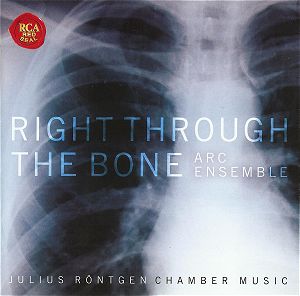
If you are puzzled, as I was, by the title of this CD then there
is a logical explanation which is given at the beginning of the
booklet notes. It was Julius’s cousin Conrad Röntgen (1845-1923)
who discovered X-Rays, who won the Nobel Prize in 1901 and who
ultimately transformed medical science. Knowledge of Conrad however
led Grieg to say, after hearing a piece by Julius, that the music
“went right to the bone”, hence the CD title. Although it seems
to be just a clever remark it has more than a ray of truth!
The
music of Julius Röntgen is just beginning to be noticed again
after years of lying forgotten on dusty shelves. “Oh no,” you
say, “Not another mediocre worthy dug out by musicians with
nothing else to do.” Well if you think that then read on - indeed
listen on - because I can tell you that this is very fine music
indeed. The revival which is just beginning is worth every penny
and every column inch spent on it. So let’s forget that this
music was written when Bartók, Schoenberg and Ives were at their
heights and take it with an innocent ear just as it comes. Indeed
it may be more helpful to remember that Röntgen is almost an
exact contemporary of Elgar.
A
few words of biography first. In 1924 Röntgen retired from public
life to concentrate on composing. Although already quite prolific,
many more works started to flow from him. He had studied in
Leipzig, meeting Liszt and Franz Lachner, Carl Reinecke
and Heinrich von Herzogenberg, but he made the surprising decision
to live and work in Amsterdam. There, amongst other
activities, he was one of the founders of the Concertgebouw
and even more significantly he was instrumental in establishing
the Amsterdam Conservatoire. He worked there not as a Director
but as an accompanist and so he had time to compose. He also
had influence as Director of an organization with the snappy
title ‘The Society for the Promotion of Musical Arts’ which
meant at that time much new music.
You
may fear that Brahms might have been a strong influence. Röntgen
was the soloist in the first Dutch performance in 1884 of the
master’s 2nd Piano Concerto under Brahms’s direction.
After that Röntgen saw Brahms socially as it were for many years.
Also Röntgen liked to work on quite large canvases, yet he is
no clone of Brahms indeed there is much originality here. The
ghostly and eerie second movement of the Viola Sonata’s outer
section is like nothing else I can describe, and the finale
has an occasional touch of Debussy about it. The initial impassioned
Allegro has an opening idea which has remained with me for some
days. The excellent booklet notes by Simon Wynberg mentions
César Franck as an influence.
The
CD begins with a fine and arresting work: the Quintet for piano
and strings. In its opening movement there is a restless and
memorable idea, sextuplets or quadruplets in the piano and cello
with the violins above singing a lovely melody canonically in
the minor key. The melting sequences also give the music an
unforgettable character. The compound time second movement,
marked Allegro, is rhythmically memorable with a wonderful
passage towards the end over an ostinato pedal building to the
final bars. The slow movement is questing and exploratory at
first until a cello melody answered by violin takes over with
a melody which Borodin would have been proud of. At the end
of the contrapuntal and at times fugal Con moto finale
Röntgen quotes briefly his first movement opening and ends the
piece in a questing atmosphere.
The
Clarinet Trio falls into three movements with an especially
sunny initial movement. Brahms did come to my mind during this
piece but none the worse for that. The main weight of the work
rests on the finale with its memorable ‘Sostenuto’ opening suddenly
transforming into a friendly Allegro commodo. It is the
earliest work (1921) here and has the occasional Mendelssohnian
touch in its lightness and sophistication.
The
String Sextet really has little in common with the two by Brahms
although it is in a late-Romantic style. The first movement
may remind one more of Max Reger; the booklet writer mentions
Max Bruch. With the grace and ease of the second movement Andante
we step gently into the world of Dvořák, except that
the middle section is unexpectedly storm-tossed before subsiding
again. Curiously it’s followed by another Andante which
is a set of variations and then an Allegro of great vigour,
especially for the cellos.
The
performances are wonderfully warm, committed and utterly convincing.
These are young performers who, one assumes, have not come across
Röntgen before. The booklet pictures them and gives some biographical
details. I remember reading a sensational review of their debut
in New York in 2003. This is, in my view, top quality musicianship
and even if the music was not that interesting I would still
be praising the music-making. The recording only serves to enhance
all that they achieve.
This
then is a fascinating disc and I urge you to look into it. From
there you might join me in a search for more music by this,
as yet, little known but true master of the early twentieth
century.
Gary Higginson