|
EXPLORE
Musicweb - CLICK
------------------
Message Board
Announcements
Twitter @MusicWebINt
------------------
RECORDING
OF THE MONTH
Shostakovich Symphony 8
RCO, Nelsons
RECORDING
OF THE MONTH

HALLÉ WALKURE
4+1CDs £22 post free
RECORDING
OF THE MONTH

Complete Orchestral Works

EMI Complete Ferrier

Storyteller

Mahler
Symphony 7
Bamberger Symphoniker
Jonathan Nott
................
RECORDING OF THE MONTH

Simone Young
RECORDING OF THE MONTH
Italia Nicola Benedetti

Only complete set
on the Market
35CDs £67

RECORDING
OF THE MONTH
Momentous!
BARGAIN
OF THE MONTH

Italian Cello Concertos
and Sonatas
3CDS £10.95

Brahms Symphonies Zinman
£26.85
RECORDING
OF THE MONTH
Beethoven Symphonies
Thielmann


Magic Moments of Opera
10 Operas Arthaus £95

Brilliant Classics 40CDs

Brilliant Classics 60CDs

9 Symphonies Chailly
£31.90

9
Symphonies C Davis
£18.70
BARGAIN
OF THE MONTH
Absolutely marvellous!
£5.99 post free

Bruch VC1 Gluzman
Quite the finest performance of the Bruch concerto
I have ever heard.

The best opera DVD of the year so far [ST]

Mahler Song Cycles
Katarina Karnéus
Available
again
The Raga Guide
4CDs + 196 page book
£33 post-free world-wide
15,000 copies sold
Editorial
Board
Classical Editor
Rob Barnett
Seen & Heard
Editor Emeritus
Bill Kenny
Editor in Chief
Stan Metzger
MusicWeb Webmaster
Len Mullenger
Assistant Webmaster
David Barker
|
 |
 |
|
alternatively
Crotchet
|
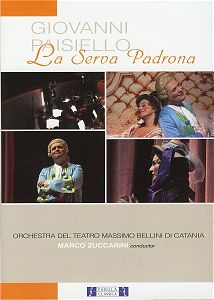
Giovanni
PAISIELLO (1740–1816)
La Serva Padrona - Intermezzo in two acts (1781)
Uberto … Tiziano Bracci
(bass-baritone)
Serpina … Gabriella Colecchia (mezzo)
Vespone … Gianni Salvo (silent role)
Orchestra del Teatro Massimo Bellini di Catania/Zuccarini
rec. Teatro Sangiorgi Catania, 17 April 2004
Stage Director: Gianni Salvo
Set Designer: Salvatore Tropea
Costume Designer: Alessandra Gramaglia
Lighting: Salvatore Da Campo
Video format: 4:3 colour
Region code: all regions
DVD format: NTSC
Subtitles and booklet notes: English, French, German, Italian
FABULA
CLASSICA FAB602 [69.00]  |
|
|
Paisiello
wrote this intermezzo in 1781 for the name day celebrations
of the young grandson of Empress Catherine II of Russia.
Paisiello was then music director at the court at St. Petersburg.
Often
recognisable characters from commedia dell’arte performed
such intermezzi as comedy between acts or scenes of more
serious drama. Indeed some stereotyping occurred so that
by the time Paisiello put pen to paper the characters in
the intermezzo could well be the clever feisty vivacious
young woman servant interacting with her blustering not-so-bright
older guardian. Thus it is in this intermezzo with cunning
young Serpina outmanoeuvring for his own good her ‘guardian’ Uberto
whose manservant Vespone utters not a word but mimes his
role.
The
plot is simple. Uberto has brought up maidservant Serpina
in his household and she now irks him by her failures; the
last being her failure to bring his chocolate before he goes
out. He tells his servant Vespone to find him a wife so that
he is rid of Serpina. Overhearing this, she herself arranges
to marry the volatile Captain Tempest (Vespone in so-called
disguise). Tempest (through Serpina) demands a dowry that
Uberto cannot afford. Failing its provision Tempest decrees
that to avoid broken bones Uberto must marry Serpina. Accepting
that lesser evil Uberto agrees and then realizes that he
has loved her all along.
For
that plot, Piero Rattalino has written a prologue and finale
that for me add little. ‘The web’ tells us that Rattalino
has been involved in many musical events and publications
and is a professor of piano. The prologue adopts the fiction
that the players are a travelling troupe that has come to
a down-market theatre for a rehearsal prior to the following
night’s appearance before the tsarina. For the most part
the prologue is predictable, fairly banal, and somewhat tedious.
It comprises spoken dialogue between Gabriella Colecchia
(Serpina) and Tiziano Bracci (Uberto) with mimed contributions
from Gianni Salvo. The finale is spoken by Salvo alone (not
silent this time) continuing the fiction that the audience
has watched a rehearsal. I do not consider that the intermezzo
needs either a prologue or finale.
Bracci
has a smooth legato with a pleasing easy tone. It shines
through constantly. However, either he holds himself back
or he lacks the power, but rarely do we hear strong dynamics.
His recitative in Ah! Poveretta lei is well delivered
but in the aria he seems to lose volume, particularly with
the orchestra playing too loud: that is until he comes down
centre stage front and puts some ‘oomph’ into the sound.
The
other problem is one of casting/make-up. Bracci has boy-ish
good looks, which is fine for him: but without heavier make
up it makes a nonsense of the idea that he helped bring up
his maidservant from when she was a baby. This is not an
old man: nor does he bluster or protest much even when describing
things that drive him mad. In this production his is the ‘stand
and deliver’ acting method which at least allows us to hear
his gentle colouring. Bracci is a young man (accepting that
four years have elapsed since this recording). With vocal
nurturing and dramatic loosening he should go far.
Gabriella
Colecchia has a dramatic lightness and sense of mischievous
fun. She has better dynamics and a stronger sound than Bracci.
She produces gentle vocal runs and leaps with security and
produces colouring to match his. However, at forte and
quicker speeds her voice from time to time develops a somewhat
harsh sound and I am not convinced entirely that every note
in her higher register was middled. That said this is a lively
performance by another young singer. Vocally they interact
deftly but his lack of dramatic responses gives her an uphill
struggle to sustain the fun.
The
orchestra is well paced if occasionally over-enthusiastic
about the sound of their instruments. As Salvo reminds us
in the finale, this setting of the libretto came some fifty
years after Pergolesi set the same text in what is generally
considered the better intermezzo. Pergolesi did not use wind
instruments – perhaps with good reason.
Salvo’s
miming in the intermezzo and parts of the prologue is superb.
His experience shines through at all times – even if occasionally
he seems to take over – but then he is stage director too.
The
booklet usefully gives track numbers, names and lengths.
There is also an interesting article by Rattalino. The DVD
has an ‘Extras’ section including biographies of the personnel – with
one or two revealing facts. An example is Colecchia’s statement
of her special interest in Neapolitan music and her then
studies refining her bel canto technique: so refreshing
to read that in a biography – the recognition of which should
also mean that she succeeds, securing a positive future.
As
far as I am aware this is the only DVD of this intermezzo.
Whilst it has its drawbacks, at a cost just into double figures,
it is a modest price indeed to pay to watch an appealing
performance.
Robert McKechnie
|
|
Advertising
Rates
Visitor
stats
MusicWeb
International
has over 40,000 Classical CD reviews on offer
Discs
received
Having a problem
Donating?

Gerard
Hoffnung Concerts &
The
Bricklayer Story
New
Releases

New
Releases


MusicWeb
sells the Polish
catalogue CDAccord
£10.50 post free W-W

MusicWeb sells the
Arcodiva catalogue
£12.00 post free W-W

£11.75
post-free world-
wide
MusicWeb
can now offer
you discs from the following catalogues:
Prices include postage
Musicweb
Special
Offers
Monthly
Best Buys
Google
Ads - for information about privacy matters, click here.
Amazon Musicweb International is a participant in the Amazon
EU Associates Programme, an affiliate advertising programme designed to provide
a means for sites to earn advertising fees by advertising and linking to Amazon.co.uk
and Amazon.com
|