Myaskovsky was a contemporary of Prokofiev and features extensively
in Prokofiev's diaries. While Prokofiev was something of a cosmopolitan,
Myaskovsky remained within the Soviet Union. Prokofiev wrote in
every genre including a varied roster of ballets and opera. Myaskovsky
restricted himself to symphonies, concertos, sonatas, quartets,
studies and some choral works. The theatre seems to have held
no fascination for him.
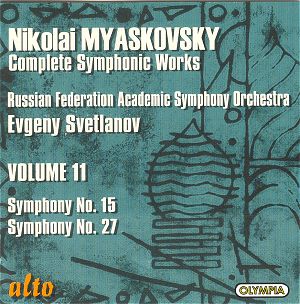
The Symphony No.
15 is in four ripely shaped and expressed movements. This
work too is radiant with the composer's trademark nostalgia
and his rip-roaring cavalry charges. You get both in the first
movement while in the second there are reminiscences of the
catastrophic nightmare world of the Sixth Symphony including
some really eerie music (2:19). The third movement is a fast-moving
waltz with the emphasis on Tchaikovskian excitement rather than
the voluptuous sway of the dancers. One can see a lineage here
traced back to Tchaikovsky 5. The finale has fanfares calling
out in the most magnificent blaze of triumph and a shade or
two of the first movement of Rachmaninov's The Bells.
The Symphony No.
27 – his last – is better known and there have been several
recordings over the years. Svetlanov brings out the autumnal,
meditative and melancholic colouration of the first movement
with its remarkably Finzian undulations and gravity. Towards
the end of the movement another ‘signature’ charge topped off
with a stomping dance 'tail' is excitingly done by Svetlanov.
He whips his orchestra into a brazen frenzy in the final moments
of this rampant fantasy of a movement which finally transforms
the charge theme into a raw and dazzling red dawn of a fanfare.
The central adagio
demonstrates Myaskovsky's art of placing and shaping woodwind
solos with the after-tone of sadness. It is all done with lustrous
grace. The finale introduces a quick-charging and rippling assault
figure. A clarinet solo links back to the music of the first
movement.
In the finale, Presto
ma non troppo the mood is developed into brash rodomontade
in the bustling and here luxuriously italicised celebratory
manner of Tchaikovsky 5 and Glazunov 8.
The sound has a very
agreeable sickle sharp edge to it.
Interesting that the
imported Alto-Regis adopted layout scheme for this cycle has
produced two couplings in each case adding an either previously
unrecorded or rarely heard work to a symphony that is much better
known. Not that anyone can really claim that any of the Myaskovsky
symphones are concert staples. Good though to see that one of
his rarest, No. 13 appears in the exemplary concert programme
for the Bard Festival in June 2008 in the USA. The conductor
is the refreshingly adventurous and gifted Leon Botstein who
has also recently conducted Shcherbachov's 1926 Second Symphony
Blokovskaya alongside Mosolov’s The Iron Foundry
(1928) and Arthur Lourié’s Chant funèbre sur la mort d’un
poète (1921) (Avery Fisher Hall, 25 January 2008).
Turning now to the
second CD.
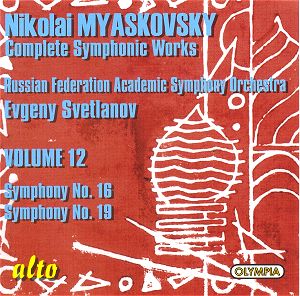
Composition of the
Sixteenth Symphony began shortly after the crash of the
giant eight engine soviet passenger aeroplane Tupolev Maxim
Gorky. For a while it even carried the title Aviation Symphony.
The first movement is full of intrepidly heroic and exciting
music. The Andante has some typically melancholic-lissom work
for woodwind - all highly romantic. The third movement has the
reverent pace of a funeral march with the emphasis on the sound
of the wind section. The finale makes use of the composer's
own popular song The aeroplanes are flying in the sky.
A deliberately wheezy clarinet introduces a sort of fugal section
where the theme is thrown gently around the orchestra - a lovely
oboe solo at 3:02. The movement ends not in a glorious blaze
but a honeyed sigh carried by the strings and by a horn solo.
The Nineteenth Symphony
has been recorded several times before; most recently with
Rozhdestvensky and the Stockholm Concert Band (Chandos).
Before that it was recorded by its initial dedicatee the USSR
State Wind Oorchestra/Ivan Petrov on Monitor MC 2038 (LP) and
then by the USSR Ministry of Defence Orchestra/Mikailov Melodiya
C10 20129 (LP). The Mikhailov version also appeared on Olympia
(OCD105) in the 1980s and another version on Russian Disc with
the Russian State Brass Orchestra conducted by Nikolai Sergeyev
(RD CD 11 007) in the mid-1990s.
The music of the first
movement of No. 19 moves between a Prokofiev-style brusque quick-march
and a sound very reminiscent of Vaughan Williams' Sea Songs
and the Moorside Suite by Holst. Then comes a rather
gallic Moderato like a fast tempo Pavane pour un infante
défunte again meeting Vaughan Williams in folksong mode.
The Andante Serioso has moving solos for trumpet, tuba
and horns. It is most touchingly done by Svetlanov. The crashing
finale finds time for a leisurely cantabile as at 1:19.
In case you were wondering there is none of the bombast you
might have been expecting from a soviet military band piece.
Playful, gleeful, romantic and even a shade heroic but as for
empty gestures not a one.
The notes are by the
knowledgeable Per Skans and are translated by Andrew Barnett
– no relation.
These two CDs are available
separately. Two more CDs will see the Myaskovsky-Svetlanov
symphony cycle completed. This will leave the ground tilled
ready for Alto to continue with the non-symphonic works also
recorded by Svetlanov with the same orchestra during the early
1990s. It will be good at last to hear the early tone poems
Alastor and Silence.
All praise to
Alto for picking up the baton where Olympia fell. There are
few examples of this sort of artistic dedication within the
record industry. That they actually quote the Olympia numbers
on the insert and booklet and continue the original Olympia
design concept is admirable. The picture is completed when we
note that these fine recordings of fascinating and unique repertoire
are available at bargain price. The discs are irresistible and
should be cheered to the rafters.
Rob Barnett
Miaskovsky
Survey of Recordings by Jonathan Woolf