Editorial Board
MusicWeb International
Founding Editor Rob Barnett Editor in Chief
John Quinn Contributing Editor Ralph Moore Webmaster
David Barker Postmaster
Jonathan Woolf MusicWeb Founder Len Mullenger
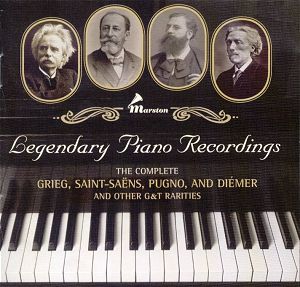
Legendary Piano Recordings; the Complete
Grieg, Saint-Saëns, Pugno, and Diémer recordings and other G & T
rarities
see end of review for track listing Edvard Grieg, Jules Massenet,
Claude Debussy, Camille Saint-Saëns, Louis Diémer, Raoul Pugno (piano)
Georgette Leblanc (soprano), Mary Garden (soprano), Meyriane Héglon (mezzo-soprano),
Maria Gay (mezzo-soprano),
Gabriel Willaume (violin)
rec. 1903-1919 MARSTON 52054-2 [77:47
+ 79:50]
For
once a title doesn’t lie. These are some of the most important
piano recordings ever committed to disc and they are foundation
blocks of any such collection. When one sees that the executants
happen to be Grieg, Saint-Saëns, Massenet, Debussy, Pugno
and Diémer then one realises the essential nature of the
collection.
Of
course other record companies have covered, partially or
exhaustively, the Paris G & T recordings under discussion
but this one has an amazing trick up its sleeve – trick is
the wrong pejorative word; more of that in a moment. APR
has released the complete recordings of Saint-Saëns – along
with much else including the complete Chaminade recordings.
It’s also recently added a fourth volume in its Piano G & T
series [APR5534] which includes all the solo Louis Diémer
recordings adding discs by Ilona Eibenschutz (Scarlatti and
Brahms, London 1903), Josef Hofmann (a series of sides, Berlin
1903) and a run of London 1908 discs made by Wilhelm Backhaus.
Symposium has all the Diémers, (and Chaminades) but not quite
all the Saint-Saëns. He made a recording of the Havanaise
with violinist Gabriel Willaume [037922-23] which is not
in that Symposium set for reasons of space, but which is
in APR’s set and of course Marston’s.
The
performances however offer a plethora of things to excite,
intrigue and amuse. Saint-Saëns was a finger technician
of the utmost clarity and brilliance. The verve and dynamism
of his playing is spellbinding and scintillating. Thus Saint-Saëns’s Valse
mignonne – especially the 1904 recording; he remade it
in 1919 - is a vivid example of his nonchalant brilliance
and colouristic palette. The varnish and command of
the excerpts from his own Second Concerto – important pointers
toward authorial projection, naturally – vie with the truncated Rhapsodie
d'Auvergne for executant scintillation. The sense of
energy and brio is palpable in all his sides. He’s a veritable
genius of the keyboard and even in the lightest of these
essentially light selections his allure is visceral. His
colleague the mezzo Meyrianne Héglon proves rather too indomitable
in her selections of the vocal music. The voice has perceptible
registral breaks and the lower part comes perilously close
to crossing the Channel in search of Clara Butt. Gabriel
Willaume plays with Gallic sensibility – an essentially vibrato-pure
performer without undue mannerisms. Grieg’s
May 1903 recordings were waxed on a single day and are all
of his own music of course. Subtlety and clarity inform
his playing which is strongly characterised, digitally pretty
well immaculate and of tremendous strength. Though he had
not long to live these nine sides attest to his still powerful
technique and an unsentimental command .He was known for
his dislike of showy rubati and he demonstrates how well
he practised what he wrote. The Butterfly Op.43 No.1
is especially captivating.
Massenet
can be sensed on one title, accompanying Georgette Leblanc
on his own Pendant un an je fus ta femme from Sapho;
sensed rather than actively heard as he really is in the
dim distance. Debussy’s famed recordings with Mary Garden
are here. I read recently that Maggie Teyte once threw out
one of her own copies of these precious discs in her old
age; she had ceased to care about it all. But the pleasure
and benefit of hearing Debussy in these four brief pieces
is nevertheless incalculable -. and fortunately he’s better
recorded than Massenet had been the previous year.
Louis Diémer plays two of his own sweetmeats but was better known as an executant.
The five sides here were made when he was in his very early sixties, in 1904.
His own Chant du nautonier is a rather meretricious etude-like affair
but is played with the same kind of brilliance that informs the musicianship
of his disc mates. His Godard is vivacious though his Chopin is rather reserved
and over-fleet of finger.
Pugno’s
thirteen discs come from Parisian sessions in April and November
1903. Multifaceted and multi-talented Pugno was variously
pianist, organist, accompanist and composer but didn’t specialize
as a pianist until he was forty. You will be rewarded with
some remarkable pianism from the sonata partner of Ysaÿe
and the man who encouraged Grieg to record. His tempo in
the Chopin Waltz Op 34/1 is conventional, the playing excellent
but it is his famous recording of the F Sharp Nocturne that
will pull you up short. He claimed the excessively slow tempo
was from Georges Mathias, his piano teacher and one of Chopin’s
best students. Exceptional grace animates the Mendelssohn
Song without words and Massenet’s Valse folle is driven
through with passion, the ritardandos stylish and playful.
Incision, clarity of fingerwork and superb touch distinguish
the Chabrier and superb voicings do likewise with the Chopin
A Flat Impromptu. His delicacy and sensitivity to dynamics
are clear in the D Flat Berceuse and in fact everywhere the
superiority of his imagination and pianism is evident. If
you’ve had to struggle all these years with the famous old
OPAL transfer then struggle no more with this one. A tremendous
improvement.
So,
essential items for your specialist pianophile shelves. As
for the competition where it exists Symposium’s transfers
are not as extensive, of course, as either Marston or APR’s
and are rather noisier and scuffier than APR’s. They also
have rather more blasting in fortes than the rival company.
But they are however somewhat more immediate and allow one
to hear with clarity, through their non-interventionist approach,
the roll-call of pianism on display.
And
now for the “trick” referred to earlier. Forget the forgoing
question of competitor pressings. A number of these Paris
sessions were grievously ruined by pitch instability. Many,
in fact most, of the 1902-04 Paris G & T recordings were
the subject of this wretched imperfection. Anyone who has
laboured through the endemic wow will know how frustrating
and debilitating an experience it is and how much has to
be taken on trust. But now Marston has teamed up with Dmitri
Antsos, an audio engineering consultant. It’s to him that
Marston pays tribute in his notes to restoring the pitch-defective
recordings. How he did it – and how many hours he must have
spent on it – must remain his secret. But I can attest to
the miracle he has wrought. It is an astonishing piece of
work; restoration work of the highest importance that has
not compromised the source material. Frankly all piano collectors
are in his and Marston’s debt. This is a heroic undertaking
that transforms the listenability of these priceless recordings
at a stroke. Nobody is pretending that listening to Paris
G & Ts is an everyday event but in the past it has been
a trial and a labour more of responsibility than of musical
pleasure. All that has now changed, at one fell swoop. It’s
for this reason that this will be one of my Records of the
Year – a magnificent example of the use to which technology
can be put, when it’s carried out with integrity and at the
service of the music.
Jonathan
Woolf
Track listing Edvard GRIEG (1843–1907)
Alla Menuetto, from Sonata in E Minor, op. 7 [2:42]
Finale (Molto Allegro), from Sonata in E Minor, op. 7 (abridged)
[2:41]
Humoreske in G-sharp Minor, op. 6, no. 2 [1:45]
Bridal Procession, op. 19, no. 2 [3:00]
Butterfly, op. 43, no. 1 [1:58]
To Spring, op. 43, no. 6 [1:55]
Gangar [Norwegian Peasants’ March], op. 54, no. 2 [2:02]
Wedding-Day at Troldhaugen, op. 65, no. 6 [2:03]
Remembrances, op. 71, no. 7 [2:24]
Edvard Grieg (piano), Paris, 2 May 1903
Camille SAINT-SAËNS (1835–1921)
Andante sostenuto - Molto animato, from Piano Concerto
No. 2 in G Minor, op. 22 (extracts) [3:54]
Rhapsodie d’Auvergne, op. 73 [1:52]
Improvised cadenza on Africa, op. 89 [2:48]
Valse mignonne, op. 104 [2:30]
Valse nonchalante, op. 110 [3:11]
Gramophone Company Limited, Paris, 24 November 1919
Mazurka No. 1 in G Minor , op. 21 [2:58]
Rêverie du soir à Blidah, op. 60, no. 3 from Suite Algerienne
[3:47]
Marche militaire française, op. 60, no. 4 from Suite Algerienne
[3:39]
Valse mignonne, op. 104 [2:26]
Camille Saint-Saëns (piano), Paris, 26 June 1904
Prélude, arr. from Le déluge, op. 45 [3:28]
Paris, 24 November 1919
Elégie, op. 143 [4:33]
Paris, 26 November 1920
Havanaise, op. 83 [8:04]
Gabriel Willaume (violin), Camille Saint-Saëns (piano) (1873–?)
Paris, 24 November 1919
Ascanio: La, la, la… “Fiorentinelle!” Ah! qui m’appelle?
[2:27]
Samson et Dalila: Printemps qui commence [3:38]
Rêverie [3:07]
La solitaire, op. 26, no. 3 [2:26]
Meyriane Héglon (mezzo-soprano), Camille Saint-Saëns (piano)
Paris, 26 June 1904
Jules MASSENET (1842–1912)
Sapho: Pendant un an je fus ta femme [2:14]
Georgette Leblanc (soprano), Jules Massenet (piano), Paris,
1903
Claude DEBUSSY (1862–1918)
Pelléas et Mélisande: Mes longs cheveux descendent [1:47]
Il pleure dans mon coeur (Ariettes oubliées No. 2) [2:15]
L’ombre des arbres (Ariettes oubliées No. 3) [2:24]
Aquarelles-Green (Ariettes oubliées No. 5) [1:39]
Mary Garden (soprano) Claude Debussy (piano) , Paris, 1904 Domenico SCARLATTI (1685-1757)
Sonata in A, L. 495 (K. 24) [2:06] Georg Frideric HANDEL (1685-1759)
Gavotte Varié, from Suite No. 14, HWV 411 [2:41] Carl Maria von WEBER (1786-1826)
Rondo brillante in E-flat, op. 62 [2:35] Felix MENDELSSOHN (1809-1847)
Scherzo in E Minor, op. 16, no. 2 [2:01]
Song Without Words in A, op. 19, no. 3, “Hunting Song” [1:53]
Song Without Words in C, op. 67, no. 4, “Spinning Song” [1:30] Fryderyk CHOPIN (1810-1849)
Impromptu in A-flat, op. 29 [3:10]
Berceuse in D-flat, op. 57 [3:33]
Nocturne in F-sharp, op. 15, no. 2 [3:32]
Waltz in A-flat, op. 34, no. 1 [2:46]
Marche funebre: Lento, from Sonata No. 2 in B-flat Minor,
op. 35 [4:02] Franz LISZT (1811-1886)
Hungarian Rhapsody No. 11 in A Minor [4:14] Emmanuel CHABRIER (1841-1894)
Scherzo-valse, No. 10 from Pièces pittoresques [3:32] Jules MASSENET (1842-1912)
Valse folle [2:59] Raoul PUGNO (1852–1914)
Valse lente [3:16]
Sérénade à la lune [2:33]
Impromptu [2:42]
Raoul Pugno (piano),
Paris, 1903
Felix MENDELSSOHN (1809-1847)
Song Without Words in C, op. 67, no. 4, “Spinning Song” [1:43] Fryderyk CHOPIN (1810-1849)
Nocturne No. 8 in D-flat, op. 27, no. 2 (abridged) [3:43] Benjamin GODARD (1849-1895)
Valse chromatique [3:09] Louis DIÉMER (1843–1919)
Grande valse de concert in D-flat, op. 37 [2:34]
Caprice de concert in D, op. 12, from Chant du Nautonier
[3:15] Louis DIÉMER (1843–1919)
Grande valse de concert in D-flat, op. 37 [2:47]
Caprice de concert in D, op. 12, from Chant du Nautonier
[3:05]
Louis Diémer (piano),
Paris, 1904/6
Please support our advertisers below by clicking on the logos for further information.

























 Edvard Grieg, Jules Massenet,
Claude Debussy, Camille Saint-Saëns, Louis Diémer, Raoul Pugno (piano)
Edvard Grieg, Jules Massenet,
Claude Debussy, Camille Saint-Saëns, Louis Diémer, Raoul Pugno (piano)
