Editorial Board
MusicWeb International
Founding Editor Rob Barnett Editor in Chief
John Quinn Contributing Editor Ralph Moore Webmaster
David Barker Postmaster
Jonathan Woolf MusicWeb Founder Len Mullenger
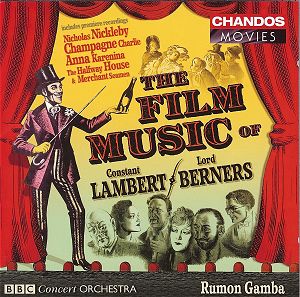
Constant LAMBERT (1905-1951)
Suite from Merchant Seamen (1940) [14:35]
Suite from Anna Karenina (arr. Philip Lane) (1948)
[30:19] Lord BERNERS (1883-1950)
From Champagne Charlie (orch. Philip Lane) (1944)
(Come on Algernon [3:08]; Polka [2:34])
Suite from Nicholas Nickleby (1947) [10:23]
Suite from The Halfway House (arr. Philip Lane)
(1944) [18:09] Mary Carewe
(soprano)
Joyful Company of Singers (female voices)
BBC Concert Orchestra/Rumon Gamba
rec. Watford Colosseum, 25-26 September 2007 CHANDOS
CHAN10459 [79:35]
The pairing of
the film scores of Constant Lambert and Lord Berners is logical.
Not only was their work for the medium very limited to the
works included on this disc, but both men were friends and
shared similar outlooks. Their music was cosmopolitan rather
than traditionally English and both were attracted to the stage,
particularly the ballet.
Lambert’s Suite
from Merchant Seamen is very impressive. It makes a
strong impact. Richly harmonized and orchestrated, it is highly
dramatic and emotional. It opens with a bracing and tangy ‘Fanfare’. ‘Convoy
in Fog’ is eerily atmospheric and menacing - the danger of
attack from hostile U-Boats implicit. ‘Attack’ signals controlled
panic and heroic, if tragically futile retaliation as the seamen
come under attack and the ship is torpedoed. ‘Safe Convoy’ conversely
evokes, one imagines, a calm sea with the waters rolling relatively
gently under breezes, the sea glistening in the sunshine. The
concluding ‘March’ is gallant and defiant, but poignantly seamed.
Bernard Herrmann
had included an 11-minute suite of music from Constant Lambert’s
score for AnnaKarenina in his 1975 album “Great
British Film Scores” (Decca 448 954 2) This new recording has
a 10-movement, 30-minute suite with much more music arranged
by Philip Lane. The album’s notes do not carry any detail about
the Tolstoy novel which relates the doomed, illicit love affair
between Anna Karenina, stuck in a passionless marriage to an
official much older than herself, and a dashing young officer.
The music has a haunting and tender dreaminess, divorced from
reality until the lovers are discovered and then it takes on
a more brutal and crushing character. The Main Titles set the
Russian location imposingly. The Séance scene is wispy and
spectral. ‘Anna’s garden’ is prettily pastoral, serene with
bird song entwined; one might imagine long summer dresses floating
between hedgerows and delicate fragrances of roses. Conversely, ‘Anna’s
illness’ reeks of the sick room, fragrances now sickly, heavy,
the music a drone. ‘Venice’ is a highlight of the suite, a
beautiful barcarolle climaxing passionately at 3:30. The Finale
covers the final tragedy as Anna falls beneath the train. The
music is creepy and dejected, tenderness turned to despair
amid rolling timps and growling bass lines.
Lord Berners’ music
for Champagne Charlie, that starred Tommy Trinder sparkles
with wit and the gaiety of the old music hall. Mary Carewe
sings with gusto “Come on Algernon” with such racy lines as “Oh
come on Algernon, that’s not enough for me give me some more,
the same as before because I can’t count under three …” The
other Champagne Charlie track, the sunny ‘Polka’, does
for that dance what Ravel did for the waltz in his La Valse.
Berners’ suite
from his score for Nicholas Nickleby, from Dickens’ novel
is cosily and glowingly nostalgic. The music a potpourri of
character studies; it twitters, dances, waltzes and bounces
along with slower romantic episodes that are charmingly coy.
In part it is something of a pastiche of drawing-room ballads.
There is a particularly heartfelt melody for Kate and Frank’s ‘Love
Scene’. The sunshine is banished only occasionally when the
score turns nasty and sinister or pompous for the lesser appealing
characters.
Halfway House was
an occult, mystical drama about a group of characters, with
assorted problems who come together at a country inn in a remote
part of Wales. Only when their problems reach some sort of
resolution, is it revealed that the inn’s landlord (Mervyn
Johns) and his daughter (Glynis Johns) are not of this world.
Berners responded with a highly atmospheric and dramatic score.
After imposing and brooding Main Titles with trumpet fanfares,
comes the bubbly, bustling miniature overture, somewhat in
the style of Sullivan, that is from ‘The Concert’ conducted
by one of the characters, who is not a well man. The third
section, ‘Bicycle ride’, an amusing evocation as the music
rushes zanily along. It is almost as if Berners was scoring
a ‘Tom and Jerry’ cartoon. In the ‘Drowning’ scene, after a
preamble of pastoral peace, the music excitingly ‘mickey-mouses’ the ‘drowning’ of
the Sally Ann Howes character as she attempts a mock suicide
to entice her father to save her in order to save her parents’ marriage.
The Viennese-style ‘Séance Waltz’ is very much à La Valse; the
world of the ballet is not far away either. ‘Resolutions and
Finale’ blends pastoral material complete with birdsong and
meditative and darkly dramatic, even tragic material. All ends
in a mood of hopefulness with the Joyful Company of Singers
joining the BBC Philharmonic in a heavenly chorus - but without
Hollywood corn.
Gamba and the BBC
Philharmonic deliver for these few Constant Lambert and Lord
Berners scores one of the best albums in the Chandos Film Music
series.

























 Mary Carewe
(soprano)
Mary Carewe
(soprano) 
