Editorial Board
MusicWeb International
Founding Editor Rob Barnett Editor in Chief
John Quinn Contributing Editor Ralph Moore Webmaster
David Barker Postmaster
Jonathan Woolf MusicWeb Founder Len Mullenger
Ottorino
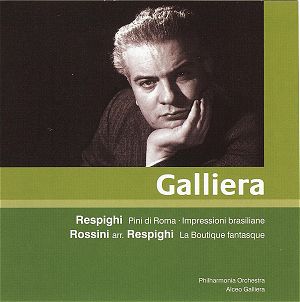
RESPIGHI (1879-1936) Pini di Roma (1923-4) [19:04] La Boutique Fantasque (Ballet arranged from piano
pieces by Rossini) (1918) [35:40] Impressioni brasiliane (1928) [18:13] Philharmonia
Orchestra/Alceo Galliera
rec. 22 January 1957 (Pini), 28-29 May 1959 (Boutique),
18-21 March 1955 (Impressioni), Kingsway Hall, London MEDICI MM022-2 [73:19]
Before the war, record companies had “house-conductors”;
Sir Landon Ronald in Great Britain, Piero Coppola in France and
Carlo
Sabajno in Italy spring to mind. After the war, through to
the 1960s, there were still “accompanying conductors”, conductors
who were adept at collaborating with soloists but who were
rarely invited to record on their own account. If you are
a collector of vintage concerto recordings by the likes of
Schnabel, Gieseking, Lipatti, Haskil, Arrau or Anda, just
to stay with pianists, you probably have quite a few conducted
by Herbert Menges or Alceo Galliera. You may have just wondered,
from time to time, what happened when they conducted symphonies
and other orchestral works. Or just possibly, you may not,
since the art of these gentlemen was to turn in a good, musicianly
job without drawing attention to themselves very much.
Alceo Galliera was born in Milan in 1910, son of a composer and organ
professor. His first professional appearance as conductor
was in Rome in 1941. He held just three permanent appointments
during his life, with the Melbourne Symphony Orchestra (1950-1),
the Teatro Carlo Felice of Genoa (1957-60) and the Strasbourg
Municipal Orchestra (1964-72). He was admired by Walter Legge
who employed him frequently with the Philharmonia in the
late 1940s and the 1950s, in concert as well as on record.
A few purely orchestral recordings were made, while his operatic
experience in Genoa presumably qualified him to direct the
Callas/Gobbi “Barbiere”.
“Accompanying conductors” lingered on a little longer at Philips,
with whom he worked considerably in the 1960s. He shared
the conducting of Haebler’s Mozart cycle and set down the
Beethoven Concerto with Grumiaux in 1966. The latter re-recorded
the Concerto only eight years later with Colin Davis, though
the Galliera version had been widely praised. This may be
taken as symbolic of the demise of the “accompanying conductor”.
Galliera died in 1996. David Patmore’s informative note, from which
most of the above comes – a few other sources and an internet
trawl provided little I could add – does not say when he
retired. After relinquishing the Strasbourg post he seems
to have just quietly faded from view.
So what did he have to offer? These three Respighi works all get excellent
performances, with fine orchestral playing, lively rhythms,
expertly realized colours and well-shaped phrasing. Given
that this is hardly great music, what else could you want?
Well, for my comparisons in “Pini di Roma” I didn’t go to commercial
recordings – obvious ones would be Toscanini and, in early
stereo, Reiner – but to two off-the-air tapes from RAI broadcasts
under a pair of very great conductors, Vittorio Gui (Rome
1953) and Sergiu Celibidache (Turin 1968). Galliera is lively
and brilliant at the start, but Gui is something else, his
players are really aflame. There’s a lushness and a feeling
of emotional participation to the middle movements. “I pini
del Gianicolo”, in particular, build up to an over-the-top
splendour reminiscent of the “Hymn to the Sun” from Mascagni’s “Iris”.
While in “I pini della Via Appia” he succeeds in not giving
away too much too soon, then when the climax comes he pushes
the orchestra in a way Galliera doesn’t quite manage.
Stretching the orchestra beyond the theoretically possible is the
mark of great conducting and this is where the expert Galliera’s
limits begin to show.
Celibidache was also no stranger to pushing his orchestras beyond
the possible. In the first movement he decides to show that
this music has a Debussy-like refinement. The players are
not aflame but the pointillist interplay of colours has its
own fascination, while he really lets fly at the end of this
brief piece. The slower movements are not over the top but
waft along with a sort of Delian nostalgia. Like Gui, he
paces the last movement more artfully than Galliera.
It may seem unreasonable to spend most of the review talking about
performances other than the one being reviewed, especially
when they can’t be bought, but the comparison has enabled
me to focus on what Galliera does and doesn’t offer.
I had no comparison for “Boutique” and found it very neatly turned,
precise with well-sprung rhythms. But this is such flimsy
music. Surely, if it’s to be worth really listening to, as
opposed to agreeable stuff to encounter at the end-of-pier
bandstand, the conductor needs to challenge the orchestra
to characterize just that bit more.
My only available comparison for “Impressioni brasiliane” didn’t look
particularly promising – again off-the-air with the Rome
RAI orchestra some time in the 1960s under Armando La Rosa
Parodi (1904-1977). Parodi is not a conductor whose name
is invoked with baited breath, though collectors of anti-Pavarotti
stories might look
here – scroll down to nearly the end. It’s interesting
that, while Galliera is just slightly brisker than Gui and
Celibidache in Pini (Galliera 19:04, Gui 21:22, Celibidache
21:24), there’s a big difference in “Impressioni”, where
he takes 18:13 and Parodi spreads to 24:17. I won’t go so
far as to say that Parodi stretches the orchestra like the
great conductors mentioned above, but in the opening “Tropical
Night” he shows the sort of flexibility old-time Italian
conductors used to bring to Puccini. He creates a sort of
hypnotic undulation. I thought Galliera’s more literal performance
very nice, but Parodi made me want to go on listening for
ever. Parodi’s serpents in the second piece are lewder, more
threatening, while in the last he finds space for some naughty
inflections to the dance rhythms. Galliera plays them straighter.
I realize I’m again not being very helpful in preferring a performance
that’s unlikely ever to become available. However, the comparison
has enabled me to show that Galliera, even when measured
against a half-forgotten conductor whom nobody ever rated
as “great”, emerges only as a skilled but slightly anonymous
practitioner.
“Boutique” is in good, atmospheric stereo. The stereo spread in “Pini” is
more limited; at the beginning, for example, the glockenspiel
is on the far right but everything else comes from the centre. “Impressioni” is
in goodish mono.

























 Philharmonia
Orchestra/Alceo Galliera
Philharmonia
Orchestra/Alceo Galliera 
