The Naxos label are sterling advocates of the music of Gerard
Finzi with several wonderful releases in their catalogues notably:
the Cello Concerto; Eclogue for piano and orchestra
and Grand Fantasia and Fugue for piano on 8.555766;
Song Cycles Earth and Air and Rain; To a Poet and
By Footpath and Stile on 8.557963;
Clarinet Concerto; Five Bagatelles; Three Soliloquies
and Romance on 8.553566;
Intimations of Immortality and For Saint Cecilia on
8.557863;
Song Cycles I said to love; Let us Garlands Bring
and Before and After Summer on 8.557644;
Choral Music Lo, the full, Final Sacrifice etc. on 8.555792.
Once
again Naxos look to Finzi with this new release. These works
are written essentially in the composer’s characteristic pastoral
idiom.
In
terms of output the London-born Finzi was not prolific but
I believe his scores display a consistently fastidious, high
quality craftsmanship and a memorable quality; a splendid
blend of attributes not always present in the works of his
contemporaries.
Finzi
had an unbridled and enduring passion for literature, especially
seventeenth century English poetry. At his death he left a
stunning collection that contained over three thousand books
now stored at the Finzi Book Room at Reading University. The
thoughtful Finzi excelled as a particularly effective and
sensitive setter of texts of his favourite poets and a large
proportion of his scores were written for the voice. Finzi
certainly made a major contribution to twentieth-century English
song that has endured with considerable fondness both in the
recording studio and in the recital hall. As outstanding as
Finzi was as a song setter I cannot overlook the extraordinary
contribution in the genre made by many of his English born
contemporaries namely: Gurney, Vaughan Williams, Warlock,
Quilter, Ireland, Howells, Holst, Butterworth and Britten.
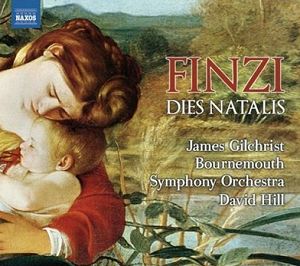
The dignified Dies natalis, a cantata
for high voice and strings was composed in between 1925 and
1939. Designed in five sections, Finzi sets texts from Centuries
of Meditation by the seventeenth
century cleric and poet Thomas Traherne. The
intended premiere of the score was the 1939 Three Choirs Festival
at Hereford but that had to be aborted owing to the outbreak
of war. Belatedly the world premiere was given in January
1940 at London’s Wigmore Hall. Elsie Suddaby sang the soprano
part with the Maurice Miles String Orchestra conducted by
Maurice Miles.
The
prevailing pastoral quality of Dies natalis is asserted
through pages of seductively feather-like, flowing tones meshed
with strains of reflective yearning. Tenor James Gilchrist
is a generally assured soloist. His diction is impressive
as is his ability to convincingly display a range of emotions.
I love the way his voice can easily soar up to the heavens.
However, when under pressure as in The Rapture movement
his tone rather loses its attractiveness and his vibrato becomes
more conspicuous.
With
regard to alternative versions of Dies natalis I strongly
advocate the impeccable and highly moving, now ‘classic’ 1963
Abbey Road, recording from tenor Wilfred Brown and the English
Chamber Orchestra under the direction of the composer’s son
Christopher ‘Kiffer’ Finzi on EMI Classics 5 65588 2.
The
Prelude for string orchestra, Op. 25 was completed
in 1929 but Finzi had devised it a few years earlier as part
of an unfinished chamber symphony. The short Prelude
has vigorous forward momentum that develops in tension to
a powerful climax. Finzi composed his orchestral work The Fall of the Leaf
(Elegy), Op. 20 over a number of years from the
1920s and revised the score in 1940-42. It was composer Howard
Ferguson who completed the orchestration of the score. The
Nocturne was composed in 1928 undergoing revision in
the 1940s. Finzi stated that he had been inspired by two literary
works: Charles Lamb’s New Year’s Eve essay from his
Essays of Elia and Robert Bridges’ poem Noel:
Christmas Eve, 1913.
David
Hill and the Bournemouth strings convey soothing tenderness
and beauty in their playing of the Prelude; Fall
of the Leaf and Nocturne. Throughout
all three scores one is aware of an underlying sense of grief
and yearning. It is as if Finzi, who had experienced the deaths
of several family members, intended the scores to serve as
musical tributes to close friends who had died.
Composed
in 1928 the Two Sonnets for tenor and small orchestra are
settings of texts by the eminent seventeenth century poet
John Milton. The first sonnet When I consider develops
to a powerful climax and is impressive for Gilchrist’s strongly
felt contribution of tender and nostalgic longing. Also impressive
is the tenor’s enthusiastic and moving performance of the
second sonnet How soon hath Time.
Finzi
composed his Farewell to Arms: introduction and
aria for tenor and small orchestra (or strings)
in 1926-8. He subsequently revised the score in the 1940s.
The seventeenth century Ralph Knevet provides the text for
the Introduction and sixteenth century George Peele
the text for the Aria. Initially the singing in the
Introduction has a sombre character. Bordering on the
sinister, the music gives way to a characteristic pastoral
quality; evocative of Finzi’s adored English countryside.
The Aria inhabits a similar mood to the Introduction
carrying an even greater weight of aching tenderness.
Recorded
at the Lighthouse Concert Hall in Poole the Naxos engineers
have provided admirable sonics. The accompanying booklet contains
an informative essay by Andrew Burn. Unfortunately and annoyingly
the booklet does not include the texts which can be found
on the Naxos site.
Pleasingly performed and well recorded this Naxos release makes a worthwhile
addition to Finzi’s discography.
Michael
Cookson
see also
Review
by Rob Barnett

























 James Gilchrist
(tenor)
James Gilchrist
(tenor)
