These are two pieces with two entirely different basic starting
points, but each with their own freedoms and controls. Seven
is framed like an oil painting – the exact boundaries are
the number of musicians; seven, and the length of the piece –
exactly 20 minutes. These would seem to be unlikely stipulations
for what is essentially an improvisatory work, but the musicians
play from 20 notated bars – their freedom lying in the moments
at which they start or stop playing. In this way, the character
of the music is guaranteed, even when each performance is a unique
version of the work. This character is essentially meditative,
with many long sustained notes, the character of the instruments
dictating how these notes sound. In regard to this the piano has
a powerful role, the attack and delay of the notes having a strong
character against all of the others. Bowed percussion, winds and
strings simultaneously exist within their own little worlds and
contribute to the whole, from a double-bass which sometimes sounds
like a subway train is passing, to the ringing sustain of a clarinet.
The slow moving chorale which results has many moments of chance
beauty, but the general feel is one of other-worldliness – a musical
transport to realms where the imagination can run riot, if you
are prepared to allow it so to do.
Quartets
I-VIII was written for
the bicentennial of the U.S.A., and uses eight old American
chorales which were fragmented by Cage and reformed into this
piece using the Chinese I Ching as a guide to where each
should be placed. The Quartets in the title refers to
the way in which only four instruments of the 24 strong ensemble
are playing at any one time. The exposed nature of the music
allied to its clearly tonal basis make for a Mozartean challenge
to performers. As Daniel Grossman says in his notes, “...the
most difficult requirement is fitting the few notes to be played...
such that meaningful phrases ultimately result.” In fact, this
is a kind of Weberneque extension of Charles Ives’s irreverent
treatment of traditional and venerable old American musics,
and the shadow of Copland is never all that far away either
– you wouldn’t be entirely surprised if “Tis a Gift to
be Simple” were suddenly to break through. By the way, these
early American pieces are also known as ‘shape note hymns’,
so called because the notes were given different shapes related
to the “fa so la” scale as well as being conventionally placed
on the stave, so that everyone could join in. Each movement
of Quartets has a similar, slow evolution, though some,
as with numbers V and the lively VI, can be very
short indeed. As with Seven, the moments of euphonic
beauty have a chance feel to them, but with plenty of consonant
intervals and almost recognisable melodic shapes around Quartets
always has a feel of ongoing, tantalisingly irresolvable
cadence.
This SACD recording
is very good and has a superb sense of depth, but brings the
musicians in very close – I certainly had more the feeling that
I was sitting amongst the players rather than as an audience.
This has its benefits, but made the experience as much analytical
journey as one which can be witnessed and enjoyed from a respectful
distance. The fairly dry acoustics of each venue also contribute
to this close feel. The playing is very good – sensitive to
Cage’s idiom, and usually full of life and expression even under
the ‘difficult’ conditions of the bare-bones style of the music.
The oboe has a bit of a problem making a nice tone from out
of nowhere sometimes in Quartets, but I sympathise –
it must be hell getting a double reed to behave under such sparse
conditions.
There seem to be
very few if any recordings of either of these works around,
so this release is a very welcome addition to the catalogue.
My only niggle is the inherent contradiction in putting this
music on CD at all. Daniel Grossman says “the objective of making
every performance unique was one of John Cage’s central principles”,
but every time you play the recording you just get the same
one version, each time, over and over...
Dominy Clements
























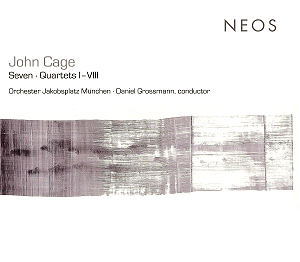

 Orchester Jakobsplatz München/Daniel Grossman
  [
[
