My traversal of the
recorded operas of Nicolae Bretan ends
rather incongruously with his earliest
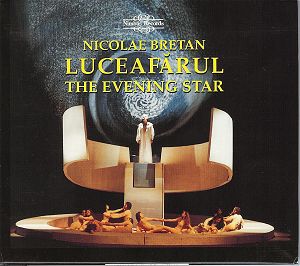
work in the genre, Luceafărul
(The Evening Star). With a playing time
of around one hour it is a substantial
work. By 1921, when the opera was premiered,
Bretan was already a mature composer
in his mid-30s. The opera is based on
a poem by Mihai Eminescu although Bretan
wrote the libretto himself. It is a
kind of parable, dealing with love,
desire, fulfilment and loss.
In this opera the Evening
Star has fallen in love with the King’s
Daughter and is prepared to renounce
his immortality for love. The Archangel
Michael and the Chorus of Stars try
to stop him but he plunges to earth,
into the ocean. In the meantime the
King’s Daughter has fallen in love with
the Evening Star, having heard her Lady-in-Waiting
telling a story about this. When the
Evening Star appears before her in human
form she feels he is alien and can’t
accept his love. Instead she falls in
love with the Page who comes to ask
for her hand and they sing a duet ‘in
which they praise death as the final
destination in life and declare their
ultimate place of rest to be by the
sea.’ In the Epilogue the Evening Star
has returned to his place in the heavens,
sees the two lovers and realizes that
his dream was unrealistic. He accepts
his fate of immortality.
Bretan’s choice of
this poem became a symbol for his own
youthful love to Maria Scridon – never
expressed – and he felt he was the Evening
Star. Without knowing this one could
almost guess that there was a personal
inspiration behind this music: it is
so filled with beauty, warmth, passion
and longing. Long stretches are pastoral,
even sacred in tone. The prelude seems
to have emanated from Die Zauberflöte
– the priests – and the Chorus of Stars
is also heavenly. The postlude of the
Prologue is a marvellous composition
with first an English horn, then a French
horn and then a trumpet. The ballet
pantomime opening the Act is in a vein
reminiscent of Lars-Erik Larsson’s pastoral
music from the late 1930s. The Lady-in-Waiting’s
tale of the Evening Star and the King’s
Daughter, accompanied by harp, is a
fine piece. The scene between the King’s
Daughter and the Evening Star (in ‘real
life’) has drama as well as lyricism
and when the voices intertwine the music
rises to ecstatic heights. Even this
is surpassed by the agitated ecstasy
of the encounter between the King’s
Daughter and the Page. In the Epilogue
we are back in the pastoral mood in
which the opera began but wrapped in
melancholy. The Evening Star sings his
final words: You live there in your
narrow world / A plaything in its hold
/ While in my boundless world I reign
/ Both deathless and dead-cold to
a movingly beautiful melody, followed
by the Chorus of Stars repeating the
words.
The music is deeply
felt and the singers on this recording
have obviously taken it to their hearts.
Béla Hary draws impassioned playing
from The Philharmonic Orchestra Transilvania
and the anonymous chorus sings beautifully.
Of the soloists Adriana Croitoru as
the King’s Daughter stands out with
dramatically convincing singing, slightly
edgy at the top but with ravishing piano
singing. The mezzo-soprano Elena Casian
has a classy voice and narrates her
tale with expression. Balint Szabó
in the Archangel’s solo sports a good
bass voice, slightly uncomfortable at
the top, and Ionel Voineag is a convincing
Evening Star, though not without strain.
The Page is sung with youthfulness and
enthusiasm and a great deal of lyric
Schmalz by Ioan Pojar. The opera
unfolds mainly in monologues – arias
if you like – and it is only in the
confrontation between The King’s Daughter
and her two suitors that there is true
dialogue. But everything is laid out
in Bretan’s highly personal late-romantic
language seasoned with a tinge of folk
song. I have been deeply fascinated
by his other operas as well as his songs
(see review
of his operas Golem and Arald
for links to the other recordings) but
Luceafărul
has a special magic that makes it irresistible.
The recording is excellent
and the booklet has a biographical article
on the composer, a penetrating analysis
of the opera and texts and translations.
I urge readers – as I have done in previous
reviews – to investigate Nicolae Bretan’s
very special musical world. It is not
difficult, nor is it bland, but I believe
it has something for everyone with an
open mind and Luceafărul
is as good a place as any to start.
Göran Forsling
























 Philharmonic Orchestra Transilvania, Cluj/Béla
Hary
Philharmonic Orchestra Transilvania, Cluj/Béla
Hary 
