Editorial Board
MusicWeb International
Founding Editor Rob Barnett Editor in Chief
John Quinn Contributing Editor Ralph Moore Webmaster
David Barker Postmaster
Jonathan Woolf MusicWeb Founder Len Mullenger
Ludwig
van BEETHOVEN (1770–1827)
Symphony No. 1 in C Major, Op.21 (1800) [26:12]
Symphony No. 2 in D Major, Op.36 (1801) [33:16]
Symphony No. 3 in E Flat, Op. 55, Eroica (1803) [47:04]
Symphony No. 4 in B Flat, Op. 60 (1806) [31:36]
Symphony No. 5 in C Minor, Op.67 (1807) [31:28]
Symphony No. 6 in F, Op.68, Pastoral (1808) [40:05]
Symphony No. 7 in A, Op.92 (1812) [38:20]
Symphony No. 8 in F, Op.93 (1812) [26:20]
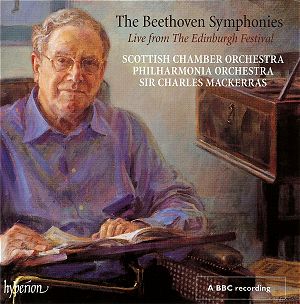
Symphony No. 9 in D Minor, Op.125, Choral (1824) [61:34] * Scottish Chamber Orchestra/Charles
Mackerras
Janice Watson (soprano), Catherine Wyn-Rogers (mezzo), Stuart
Skelton (tenor), Detlef Roth (bass)/Philharmonia Orchestra
and Edinburgh Festival Chorus/Charles Mackerras *
rec. live, Usher Hall, Edinburgh, BBC Scotland, Edinburgh
International Festival, August and September 2006 HYPERION
CDS44301/05 [5 CDs: 59:28 + 78:40 + 71:33
+ 64:40 + 61:34]
Mackerras’s Beethoven cycle
was recorded live in the Usher Hall, Edinburgh, during August
and September 2006. As one would expect of him musicological
insights are wedded to questions of appropriate sonority,
balance, tempo relationships and orchestral size, to produce
performances of consistent intelligence and perception. The
chamber orchestra approach of the first eight symphonies
with the Scottish Chamber Orchestra is followed by a performance
of the Ninth with the Philharmonia Orchestra and Edinburgh
Festival Chorus.
This
is Mackerras’s second symphonic cycle; the earlier set, with
the Royal Liverpool Philharmonic is available on Classics
for Pleasure – a five disc set [CD BOXLVB1]. The performances
are not dissimilar; in fact the Edinburgh cycle is on balance
just a trifle steadier in terms of absolute tempos, though
there is one case, the opening movement of the Seventh, where
Mackerras has somewhat rethought things. To forestall my
conclusion regarding the conductor’s two cycles I doubt that
there is a compelling case to be made for acquiring both,
unless you’re a fanatical devotee, but this latest cycle
must stand as his final thoughts on the matter, ones set
down over a decade later than that earlier cycle, which was
recorded piecemeal throughout the 1990s.
In
the First Symphony he is trenchant but not unyielding.
The slow movement is warmly phrased and the Scherzo’s trio
is felicitously moulded. There are some splendidly bucolic,
almost buffo-like moments in a virile and athletic finale. The Second Symphony
is propelled by crisp brass and “hard stick” percussion.
The conclusion of the opening movement is exceptionally kinetic
and exciting, securely balanced by an equally driving but
clarity-conscious finale. The Eroica receives a reading
of unmannered authority, tensile, purposeful, textually aerated
but unstinting of the nervous energy and fissures inherent
in the music. It’s a reading once again very similar to his
earlier Liverpool recording, though obviously the chamber
scale of the Edinburgh reading grants it a different kind
of weight. The Fourth opens with intense, brooding
introspection – very finely balanced strings and winds add
stature to the reading - in a performance of remarkably persuasive
force. If I were to be asked to recommend just one example
of Mackerras’ way with the cycle I think – perverse though
it may sound – I would point to the Fourth. It enshrines
his greatest virtues – intensity of expression, clarity of
texture, great attention to choir separation, and beyond
these things a purposeful excitement that meets the score
head on.
The Fifth opens
weightily – it’s tensile with observed commas that don’t
slow the symphonic argument. The chamber orchestra’s relatively
discreet use of vibrato pays dividends throughout. Some may
find the finale a shade underpowered but I found it naturally
expressed and quite powerful enough for my tastes. The Pastoral is
taken at a basically fast tempo though as ever Mackerras
ensures that nothing seems rushed so natural is the phrasing,
so purposeful the accents. The lyric passages of the first
movement sound utterly, naturally integrated, the light chamber
textures of the second movement flow richly. The scherzo’s
trio is passionately lithe and the finale is bathed in simplicity
and pliant warmth.
No.7 is a real winner, vying with No.4 for
the honour of the most outstanding recording in the cycle.
The joyous dynamism of the opening – rhythmically
etched, propulsive – sets a cracking pace and sense of momentum. This
is properly maintained by the second movement, one that never
seeks any kind of marmoreal independence, and is strongly
correlated to the zest and wit of the scherzo. The directional
surety of the finale seals a performance of vitality, blazing
drama and absolute conviction. The Eighth is charmingly
pointed and adeptly balanced. Mackerras’ sense of characterisation
is given full rein here and the crisp ensemble, its deft
exchanges, the vitality of the inner part writing, all disclose
the elevation of the conception. Finally to crown the series
there’s the Ninth with the Philharmonia, some excellent
soloists and the Edinburgh Festival Chorus. Mackerras marries
intensity of expression with a fast, forward-moving tempo.
The Adagio moves in an arc, each moment of its potentially
discursive rhetoric having been thoroughly absorbed – compare
and contrast with such as, say, Beecham (Somm), also from
Edinburgh, and far too short-breathed, and Pletnev’s recent
jumpily unconvincing DG attempt. Mackerras has the movement’s
full measure; indeed as the symphony progresses it gathers
in momentum and energy toward an overwhelming climax.
The
performances were all recorded by BBC Scotland with warmth
and detail. This invigorating box contains performances of
vitality and life enhancing verve. The audiences are pretty
well silent throughout and no applause has been included.
For a contemporary set recorded on modern instruments, chamber
sized except for the Choral, but fully aware of historical
practice, you really can’t do much better.
Jonathan
Woolf
see also review by Owen
Walton(May 2008
Recording of the Month)
Please support our advertisers below by clicking on the logos for further information.
























 Scottish Chamber Orchestra/Charles
Mackerras
Scottish Chamber Orchestra/Charles
Mackerras 
