The recordings of the controversial figure of Guila Bustabo still
make for exciting listening. She was Wisconsin-born in 1917 –
making her a contemporary of Ruggiero Ricci. Both studied with
the leading American pedagogue of the day Louis Persinger and
both soon gravitated to Europe. Bustabo enjoyed the greater early
celebrity, making her London debut in 1934 and recording talent
scouts were clearly out in force as she went into the studios
the following year to record with Gerald Moore – a brilliant but
inconsistent series of discs it must be noted. She studied further
with Enescu and Hubay, played for Sibelius, then returned to America
in 1938. And then, amazingly, she and her domineering mother returned
to Europe arriving in Paris in May 1940, just before the Occupation.
Her career never recovered from the stigma of the performances
she gave in Nazi Germany and post-War she was shunned by American
orchestras. In the 1970s she did finally return to join the Alabama
Symphony and the last years of her life were spent in seclusion
or as a recluse, depending on how one looks at it.
Of the two concertos
here I’ve heard the Beethoven before but not the Dvořák.
The Beethoven is the 1943 broadcast with another equivocal figure,
Mengelberg and I last heard it on Michael G. Thomas’s label
devoted to a slew of the conductor’s recordings (Mengelberg
Edition ADCD117, coupled with the Bustabo/Mengelberg Bruch G
minor – a magnificent live performance). She was free to indulge
her very personalised sense of rubato with Mengelberg who offered
her a kind of mirror image of her own combustible rhythmic sense.
Mengelberg’s opening paragraphs are therefore defiantly etched,
accelerandos driving the musical argument forward. This volatility
is paralleled in Bustabo’s playing – both in terms of tempo
and mood – with a very slow second subject lent into with Bustabo’s
trademark quivery vibrato – something that had earlier disfigured
some of her first commercial Columbia 78s. These moments are
affecting or sickly according to taste but the extremes of dynamics
and elasticity of line attest to a singularly highly charged
meeting of musical minds. The slow movement is extremely slow,
stretched once more and bordering on the sentimentalised. Whereas
the finale is big boned, albeit the cadenza is not especially
convincing. Of the two transfers that I’ve sampled Tahra’s is
the one to have; the earlier transfer was very rough and ready,
afflicted with swish and lacking in detail. Tahra’s work is
excellent.
The companion work
shows Bustabo in repertoire that suited her better. The 1955
sound is clearly much better than the Beethoven and unproblematic
sonically. The NWDR Symphony Orchestra is directed by Hans Schmidt-Isserstedt
– a touch foursquare in places. Bustabo plays here with great
personality, ensuring that her legato, singing line in the first
movement isn’t disturbed by too much slowing down at cadential
points. Her rhythm sounds considerably tighter than before,
far more stabilised, and her tone lacks the rather hysterical
edge that could creep in back in pre-War days. Her fast vibrato
ensures vibrancy and an alert imagination at play. Altogether
this is a fine performance with a festive finale, and some nice
inflected hues in the folkloric episodes.
There is a bonus
of a two-minute snippet from an interview conducted with Bustabo
in 2001, the year before she died.
This is a contrasting,
valuable, excellently presented brace of performances, ones
that reveal the excellences and limitations of Bustabo’s art.
Jonathan Woolf
























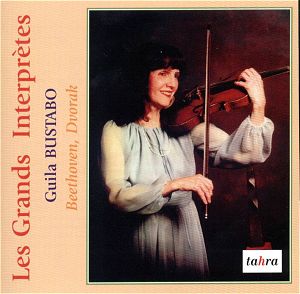

 Guila Bustabo
(violin)
Guila Bustabo
(violin) 
