|
EXPLORE
Musicweb - CLICK
------------------
Message Board
Announcements
Twitter @MusicWebINt
------------------
RECORDING
OF THE MONTH
Shostakovich Symphony 8
RCO, Nelsons
RECORDING
OF THE MONTH

HALLÉ WALKURE
4+1CDs £22 post free
RECORDING
OF THE MONTH

Complete Orchestral Works

EMI Complete Ferrier

Storyteller

Mahler
Symphony 7
Bamberger Symphoniker
Jonathan Nott
................
RECORDING OF THE MONTH

Simone Young
RECORDING OF THE MONTH
Italia Nicola Benedetti

Only complete set
on the Market
35CDs £67

RECORDING
OF THE MONTH
Momentous!
BARGAIN
OF THE MONTH

Italian Cello Concertos
and Sonatas
3CDS £10.95

Brahms Symphonies Zinman
£26.85
RECORDING
OF THE MONTH
Beethoven Symphonies
Thielmann


Magic Moments of Opera
10 Operas Arthaus £95

Brilliant Classics 40CDs

Brilliant Classics 60CDs

9 Symphonies Chailly
£31.90

9
Symphonies C Davis
£18.70
BARGAIN
OF THE MONTH
Absolutely marvellous!
£5.99 post free

Bruch VC1 Gluzman
Quite the finest performance of the Bruch concerto
I have ever heard.

The best opera DVD of the year so far [ST]

Mahler Song Cycles
Katarina Karnéus
Available
again
The Raga Guide
4CDs + 196 page book
£33 post-free world-wide
15,000 copies sold
Editorial
Board
Classical Editor
Rob Barnett
Seen & Heard
Editor Emeritus
Bill Kenny
Editor in Chief
Stan Metzger
MusicWeb Webmaster
Len Mullenger
Assistant Webmaster
David Barker
|
 |
 |
|
alternatively
CD:
Crotchet
AmazonUK
AmazonUS
|
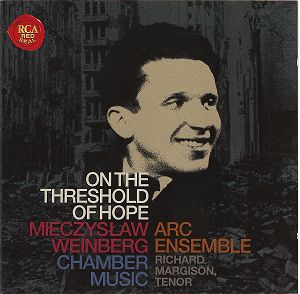
Mieczyslaw
WEINBERG (1919-1996)
On the threshold of hope
Clarinet Sonata op. 28 (1945) [18:41]
Jewish Songs after Shmuel Halkin op. 17 (1944) [14:40]
Piano Quintet op. 18 (1944) [43:22]
ARC Ensemble:
Joaquin Valdepeñas (clarinet); Dianne
Werner (piano); Richard Margison (tenor); Erika Raum
(violin I); Marie Bérard (violin II); Steven Dann (viola);
Bryan Epperson (cello); David Louie (piano)).
rec. Toronto Centre for the Arts, 14, 16 April 2006 (opp.
18, 28); Willowdale United Church, Toronto, 12 June 2006
(op. 17). DDD
RCA/BMG RED SEAL
828768 77692 [74:43]  |
|
|
Weinberg
(aka Vainberg) was a Russian Jew of Moldovan extraction.
He enjoyed, then endured, the various phases through
which Soviet Jewry lived in Soviet Russia. The clouds
only parted - and just in time too - on the death of
Stalin in 1953. A favoured pupil of Shostakovich, Weinberg
benefited from the comparatively lavish life of a celebrity
composer in Moscow and this continued after Shostakovich's
death in 1975.
The three
works being played here date from the years after Hitler's
Operation Barbarossa - the Nazi invasion of the USSR
in 1941. Safety beckoned in the Soviet capital although
Weinberg's fortunes remained fragile until 1953.
The Clarinet
Sonata is a comparatively untroubled melodic work. It
seems in the first movement to depict a happy home-life
with only the occasional dark intimation. The clarinet's
line coincides with passages in the Finzi Clarinet Concerto.
The second movement has the character of a saunter around
a city in the cool of the evening. There are occasional
pauses for a klezmer soliloquy as at 3:12. Typically
for Weinberg the last movement is a melancholically pensive Adagio that
resonates with tragic power and protest. The piano part
carries a particularly memorable strummed ostinato effect.
In the
six songs Richard Margison is something of a heldentenor
with baritonal overtones. The songs range from ringing
hysterical exhortation to a much lighter cantilena as
in Di muter. Margison's enunciation is crystal
clear. These songs have an heroic pressure behind them
but the melodic caste places them squarely in the Schubertian
lieder tradition.
The Piano
Quintet - in five movements - is a major work in every
sense. Rather like the Galynin piano works heard recently
on Toccata the piano part has the song-line of Shostakovich
in the Second Piano Concerto. This impression returns
in the keyboard torrents of the Presto (III) although
leavened by a disorientating and refracted flavour of
cafe culture. The string quartet parts are more resolute
and rhetorical reflecting the shuddering and tragic manner
of the times. March figures flit in and out, clouds scud
across the horizon, and a troubled equipoise is secured
out only after grief. That Schubertian foundation can
be heard again throughout this work although it has had
infused into it large draughts of tragic discord and
haunting fear. This is a far tougher, more knowing and
adult work than the other two. The music is blown hither
and thither by the hot winds of war. The Presto (III) ends
with a raspingly exciting thunder of notes and slashing
double flourish from piano and quartet. Shostakovich
amid the T34s and Katyushas sounds out in the powerful
stirring Largo (IV) although the Schubertian wistfulness
returns for the central piano-led heart of the movement
even if the piano line is clearly a slowed fanfare. This
movement is unsurprisingly the heart of the piece in
much the same manner as equivalent movements provide
the rooted core of the Shostakovich wartime symphonies.
The Allegro agitato starts in an abrupt, incessant-obsessive
insistence. This soon falls away into a classically dancing
reminiscence of happy days. This is soon fractured and
collaged and the shards are moved in a kaleidoscope of
reminiscence and fantasy. The work ends in a chipping
and stuttering interplay from piano and violin fading
into silence; no circus finale here. The quintet was
premiered by Emil Gilels in Moscow in 1944.
I should
add that Dianne Werner is the pianist in the first two
works and David Louie in the last. The liner-notes are
by the late Per Skans. The words of the songs are printed
legibly in the booklet in both the sung Yiddish and in
parallel English translation.
The Quintet
has the confident air of a masterpiece of beauty, torment
and tragedy. However all three pieces are deeply sincere,
accomplished and memorable.
Rob Barnett
|
|
Advertising
Rates
Visitor
stats
MusicWeb
International
has over 40,000 Classical CD reviews on offer
Discs
received
Having a problem
Donating?

Gerard
Hoffnung Concerts &
The
Bricklayer Story
New
Releases

New
Releases


MusicWeb
sells the Polish
catalogue CDAccord
£10.50 post free W-W

MusicWeb sells the
Arcodiva catalogue
£12.00 post free W-W

£11.75
post-free world-
wide
MusicWeb
can now offer
you discs from the following catalogues:
Prices include postage
Musicweb
Special
Offers
Monthly
Best Buys
Google
Ads - for information about privacy matters, click here.
Amazon Musicweb International is a participant in the Amazon
EU Associates Programme, an affiliate advertising programme designed to provide
a means for sites to earn advertising fees by advertising and linking to Amazon.co.uk
and Amazon.com
|