If you appreciate
contrast and shared Shakespearian
inspiration then this disc will suit
you well. The lives of the two composers
overlapped by 35 years. I wonder if
Sullivan ever heard any Sibelius and
what he thought of it. It seems unlikely
but not impossible as Sibelius was
35 when Sullivan died.
We hear the nineteen
year old Sullivan's seven movement
suite from his score for The Tempest
- his earliest piece. This music
is smooth, full of lissom invention
and generally in the style of Schumann
and Mendelssohn with the odd infusion
from Massenet. Truly charming is the
skipping flute figuration in Banquet
Dance. The orchestra is just as
successful in the light as down Dance
of Nymphs and Reapers. Mendelssohn
is certainly engaged in the Act IV
overture. The Act V Prelude with its
shivering-plodding string pizzicato
and epic lassitude is another magnificent
effort. The Kansas City Symphony and
Stern - son of Isaac Stern - do all
of this superbly. The orchestra sports
a magnificent rank of woodwind principals
that’s for sure.
The Sibelius score
was a commission from his Danish publishers,
Thomas Hansen. He delivered a 35 section
work of which Michael Stern gives
us the prelude and the two suites
- altogether twenty pieces. This version
of the Prelude seemed unfocused
during the whirling conflict but miraculously
clear and pleasing during its long
musing descent. These are very controlled
performances and more of a sense of
danger would have helped the feral
Storm section. Expectations
raised by the delicacy of the Sullivan
movements were met again for the many
gentle and fairytale episodes in this
long sequence spread across the two
suites. I did however think that the
Dance of the Nymphs remained
too much in contact with the earth.
It should have floated more buoyantly.
The same buoyancy is however lovingly
articulated for Song II with
its Hispanic bounce and flow. The
Miranda movement is just a
little hurried but earthbound. On
the other hand Stern very nicely captures
the chilly, elemental and dervish-obsessive
Dance Episode. This really
holds the attention with its feathery
epilogue into silence. The First Suite
- which appears second on this disc
- opens with The Oak Tree which
also works exceedingly well. The
recording nicely opens out the detail
of the sphinx-like brass chords as
much as the Chandos team did for Segerstam's
DRSO in the brass hammer blows of
Sibelius 5 at the close. The cool
mesmerising inhumanity of the flute
suggests the supernatural. Humoresque
is classic ebullient light incidental
Sibelius and it's extremely well done.
The Reference Recordings team are
at their adept and most nuanced best
in the Scene (tr. 23). Its
transitions from gruff stomp to filigree
pizzicato fragility and tambourine
pastel are memorable. The very brief
Intrada returns us to the scathing
and boiling power of Tapiola
and the Seventh Symphony. It reminds
the listener that Prospero's island
is one of mystery and danger. Lastly
comes The Storm; this is contained
and ultimately too controlled for
its own good. Against Vänskä
and Beecham this version cannot be
regarded as superior though all Sibelians
should make it their business to hear
this when they can.
The massed violins
of the Kansas Symphony sometimes sound
a little less than opulent especially
in the Sullivan tracks. On the other
hand the recording venue is very lively
and makes for an extremely attractive
sound throughout. Listen to the silky
fade-down at the end of the Sullivan
Postlude – so beautifully done.
A substantial essay
is provided in English only by Antony
Hodgson.
This is a fine and
thoughtfully put together project.
I hope we will hear more from this
orchestra and conductor in similarly
inventive couplings. Please continue
to steer clear of the obvious. Their
Sullivan is excellent and except for
a few missed opportunities the Sibelius
is good to fine.
Let us hope that
this disc signals a rebirth of classical
orchestral activity from this great
original among American labels and
that there will be much more from
Kansas City and Stern.
Rob Barnett
























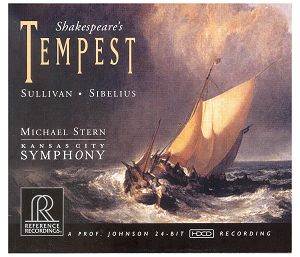

 Kansas City Symphony/Michael Stern
