This is, in general,
a most enjoyable disk. Nothing profound
in the music, but it’s played with
such enjoyment and style that it is
irresistible.
In the 1930s, Martinů
heard an English group singing madrigals.
He loved the free flowing polyphony
and independent lines of the music.
Immediately he set to work writing
madrigals, some for chorus and four
sets for (different) instrumental
combinations. This is one of
the final works in this style.
Martinů’s
style, after the jazz-inspired works
of his early Paris years, settled
into an easy-going neo-classicism,
and the outer pieces of these Three
Madrigals are full of that delightful
chatter: two friends who have lots
to say and fall over each others speech
so urgent is their need to get their
thoughts heard. It’s great fun, and
makes most enjoyable listening, but
is, I imagine, difficult for the players.
The middle movement is full of the
night, long tremolandos fill the music
and even invade the tunes from time
to time. There’s much more fioritura
here, as the tempo and material allows
for it, than in the other movements.
It’s very beautiful, and very beautifully
played.
Because of Martinů’s
neo-classical leanings, the music
of Mozart follows easily and there
isn’t the shock which sometimes comes
when one aurally steps back 150 years.
There is a story that we owe the existence
of Mozart’s two Duos –
this one and another K423 – to pure
chance. The story goes that Michael
Haydn, due to illness, couldn’t finish
six duets commissioned by the Archbishop
of Salzburg so Mozart stepped in and
completed the set with his two works.
Despite Mozart being able to duplicate
Haydn’s style these pieces are pure
Mozart. It’s hard to believe the Archbishop
was fooled by the subterfuge – but
perhaps he was. The first movement
is an amiable discourse between the
instruments, full of musical jokes,
the slow movement, however, is very
serious; perhaps here the dialogue
is philosophical. It’s back to high
spirits for the final movement. It’s
a superbly proportioned work, well
laid out fore the instruments and
not a note is wasted.
Astor Piazzolla comes
as a shock after this. Because of
his recordings and touring, Piazzolla’s
special brand of Tango Nuevo
is now known the world over and many
of his works have been arranged for
many different instrumental combinations
– even full orchestra. I even know
a busker who regularly plays a solo
violin version of Adios Nonino.
With the quintet or sextet, which
he led playing the bandoneon, the
tangos were the sexy works they so
obviously are, helped by Piazzolla’s
suggestive movements as he played.
However, once you remove that real
spirit of the tango – and the bandoneon,
guitar, violin and bass – the tunes
survive. It would be impossible for
them not to as Piazzolla had a strong
melodic vein in his body - but that’s
all you’re left with: the tune. These
two arrangements, good though they
are, are pleasant but they really
have nothing whatsoever to do with
tango, and the music really doesn’t
ignite. The, almost, dirty passion
is missing. Of the two, Invierno
Porteño (Winter in Buenos
Aires) comes off best, with its
sultry phrases and laid-back melodic
line. But it’s always good to hear
these marvellous tunes and they make
a pleasant, if not wholly satisfactory,
end to a splendid disk.
The booklet has brief,
but clear notes and the disk is attractively
packaged.
Bob Briggs
























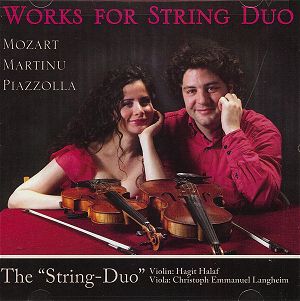

 Hagit Halaf (violin); Christoph Emmanuel
Langheim (viola)
Hagit Halaf (violin); Christoph Emmanuel
Langheim (viola) 
