I have to admit I
never understood the fuss over Simon
Rattle, based on his early flurry
of recordings. It wasn't until I attended
one of his actual concerts -- a Dream
of Gerontius at the 1986 Edinburgh
Festival, roughly contemporaneous
with his studio recording - that I
realized what exactly he was doing:
carefully applying dynamic control
to bring out the expansive contours
of the musical phrase. The resulting
sense of a continuing ebb and flow
could make for compelling results.
The problem was that
Rattle frequently concentrated on
realizing his preferred phrasing to
the exclusion of everything else.
Precision as such seemed not to interest
him - attacks and releases in the
concert Gerontius tended to
be gently smudged - nor did clear
textures, nor firm rhythmic grounding.
On record, lacking the usual visual
clues as well as the conductor's charismatic
podium presence - which clearly drew
the players, as well as the audience,
into his artistic vision - Rattle's
performances, for all his care over
individual musical strands, could
sound thick and shapeless as a whole.
The opening of this
Sibelius rather neatly illustrates
the plusses and minuses of the conductor's
approach. After the firm, clear horn-call,
Rattle teases the various statements
of the woodwind motif almost note
by note, guiding and building them.
But the sticky legato blunts
the rhythmic definition, and the crest
of the musical arc at 0:57 is a dull
plop, setting the stage for a sluggish
reading of the movement. Even the
trumpet's syncopated theme in the
coda fails to provide forward impetus.
The mushy, under-committed
wind chorale which begins the slow
movement at least suggests the right
prayerful feeling; but when the strings
enter with contrasting material, the
chorale stops registering as a theme
- a contrapuntal element - and turns
into a sort of all-purpose thickening
agent. Rattle understands the finale's
broad nobility, but in striving for
mass and weight, he burdens the horns'
"Thor's hammer" theme with thick tenutos
that impede forward motion. By the
time the trumpets take up this theme
in the home stretch, it's become soggy
and dispirited, and the important
landing at 8:27 is another dull plop.
Unexpectedly, the final chord sequence
is terrific -- clean, firm, and impeccably
balanced - but it's too little, too
late.
Moving to Nielsen,
the conductor doesn't bind the discrete
episodes of the "pastorale" Pan
and Syrinx into a coherent whole.
Rhythmic address in tutti remains
slack and laissez-faire, and
to play all the little oboe solos
for pathos, as Rattle does, rather
than for stoic resignation constitutes
a fundamental aesthetic misreading.
The Inextinguishable,
on the other hand, comes off rather
well. It doesn't hurt that Rattle
was working with "his" City of Birmingham
Symphony, rather than guesting with
the relatively unfamiliar Philharmonia
- though that was also true for Pan
and Syrinx. The design of the
piece also better plays to the conductor's
strengths - listen to the firm, carefully
guided surge of the violin phrases
- and the mode of attack is altogether
more alert. The woodwind chorale of
the Poco allegretto is more
hushed and devotional than that in
the Sibelius, though it remains overly
soft-edged for my taste. In the Poco
adagio, quasi andante, Rattle
excels in shaping the quieter expressive
pages, drawing the woodwind interruptions
- foreshadowing the Fifth Symphony's
ostinatos - in sharp relief; and he
projects the finale's grandeur without
undue heaviness.
So this Inextinguishable,
while not consistently superior, has
its distinctive points, and it's garbed
in decent sonics: the tuttis
are a bit congested and too insistently
in-your-face, but the well-tuned tympani
register clearly without causing a
textural muddle, as can happen in
so many more recent recordings. Unfortunately,
the competition is formidable: even
if we put aside the brilliant Martinon
(RCA) and Bernstein (Sony) accounts,
Blomstedt (Decca), Barbirolli (EMI
Phoenixa), and Mehta (Decca) have
served up more consistent realizations.
And many recorded Sibelius Fifths,
beginning with Gibson's (Chandos),
are preferable to Rattle's.
Stephen Francis
Vasta
























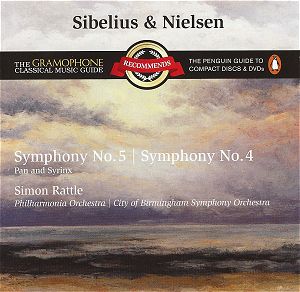

 City of Birmingham Symphony Orchestra, *Philharmonia
Orchestra/Sir Simon Rattle
City of Birmingham Symphony Orchestra, *Philharmonia
Orchestra/Sir Simon Rattle 