Editorial Board
MusicWeb International
Founding Editor Rob Barnett Editor in Chief
John Quinn Contributing Editor Ralph Moore Webmaster
David Barker Postmaster
Jonathan Woolf MusicWeb Founder Len Mullenger
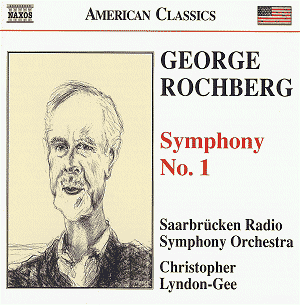
George ROCHBERG (1918-2005)
Symphony no. 1 (1948-49, rev. 1977 and 2003) Saarbrücken Radio
Symphony Orchestra/Christopher Lyndon-Gee
rec. Großes Sendesaal, Funkhaus Halberg, Saarbrücken, Germany,
6-9 January 2004. NAXOS 8.559214 [64:15]
By
now it's an old-story: a young lion of the serialist, atonal
avant-garde
becomes a tuneful symphonist ... or a minimalist. This is
the story told of American composer George Rochberg, whose
collected
orchestral works Naxos is endeavoring to record with the
help of Christopher Lyndon-Gee. It is, like so much of what's
happening on Naxos' "American Classics" series,
to be met with shouts of joy.
Rochberg's First
Symphony was written in the late 1940s, while the composer
himself was just turning 30. Yet the score was revised "top
to bottom" in 1977, and again in 2002-03 in preparation
for this recording; the composer died in 2005. Rochberg,
like Bruckner before him, fell victim to others' attempts
to make his music more manageable and accessible. Eugene
Ormandy convinced him to submit to the editor's ax. When
he was finally willing to cut no more, Ormandy retorted, "Far
be it from me, a mere conductor, to tell a composer
how he should write his music." It must have been gratifying
to Rochberg to participate in the present rehabilitation
of the original score.
So, the symphony
began its life before the composer adopted serial
methodology, and then through subsequent revision assumed
a form far more reflective of his artistic maturity. His
post-serial mission, in Richard Taruskin's charged words,
was "to challenge the whole idea of stylistic obsolescence.
And to challenge that idea was to put in question the ‘necessity’ of
the twentieth century’s stylistic revolutions — the most
sacred of all modernist dogmas."
Rochberg himself
could describe his purpose even more grandiloquently and
obtusely. "Subjective man views existence as change;
himself and his history at the center of a process of becoming.
Subjective man cannot transcend time; he is trapped in it.
However, when man seizes on the present moment of existence
as the only 'real' time, he spatializes his existence; that
is, he fills his present with objects that take on a state
of permanence." If we are to take this as Rochberg's
compositional philosophy, then what process of becoming do
we find "spatialized," made permanent, in the First
Symphony?
Structurally,
this symphony shows similarities to Mahler's Seventh: both
have five movements constructed in an arch. Rochberg even
has a second movement "Night Music," though where
Mahler would insert a funeral march, we get instead the lurching
graveyard revels of dancing ghosts and skeletons, with an
undead fiddler for good measure. This after an opening movement
(marked "Exultant !!") of Nielsen-like exuberance.
The third movement Capriccio ("fast and impetuous; like
a curtain-raiser") with percussion outbursts and obbligato
piano (and that's just in the first minute) caused his own
teacher to exclaim "This is the craziest music I have
ever seen!" Stitching together the craziness, however,
is sweet, yearning writing for strings and winds. The fourth
movement Variations continue elegiac writing for strings
and brass in a "very slow and stately" mode. The
finale brings pealing brass heralding war fury and, after
uncertainty – perhaps - victory.
Sure, it sounds
like a lot. But it all hangs together, which is more than
half the wonder. Whether the whole adds up to an extra-music
programmatic narrative, however, is a verdict I'll leave
to the reader-listener.
Lyndon-Gee's
involvement in the recording of Rochberg's works extends
beyond conducting to writing the notes as well. In these
notes he demonstrates his deep knowledge and passion for
the music, even if he shares the composer's tendency to start
talking about music and end up talking metaphysics.
As far as the
playing is concerned, this is no mere read-through. The musicians
from Saarbrücken play with commitment and intensity, with
polished and integrated tone, and with the precision of articulation
that can elude better-known orchestras. Lyndon-Gee, for his
part, is a natural at organically shaping phrases and building
climaxes.
Fans of the twentieth-century
symphony should consider this essential.

























 Saarbrücken Radio
Symphony Orchestra/Christopher Lyndon-Gee
Saarbrücken Radio
Symphony Orchestra/Christopher Lyndon-Gee 
