George Rochberg is
not a familiar name to many people nevertheless
he was a composer of great power and
imagination. His works are often large
in scale and ambition. He had wonderful
control over orchestral colours and
textures and always presented a cohesive
musical argument. Rochberg was born
in Paterson, New Jersey of Jewish Ukrainian
parents on 5 July 1918. Like his close
contemporary (and fellow impressive
symphonist), William Schuman, Rochberg
played jazz piano in New York clubs
as a student. He studied at the Mannes
School of Music where his studies brought
him into contact with, among others,
George Szell, later studying at the
Curtis Institute in Philadelphia. He
was seriously wounded at the Battle
of the Bulge during the Second World
War and he remained with a slight limp
for the rest of his life. He was director
of publications for Theodore Presser
from 1951 and in 1960 became chairman
of the music department at the University
of Pennsylvania and then Annenberg Professor
of Humanities from 1979 until retirement
in 1983.
Rochberg’s musical
style falls into three distinct periods.
Before his meeting with Luigi Dallapiccola
in 1951, Rochberg’s music was chromatic,
almost atonal, although still recognisably
from tonal roots. Between the early
1950s and 1963, he was the darling of
the American avant-garde and
wrote exclusively serial music, the
most important work from this period
being the Second Symphony of 1955-56,
premiered by Rochberg’s former professor
George Szell and the Cleveland Orchestra
in 1961. The Naxos American Classics
recording of this work has been reviewed
several times previously for Musicweb,
as has the Fifth Symphony by Neil Horner
[review].
Following the death of his son in 1964,
Rochberg abandoned the twelve-tone system
in search of a music language which
would allow him the increased degree
of expression he sought. Possibly his
most notable work from this third period
is the Third String Quartet from 1972,
which also bore the Transcendental
Variations, an arrangement for string
orchestra of the Quartet’s slow movement.
"This is the craziest
music I have ever seen" is reportedly
how Rochberg’s teacher Leopold Mannes,
reacted to being shown the piano score
of the Capriccio of Rochberg’s
First Symphony. The Symphony is a monster,
it has to be said, being a five-movement
work of well over an hour’s duration.
At the most superficial level, the First
Symphony resembles the model of Mahler’s
Seventh Symphony – two substantial symphonic
movements at beginning and end, a furious
scherzo in the centre and two
‘night music’ pieces as second and fourth
movements. This superficial level is
where the similarity ends, however.
This symphony is a vastly ambitious
creation for a young 30-year-old composer
to attempt and I was constantly struck
by the confidence and assurance shown
in the composition of this powerful
yet slightly rambling work. Originally
written during 1948-49, Rochberg revised
the First Symphony in 1977 and then
again in 2002-03 in preparation for
this recording.
The first movement
(along with a great deal of the rest
of the Symphony) shows the strong influence
of the music by Stravinsky Rochberg
doubtless heard in New York such as
the Symphony in C and Symphony in 3
Movements, as well as (to my ears) early
Schoenberg and hints of Berg, Martinů,
Varčse, Copland and early
Bernstein – whose own First Symphony
had appeared in 1942. The work opens
without any preamble whatsoever and
brings to mind the aforementioned Stravinsky
Symphony in Three Movements. There seems
to be almost a straight quote from the
Stravinsky work at around 3:03 and again
later at 9:04. Rochberg’s confidence
in his skills is shown not only in the
complex, dissonant, contrapuntal music
that pervades much of the movement but
also in the bravery of ending the ‘exposition’
section with a blatant, richly scored
C major chord. The movement is taughtly
argued throughout its eleven minutes
and makes an impressive start, living
up to the marking Exultant!!
in the score. Wherever next?
What we have in the
second movement is a true Night Music.
This is not, however, a night music
like Mahler or Bartók. This was
the first part of the Symphony to be
written, standing alone for some months,
and is very much Rochberg’s own distinctive
sound world. The heart of this movement
could quite easily be the slow movement
of a cello concerto. This is a lament
of extreme tranquility and one feels
that Rochberg’s dedication for the Symphony
"To my mother, in memoriam"
is at its most deeply felt here. This
extensive ruminatory music is framed
by sections more agitated in nature.
The Capriccio
third movement is a Stravinskian/Varèsian/Coplandesque
scherzo of massive proportions.
The percussion comes very much into
prominence here and the music has a
relentless forward drive that leaves
the listener breathless after nearly
fourteen minutes. The huge Variations
fourth movement sounds oddly ‘English’
in many places, Rochberg’s symphonic
contrapuntal skills echoing those of
Edmund Rubbra. The movement leads straight
into the Finale - the First Symphony’s
only movement lasting under ten minutes.
After a brief slow introduction which
continues the hazy music which concluded
the Variations, we are thrust
into what Rochberg himself described
as "peg-leg Pete" music, with
its lolloping gait and constant changes
of direction.
The performance of
the Saarbrücken Radio Symphony
Orchestra is exemplary in every way
and Christopher Lyndon-Gee obviously
has the full measure of this gargantuan
work. His credentials have already been
fully shown in the previous Rochberg
releases which have won such critical
acclaim. The recording is first rate
to match, having the perfect combination
of warm, natural sound and enough detail
in the recording to hear Rochberg’s
sometimes complex contrapuntal textures.
This Symphony has been
a major discovery for me and repeated
listenings have been intensely rewarding.
Rochberg is undoubtedly one of the most
important American symphonists. I think
only William Schuman could realistically
vie with Rochberg for the mantle of
‘the’ most important American symphonist.
This giant of a symphony has not had
an easy life and I hope Christopher
Lyndon-Gee’s world première recording
will bring to it the larger audience
it so richly deserves.
Derek Warby
























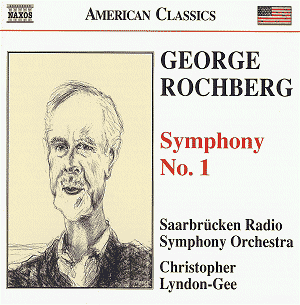

 Saarbrücken Radio Symphony Orchestra/Christopher
Lyndon-Gee
Saarbrücken Radio Symphony Orchestra/Christopher
Lyndon-Gee