Site
Map
More
Reviews
How
to find a review
Classical CD Review Archive
Book
Reviews
Film
Music Reviews
Jazz
CD Reviews
Nostalgia
Comment
Norman
Lebrecht Weekly
Arthur
Butterworth Writes
Phil
Scowcroft's Garlands
Classical
blogs
Reviewers
Logs
Announcements
Don't
Go Here!
Community
Bulletin
Board
Web
Ring
Reviewers
Helpers
invited!
Resources
How
Did I Miss That?
British
Composers
British
Light Music Composers
Other
composers
Indexes
Label
Masterwork
Discographies
On-line
Music
[Download sites]
Themed
Review pages
Our
Classic Classics
Online
books
MWI
Classical
Encyclopaedia
Gilder
Dictionary of
Composers
MWI
Pop
Encyclopedia
Other
Complete
Books
Programme
Notes
British
Music Society
Performers
The
BBC Proms
Musical
WWW pages
Classical
Music Online
Recording
Companies and Retailers
Agents
and Marketing
Publishers
Non-Classical
Web pages
Orchestra
Web Sites
Newsgroups
Web
News sites etc
Editorial
Board
Classical Editor
Rob Barnett
Seen & Heard
Editor and Webmaster
Bill Kenny
MusicWeb Webmaster
Len Mullenger
Assistant Webmasters
Patrick Waller
David Barker
PotPourri
A
pot-pourri of articles
MW
Listening Room
MW
Office
Helping
MusicWeb
Advice
to Windows Vista users
Questionnaire
Site
History
What
they say about us
What
we say about us!
Where
to get help on the Internet
CD
orders By Special Request
Graphics
archive
Currency
Converter
Dictionary
Magazines
Newsfeed
Web Ring
Translation Service
Rules
for potential reviewers :-)
Do
Not Go Here!
April Fools
|

 |
 |
|
alternatively
CD:
Crotchet
|
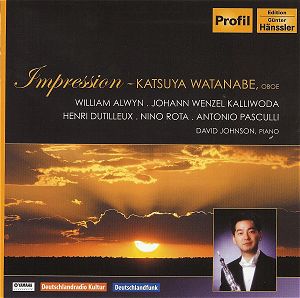
Impression
William ALWYN (1905-1985)
Sonata for oboe and piano (1934) [19:15]
Johann Wenzel KALLIWODA (1801-1866)
Morceau de Salon Op. 228 [12:20]
Henri DUTILLEUX (b.1916)
Sonata for oboe and piano (1947) [13:22]
Nino ROTA (1911-1979)
Elegia (1955) [3:47]
Antonio PASCULLI (1842-1924)
Gran Concerto (c.1860) [20:46]
Katsuya Watanabe (oboe); David
Johnson (piano)
rec. 6-8 February 2008 Jesus-Christus-Kirche Berlin. DDD
HÄNSSLER PROFIL PH08038 [69:31]  |
|
|
The
bottom line is that I thoroughly enjoyed the music and
the playing on this CD but I was very disappointed by the
presentation. Let me explain. As a listener and a reviewer
I do not feel that I should be obliged to trawl through
dictionaries and surf the ‘web’ to find out basic information
about the featured composers and their music. In this CD
virtually no background information is provided on these
composers –in spite of two of them being virtually unknown
and the other three not being exactly household names.
Furthermore the ‘descriptive’ notes on the pieces are uneven.
There is practically no comment on the Alwyn or the Dutilleux,
yet these are the two oboe ‘masterpieces’ on this CD.
Now
it could be argued that the innocent ear is a great strategy.
Do I really need to know that Pasculli was born in Palermo
or that Rota was Milanese? Is it essential that I know
Dutilleux is still alive? Or that William Alywn destroyed
much of his pre-war music? I think it does matter. At least
it gives some referential markers for judging a given piece
of music. Three of these works were unknown quantities
to me. I would have liked something to go on: something
to help me form an educated opinion.
One
last criticism - I understood that the Alwyn Sonata was
first played in 1934 and not written ‘about 1955’ as the
programme notes suggest!
The
Alwyn Oboe Sonata was first played at a Royal Academy
of Music concert in 1934 by Helen and Lillian Gaskell.
The work was well received with the Times reviewer suggesting
that it was a “‘true sonata’ that gave each instrument
a share in the progress of the music.” Apparently, it was
so popular in the late nineteen-thirties that it was included
in the BBC Radio Programme – Your Choice for the Week!
The work is written in
three unbalanced movements – the first being as long as
the last two put together. The first few bars provide most
of the material for the remainder of the opening movement.
This is signed 'moderato e grazioso’ yet much of
the music is actually slow and reflective – perhaps a little
untypical for first movement form. It would be disingenuous
to talk about ‘cow pats and fences’ – but this movement
is pretty close to ‘pastoral imagery’. And there is a definite
French feel to this well wrought music that makes it just
that little bit more sophisticated than a meditation on
the fields around Northampton. Yet there is nothing here
to disturb the listener’s peace of mind on a hot summer’s
evening. The second movement is a choral-like ‘andantino’ which
continues the mood of the last pages of the ‘moderato’.
It is truly lovely music that explores a wide-ranging and
lyrical tune. Of course the temper of the music changes
and slightly more intense feelings inform the proceedings.
Yet the sheer beauty of this movement is never compromised.
The allegro is much livelier than most of what has
gone before: it is actually a ‘pastiche’ waltz. However
the character of the movement changes towards the end when
the soloist indulges in a reflective coda. This is a fine
work by one of Britain’s great composers. Yet it is fair
to say that few of the ‘typical’ Alwyn fingerprints are
found in these pages.
Unfortunately
there is virtually nothing in the sleeve-notes about Henri
Dutilleux and his Oboe Sonata (1947). Yet this work
is regarded as one of the masterworks for the instrument.
Dutilleux is a composer who is actually quite hard to pin
down, stylistically. He has used serialism in some of his
compositions but has never become a slave to its methods.
He was seriously influenced by Debussy and Ravel. Additionally,
it is not hard to hear Stravinsky and Bartók in much of
his music. And there are echoes of ‘Les Six’ - however
it is well known that in spite of being friends with at
least three of the group he declined to become the Seventh!
It is fair to say that Dutilleux denies belonging to any
particular school. He wrote this Sonata just after
the Second World War and it was part of the composer’s
emergence onto the Paris scene. The work is actually quite
short and is in three contrasting movements. It is clear
that there is a hiatus or at least a tension between the
pensive opening ‘aria’ and the almost jaunty ‘final.’ I
have noted before that the middle movement, the ‘scherzo’ is
the heart of the piece. This is split into two sections – with
complex fast music and an introspective ‘trio’ section.
The ‘scherzo’ music is not repeated before the start of
the last movement. There has been discussion about the
nature of the ‘finale’ – is this ‘light’ music or something
more ironic. It has been seen as being a “gallivant around
the boulevards of Paris”. However, the truth is more prosaic.
This is simply an optimistic conclusion to a work that
opened with dark thoughts. Strangely the scherzo is an
epitome of the entire Sonata.
I
am totally dependent on the sleeve-notes for information
about the Bohemian composer Johann Wenzel Kalliwoda. I
have found out that he was born in Prague in 1801 and died
in 1866. Furthermore he wrote a number of large-scale works
including symphonies. He was obviously seriously prolific
as this piece was his Op. 228. However I have no idea when
it was composed. Apparently when Kalliwoda penned his Morceau he
was not thinking of the ‘middle class salon culture’ but
good old proletarian music-making: Cousin Winifred and
Uncle Eustace gathered round the piano after Matins on
a Sunday afternoon type of thing … The work allows the
soloist to express both lyrical melodies and complex ‘stretto’ passages.
The piece itself is in ternary form with a central set
of variations. If I was looking for some musical references
I guess that it would be Liszt or Paganini and quite often
Sir Arthur Sullivan. My only gripe would be that for a ‘morceau’ it
is a little long at just over twelve minutes - although
the sheer attractiveness of the main melody mitigates this
to some extent.
The Elegia (1955)
by Nino Rota is one of those pieces that are absolutely
timeless: every note is perfectly stated; every phrase
is faultless. The programme notes suggest a connection
with the Syrinx myth that was musically perpetuated by
Claude Debussy. But although there is certainly much truth
in this comparison, the two composers’ interpretations
of this myth are totally discrete. What is fascinating
about this present piece is the fact that it is a million
miles away from being film music - yet could easily be
used in film. Enigmatic is the only possible description – yet
quite beautiful.
The
only thing that I know about Antonio Pasculli, apart from
the fact that he was born in Palermo in Sicily, is that
he was dubbed the ‘Paganini of the oboe’. The present piece
shows off both the composer’s skill and the player’s technique
to great effect. The complete title of the work is Gran
Concerto su temi dall’opera ‘I Vespri sicilani’ di Verdi.
The piece is a subtle set of variations that explores virtually
every possible characteristic of the oboe. The programme
notes suggest that after “150 years, they are still among
the most difficult passages ever written for the instrument.” They
are certainly beautifully and competently performed on
this disc.
The
playing is superb and the sound quality excellent. It is
a disc that most oboe enthusiasts would want to add to
their collections. The three twentieth-century works are
essential and the two earlier pieces are well worth the
listening effort. But perhaps the revelation for me was
the Elegia by Nino Rota: a truly gorgeous work that
defies criticism.
John France
|
|
Advertising
Rates
Visitor
stats
MusicWeb
International
has over 21,000 Classical CD reviews on offer
Gerard
Hoffnung Concerts &
The
Bricklayer Story
Purchase
Brilliant Classics
New
Releases

New
Releases


MusicWeb
sells the Polish
catalogue CDAccord
£10.50 post free W-W

MusicWeb sells the
Arcodiva catalogue
£12.00 post free W-W

Price
Reduction: £11.00
post-free world-wide
Try
it and see - Sale or Return
MusicWeb
can now offer you discs from the following catalogues:
Prices include postage
MusicWeb
Recommended Recordings 2008
DISCS
OF THE YEAR 2007
|