Handel’s Hercules was the second oratorio-style work in
which he tried to get away from a strictly biblical source for
his stories. His first attempt, Semele, had been premiered
in 1744 with distinctly mixed results. Handel does not seem to
have been deterred and premiered Hercules in 1745 as part
of a strikingly different season at the King’s Theatre. Instead
of his usual Lenten oratorio diary, Handel attempted to tempt
subscribers with a longer season that stretched well beyond Lent.
The experiment was
not a success, Handel failed to find enough subscribers to fulfil
the planned 24 concerts and neither of the new works, Hercules
and Belshazzar, found favour. Hercules was revived
for one performance in 1749, a further one in 1752 and then
it disappeared until the 20th century.
Hercules
has not had such a success in the 20th and 21st
centuries as Semele, perhaps because the latter work
has a more delightful principal character. Both works are moral
stories and Handel probably viewed them in much the same vein
as his dramatic oratorios. Though it must be admitted that Hercules
is a far less winning work than Semele, the two principals
(Hercules and his wife Dejanira) are powerfully drawn and made
of strong, dark dramatic stuff.
It is perhaps tempting
when casting Hercules to concentrate on Dejanira. After
all it is she who has the most dramatic part, her initial jealousy
at Hercules’s captive princess, Iole, turning to sober reflection,
then her attempt at re-kindling Hercules’s love going drastically
wrong leading to her mad-scene after his death. It is true that
getting the casting of Dejanira right is important, but Hercules
is a long oratorio and there is plenty for the remainder of
the cast to do and it is important to get this right. Like many
of Handel’s finest works they are ensemble pieces, requiring
strong performances from each member, satisfying to perform
when things go right, but easy to disrupt if one of the singers
fails to make the grade.
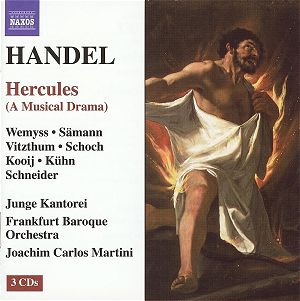
On this new Naxos
recording, taken down live at Kloster Eberbach, the first question
that we must consider is how important are the words in any
Handel oratorio? The cast contains only one native English speaker,
mezzo-soprano Nicola Wemyss who sings Dejanira; the remainder
are German and Dutch. Their English is variable, all the singers
are comprehensible and it is possible to follow them without
a libretto, but you would take none for a native English speaker.
More importantly there are many places in the performance where
the singer seems to be thinking more about pronouncing the language
than using it expressively. Of course, some of the solecisms
may be attributed to the fact that this is a live performance.
Only Wemyss, when she finally gets going in Act 3, uses the
words expressively. Interestingly, the other person who comes
closest is soprano Gerlinde Sämann who sings Iole, and who happens
to be blind.
I think I could
live with this performance, just, as regards the standard of
English, but it is certainly something to think about when considering
whether to buy it.
Joachim Carlos Martini
directs the piece in a controlled manner: it all feels a little
bit careful and steady. This has an effect on the drama which
does take quite a while to get going. In Act 2, Wemyss sings
the part well, but just doesn’t seem to get quite jealous enough,
though she is not helped by Martini’s tempered direction. Even
the Junge Kantorei, in their Jealousy chorus in Act 2
seem to be being a little too careful. It is only in Act 3 that
Wemyss really gets the bit between her teeth and carries the
drama before her in Where shall I fly.
As Hercules, Peter
Kooij has rather less to do than Wemyss. Kooij has a lovely
baritonal sounding voice and produces some beautiful runs; his
English is pretty good too. But he does not really strike sparks
from Dejanira as he should in their Act 2 recitatives and his
death scene, though well sung, seems a little too well modulated.
The results are musical but seem to lack the drama that the
piece calls for. That said, his entrance in Act 1 is both moving
and powerful, so it seems a shame that this did not carry over
into the final act.
Their son, Hyllus,
spends most of the piece simply moping after Iole, who has rejected
him. Knut Schoch has an attractive tenor voice and does what
he can with the role. His passagework is occasionally smudged,
but he sings with a lovely sense of line.
Lichas, the herald,
has the role of observer of these trials, for ever commenting
and never really participating. Nowadays this is a role often
taken by counter-tenors but it was in fact written for a female
alto, Mrs. Cibber, though due to illness she never performed
the part. Here Franz Vitzthum has a lovely sense of line and
feeling for the style of the music, but this is coupled to a
rather distinctive sounding voice which, on this showing, seems
to lack variety of vocal colour. Vitzthum’s passagework is
also rather smudged, though this is fault which applies to a
number of the cast.
Iole, the captive
princess, is the unwitting cause for all Hercules and Dejanira’s
troubles. She is sung by Gerlinde Sämann with a lovely bright,
focused voice and an attractive way with Handel’s complex vocal
lines. This means that the sequence at the end of Act 2, where
Iole’s aria is followed by her duet with Dejanira, is a complete
delight. She is the only cast member to really articulate the
passagework in a consistently clean manner.
The Junge Kantorei
make decent work of Handel’s choruses, though they never really
get the bit properly between the teeth in the drama. It does
not help that some of the choruses are recorded in such a way
that you can hear individual voices. There is also a little
untidiness in some passages.
The Frankfurt Baroque
Orchestra are also not immune to patches of untidiness, though
generally they accompany discreetly. Martini tends to include
rather too much organ in the recitatives for my taste; except
for special effects Handel tended to reserve the organ for just
the choruses. Also, in the tutti orchestral passages the harpsichord
continuo is so discreet that at times it threatened to disappear
altogether.
There are three
strong versions of this oratorio in the catalogue already. John
Eliot Gardiner’s fine one with Sarah Walker and John Tomlinson
is now getting rather old, but still does not show its age,
though Gardiner does make cuts. Mark Minkowski’s more recent
version with Anne Sophie von Otter and Gidon Saks is a very,
very strong contender. Then on DVD you have Joyce DiDonato and
William Shimmell with William Christie and Les Arts Florisants
in Luc Bondy’s fine, much-travelled production.
This is a well appointed
set, but one which lacks the fire of drama. At three discs long
you might consider it better to save up and try and get one of
the other performances; frankly, that’s what I’d do.
Robert Hugill
see also Review
by Mark Sealey

























 Dejanira – Nicola
Wemyss (mezzo)
Dejanira – Nicola
Wemyss (mezzo) 
