Gluck’s Alceste has many similarities with his more familiar
setting of the Orpheus legend. Gluck and his librettist Calzabagi
wrote the Italian versions of Orfeo and Alceste for
Vienna. Gluck then went on to make French versions of both operas
for performance in Paris in the 1770s. The changes he made to
transform Alceste into French were rather more substantial
than the changes to Orfeo. So it is important to understand
the French Alceste to be a substantially different version
of the opera to the Italian original, rather than a simple translation.
Alceste and
Orfeo have a commonality when it comes to plot and overall
tone colour. Both operas are about the love between a couple
transcending death. Whereas Orfeo enters Hades to retrieve his
beloved Eurydice, Alceste volunteers to die instead of her husband
Admète and the climax takes place at the gates of Hell. Both
operas have a small cast with no sub-plot, just a single character
to play deus-ex-machina (Amor in Orfeo, Hercules
in Alceste); in fact the character of Hercules was a
late addition to the French version and he does not appear at
all in the Italian version. But most importantly both operas
have the same dignified, sombre tones coloured by Gluck’s simple,
elegant melodies and both operas stand or fall by the name character.
Curiously, Alceste
has proved far less popular than Orfeo, as if the
notion of pure marital love was less appealing than Orfeo’s
quixotic romantic love. For many years the only viable recording
in the catalogue was Kirsten Flagstad’s 1950s version of the
Italian edition. Subsequently Jessye Norman recorded the French
version, Naxos issued a recording of the Italian version based
on performances at Drottningholm and John Eliot Gardiner recorded
the French version with Anne Sofie von Otter, which must be
the ideally recommendable recording.
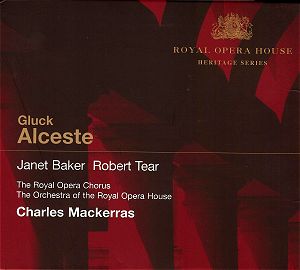
Now the Royal Opera
House have issued a live recording of Janet Baker’s 1981 performance
there. Alceste was one of a trio of operas that Baker
sang as part of her farewell year. The others were Maria
Stuarda at ENO and Orfeo ed Eurydice at Glyndebourne.
These latter two have been long available on disc and it is
with great pleasure that I report that this new disc is a suitable
companion to those two.
For anyone that
saw the production, Janet Baker’s Alceste was one of her most
notable assumptions. The opera played to Baker’s strengths and
built on her ability to carry an opera by sheer force of personality
and musicality. It is a joy to have her radiant performance
captured on disc.
At the period that
the opera was recorded, the orchestra of the Royal Opera House
seems to have been less sympathetic to the ideas of period practice
than the orchestra at ENO. That said, Charles Mackerras gets
them to deliver a finely balanced, restrained performance. From
the opening notes of the overture, I was impressed by how beautifully
the players capture the dark tones of Gluck’s orchestration
and play with a well modulated classicism. Orchestrally the
performance wears the years relatively lightly and provided
you are not looking for a performance which apes the Orchestra
of the Age of Enlightenment, then you should find this disc
far more than adequate.
But all this changes
when the chorus first enters; they sing Gluck’s lines very robustly,
with a vibrato-laden tone which seems to have little to do with
French 18th century opera and more to do with a generic
19th century performing practice. Not that the performance
of the chorus is bad, it just hasn’t stood the test of time.
In fact, in the 1980s I can remember finding a number of Royal
Opera House performances unsatisfactory because of the chorus’s
stylistic inappropriateness.
Still, all is forgiven
when Baker appears. The recording captures the bloom and radiance
of her voice; it also captures the characteristic way she slides
around the notes, something which you find either expressive
or annoying. Anyone who never heard her live will get a very
good impression of Baker’s voice and technique from this recording.
Personally I love it and find it profoundly moving; for me Baker’s
account of Divinités du Styx from the end of Act 1 is
worth the price of the set. The character of Alceste dominates
the opera and Alceste is completely focused on her marital love
so that monotony could threaten. That it does not occur is a
tribute to the varied way that Gluck articulates the opera,
plus the beauty and variety of expression of Baker’s performance.
The opera was given
a strong supporting cast. John Shirley-Quirk makes a robust
high priest. He does not sound entirely comfortable with the
high tessitura of the role and sings with assertive confidence
rather than finesse, but his performance is entirely convincing.
Robert Tear, as
Admète, is similarly challenged by the high-lying vocal line.
Tear sings the role with his familiar open tones and does not
shirk the role’s challenges. Occasionally I wished that I was
listening to a singer like Paul Agnew, who can sing these high
tenor parts with what appears to be great ease. Ease is not
something that Tear brings to Admète, but he creates an unfailingly
true line and sings with great musicality.
Both Tear and Baker
are notable for their facility with the French language; this
is one of the incidental joys, you never have to apologise for
the principals’ poor French and their diction is admirably clear.
If you can’t have the opera sung by native French speakers then
this is the next best thing.
The remainder of
the cast provide strong support with Jonathan Summers in the
small but important role of Hercules.
Mackerras conducts
with poise and dignity. In an interview in the CD booklet he
comments that there is little he would change nowadays other
than some of the speeds. I can do nothing but agree with him,
noting again that this is a performance that stands the test
of time.
The sound quality
is very good; that it is a live performance means that the singers
sometimes move around confusingly. There is not too much stage
noise, which is a good thing as the opera is given complete
with the ballet movements, though the final divertissement is
not complete. That this is a CD is of great benefit here as
we can miss out on the risible choreography which accompanied
the dance music in the original production.
Choreography apart,
I remember the production as looking fabulous and the booklet
includes a selection of production photographs. The booklet
also includes an assessment of the original performance by Rodney
Milnes, an interview with Charles Mackerras and a complete libretto
plus English translation.
I can’t honestly
recommend this as the sole library version of this opera, because
the chorus’s performance is simply not something which I would
want to hear every day. But no-one should be without Baker’s
radiant performance. Frankly this set is essential; no home
should be without one.
Robert Hugill
























 Alceste –
Janet Baker (mezzo)
Alceste –
Janet Baker (mezzo) 
