Comparison: Hidemi Suzuki (Arte dell'Arco TDK-AD009, 2003) (Gabrielli)
The history of the cello - and in general of bass string instruments
- is rather complicated. One of the difficulties is a confusion
of the terms used to describe the various low string instruments.
The word 'cello' only appears in the 1660s. Before that the
term 'violoncino' was used, but it isn't quite clear which
instrument it refers to. In the programme notes for his recording
Hidemi Suzuki refers to research by the musicologist Stephen
Bonta, who found at least 24 terms referring to a 'bass string
instrument'. "However, at the very least, in northern
Italy 'violone' was the name of an instrument either identical
or very similar to the violoncello". This explains why
in the late 17th and early 18th century the term 'violone'
often appears on the title pages of chamber music to describe
the scoring of the basso continuo.
Domenico Gabrielli has played a key role in the development of the
cello, even though he is little more than a name - often confused
with (Giovanni) Gabrieli - to many music lovers of today.
Gabrielli not only composed the first pieces for cello solo
in history, but he was also the first real virtuoso on his
instrument which contributed to the cello developing into
the main low string instrument in Italy. Here it replaced
the viola da gamba in the second half of the 17th century,
something which happened in Germany and France only in the
middle of the 18th century.
Gabrielli was born in Bologna and worked there the largest part of
his rather short life. He studied in Venice with Legrenzi,
but returned to Bologna in 1680 to become the cellist of the
San Petronio basilica, one of Italy's largest churches. In
1676 he was elected a member of the prestigious Accademia
Filarmonica and became its president in 1683. He first gained
a reputation as composer of vocal works: he wrote twelve operas
which were performed in several cities, including Bologna
and Venice. His oeuvre for cello is remarkably limited in
size and none of his cello compositions were printed during
his lifetime.
The ricercari are especially interesting as they have the character
of etudes. They were probably composed for Gabrielli's own
use, and therefore give us some insight into his skills as
a performer. These must have been considerable as these ricercari
are technically very demanding. They not only contain florid
passages but also double, triple and quadruple chords. The
sonatas - scored for cello and bc - are somewhat easier; there
are only two of them, one in two different versions.
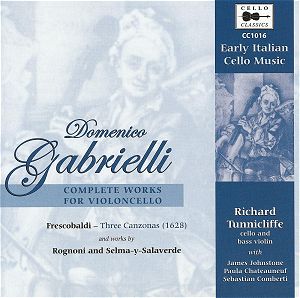
Richard Tunnicliffe has decided to put Gabrielli's works in a kind
of historical perspective by including pieces for a bass string
instrument (with basso continuo) by composers of the early
17th century: Francesco Rognoni - especially renowned for
his 'passaggi' on chansons and motets of the late 16th century
-, Girolamo Frescobaldi and Bartolome de Selma y Salaverde,
himself a player of the dulcian who in some pieces leaves
the choice of the bass instrument to the performer. Tunnicliffe
uses the cello in two different tunings as well as the bass
violin, a cello which is slightly larger than the 'normal'
cello.
The result is an interesting programme with really excellent music.
Frescobaldi is still mostly known for his keyboard works,
so it is good to hear another side of his oeuvre which is
certainly not unknown, but still largely unexplored. Unfortunately
the performances are not up to what one may expect. As comparison
I turned to the recording by the Japanese cellist Hidemi Suzuki.
Listening to the Ricercar No 1 by Gabrielli which opens this
disc and then to Suzuki playing the same piece caused quite
a shock. It was like they were playing different pieces. Not
only takes Suzuki a much faster tempo - very appropriate,
in my view -, he also articulates much better. His performance
also contains much larger dynamic shades and the rhythm is
stronger expounded. Although some pieces in Richard Tunnicliffe's
programme are rather well done, in general the performances
by Suzuki are richer in contrast, more speech-like and overall
much more dramatic. Listening to his interpretations one can
understand why he was a succesful composer of operas. In comparison
Richard Tunnicliffe's performances are blander and less differentiated.
The Ricercar No 2 is the longest and the contrasts between
the different sections are much better exposed by Suzuki than
by Tunnicliffe.
Richard Tunnicliffe's recording gives only a hint of what Domenico
Gabrielli's art may have been. Even though Suzuki's recording
is rather short - just 47 minutes, as he doesn't add any other
music - it is a much better deal.
Johan
van Veen