Why on earth do booklet
compilers insist on printing English
translations of the notes which have
clearly been made by a citizen of
the country of origin? Too often the
result is gibberish as a result of
direct translations from the original
language. In this instance we are
talking (or not) Czech. I am ‘banging
on’ about it - translate that into
Czech if you dare - because clearly
(actually not clearly) the
way this disc was recorded is unusual,
or in Czech ‘realized in a very conventional
manner’, and worth the understanding.
Well, as for understanding, try this
for size: ‘Extraordinary acoustic
dispositions of the hall Audimax made
it possible to bring into accord the
advanced digital recording technology
of today with the best practice of
the good old golden times of the phonographic
industry – the simple stereophonic
technology. … It captures real sound
field of the stage and the entire
environment with an unmerciful precision
and by its very nature it excludes
any subsequent proportional modifications
of the recording. That is why the
sound form and balance of the recording
is not secured by a usual battery
of contact microphones, manipulation
with buttons of the sound mixer and
multi-track, but solely by a manner
of interpretation, sense of sound
of the musicians and the extent of
their chamber adaptability’. Enough
– I surrender, but can’t somebody
out there do something to remedy this?
Andrew Downes
was born in Birmingham and for
long was based at the Conservatoire,
latterly as Professor of Composition.
He is a pupil of the late Herbert
Howells, and, judging by the international
activities listed in his CV, he is
clearly doing well as a composer,
with, above all, a healthy Czech book.
He seems to like brass - that is the
instruments, though I dare say the
money too - with works such as ‘Suite
for Brass Sextet’ for the Czech Philharmonic
Brass Sextet, ‘Suite for six horns’
for the Vienna Horn Society, ‘Sonata
for eight horns’ for the University
of New Mexico Horn Octet, and ‘Five
dramatic pieces for eight Wagner tubas’,
this last premiered by the horn section
of the Czech Philharmonic Orchestra
of which Ondrej Vrabec, horn-player
on this CD, is the principal. Downes’
music is very attractive, makes for
comfortable listening but at the same
time covers a wide range of emotional
contrast with appealing melody in
thoroughly tonal style. Much is meditative,
but livelier moments are crisply taut
in rhythm and articulation. The wide-ranging
demands encourage particularly fine
playing from horn and piano, although
the violin seems to take a relatively
smaller role in the ensemble. The
trio was commissioned by the Brahms
Trio Prague, who gave the world premiere
on 5 February 2008 in the Suk Hall
of the Rudolfinum in the capital.
Heinrich von Herzogenberg
- Austrian-born in Graz, but of French
descent and officially Heinrich Picot
de Peccaduc, Freiherr von Herzogenberg
- lived in the
shadow of his close friend Brahms.
So too did Friedrich Gernsheim and
Albert Dietrich, and all three composed
music which is well-deserving of a
hearing. For Brahms enthusiasts the
name of Herzogenberg will be known
as a recipient or originator of letters
between the two men in the Kalbeck
edition of Brahms’ collected correspondence.
The two men were friends for thirty
years, though being a friend of Brahms
was never easy. Max Bruch got, and
returned, the abrasive treatment at
times; so too did Herzogenberg - but
who did not give as good as he got
- who admired Brahms, ten years his
senior, to the point of adulation.
Herzogenberg moved
to Leipzig in 1872 where, with Spitta,
he formed the Bach Verein (Association),
soon becoming its conductor. From
1885 until his death he taught composition
either privately or at the Berlin
Hochschule. His own works include
many sacred and secular choral compositions,
some 150 songs, three symphonies (plus
five unpublished ones), chamber music,
sonatas and keyboard music. Links
with English music and musicians include
an assessment of the 25 year-old Vaughan
Williams, whom he passed on - briefly
as it turned out - to Bruch, his faculty
colleague at Berlin. Another was Ethel
Smyth who, in their Leipzig days,
the Herzogenbergs took under their
wing almost as an adoptive daughter
as well as pupil. ‘A more learned
musician can never have existed’,
she wrote in her memoirs. Herzogenberg
was one of those who broke free from
the throttling influence of Wagner
and switched allegiance to Brahms
after they met, when Brahms moved
to Vienna in 1862 and Herzogenberg
was studying conducting there with
Otto Dessoff. There’s not much sign
that the influence of the one giant
was any less pervasive than the other.
Both men cast vast shadows from which
Herzogenberg and many others never
broke free. Nevertheless he enjoyed
a highly respectable and respected
reputation. Though Elisabeth’s opinion
was well thought of by Brahms when
he sent them a new work, he hardly
reciprocated by encouraging her husband.
It would probably not have been anything
but an uneven contest, but any such
gesture would have been welcomed and
Herzogenberg’s self-confidence less
scarred.
The trio featured
on this disc is for horn, violin and
piano, whereas the original was for
oboe instead of violin. Whether the
change from wind to string instrument
has been made specifically for this
disc, or whether the composer had
offered the alternative, is not clear.
Whatever the truth of the matter,
the music drives home the point that
Herzogenberg was no epigone, but was
a man who had something to say in
a style not entirely derivative of
Brahms and, before him, Schumann.
Brahms wrote
his familiar horn trio in 1865, a
year after the death of his mother,
which event produced a deeply felt
slow movement in both this work and
the German Requiem. Elsewhere
the music is joyful, if clichéd
and stating the obvious with an excess
of horn calls. Played with evident
enthusiasm and panache with the violinist
now making more of her role in the
ensemble, the Horn Trio Prague reminds
us of its greatness.
This is a disc of
contrasts, though the span of years
in terms of style between Brahms and
Downes need hold no fears for the
wary.
Christopher
Fifield
























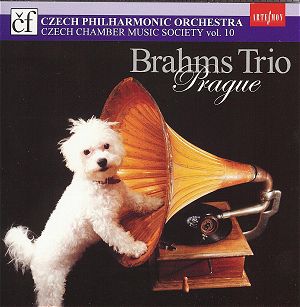
 Brahms Trio Prague (Monica Vrabcová
(violin); Ondrej Vrabec (horn); Daniel
Wiesner (piano))
Brahms Trio Prague (Monica Vrabcová
(violin); Ondrej Vrabec (horn); Daniel
Wiesner (piano))  Sample:
Downes Horn Sonata
Sample:
Downes Horn Sonata 