Editorial Board
MusicWeb International
Founding Editor Rob Barnett Editor in Chief
John Quinn Contributing Editor Ralph Moore Webmaster
David Barker Postmaster
Jonathan Woolf MusicWeb Founder Len Mullenger
Gaetano
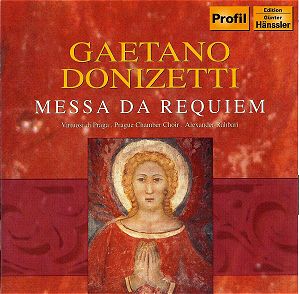
DONIZETTI (1797–1848) Messa da Requiem (1833) [63.04] Tiziana
K. Sojat (soprano)
Jaroslava Horsk-Maxova (mezzo)
Vittorio Giammarrusco (tenor)
Zdenek Hlavka (baritone)
Marcel Rosca (bass)
Prague Chamber Choir
Virtuosi di Praga/Alexander Rahbari
rec. Korunni Studios, Prague, May 1997 HÄNSSLER PROFIL
PH08026 [63.04]
Donizetti’s
teacher, Mayr, devoted a considerable amount of time to
writing sacred music so it should come as no surprise to
find Donizetti turning his hand to writing a Requiem Mass
and doing so in a highly creditable manner. What does come
as a surprise is that it is so little known.
The Requiem was
written at the behest of Donizetti’s publisher Ricordi
in response to Bellini’s sudden death. A planned performance
never took place and it is unlikely that Donizetti ever
heard the work. It remained incomplete, lacking the Sanctus, Benedictus and Agnus
Dei. It has not found its way into the recording studio
with any great frequency. The first recording was on Orfeo
in 1989 with the Bamberg Symphony Orchestra under Miguel
Angel Gomez-Martinez and a young Cheryl Studer as solo
soprano. This recording, re-issued on Hänssler, dates from
1997, seems to be the only other one in the catalogue at
the moment.
Donizetti
wrote this piece for chorus, orchestra and five soloists
with the male singers getting the bulk of the work. Though
Donizetti includes distinct arias, such as the tenor’s Ingemisco,
he also alternates chorus and solo voices in a very operatic
manner. Also operatic is his use of the soloists in ensemble.
Donizetti
has been relatively free with the text. He alternates the Requiem and Kyrie and
the text of the Kyrie re-appears at the end of the Libera
me. He sets the propers as well as the ordinary including
the Gradual, In memoria aeterna. Like Verdi and
Cherubini he also includes the Dies Irae.
The
work opens with a sombre brooding prelude which merges
into the Introit: Requiem in aeternam. The dramatic
openingof the Dies Irae, with drum rolls,
fanfares and massive choral statement of the opening words
is pure word-painting. But Donizetti does not do this consistently;
the Tuba mirum movement is rather understated and Ingemisco could
have come straight out of an opera. The Lachrymosa begins
with a fascinating section where the chorus sings homophonically
supported by a moving bass and quiet brass fanfares. This
section concludes the Dies Irae with a large-scale
fugue which put me in mind of the fugues in Rossini’s Petite
Messe Solennelle. In fact this piece seems to sit mid-way
between Rossini’s work and Verdi’s Requiem, mixing
the operatic jollity of Rossini with dramatic elements
which pre-figure Verdi.
Donizetti
disposes of the Offertorio largely as a baritone
solo. The Communio (Lux Aeterna) is a short
but dramatic choral outburst and the final Libera me mixes
chorus with solo outbursts to create a satisfying conclusion.
Though
some passages seem to have come from the operatic stage
this Requiem is much more than an assemblage of
operatic excerpts. Donizetti must have been at some pains
to keep the vocal parts relatively simple, eschewing fireworks.
The work has a suitably sombre tone, despite one or two
jolly movements, but lacks the dramatic intensity that
Verdi would bring to the Requiem Mass.
This
performance by Czech forces under Alexander Rahbari is
largely creditable. The Virtuosi di Praga play confidently
and with not a little style. The Prague Chamber Choir gives
a good account of Donizetti’s substantial choral passages.
Tenor soloist Vittorio Giammarrusco has a pleasant, open
Italian sound and makes good work of his solo. Similarly
bass Zdenek Hlavka and baritone Marcel Rosca acquit themselves
well, providing stylish contributions and some attractive,
if grainy, tone. However the recording falls down when
it comes to the two female soloists, Tiziana K. Sojat and
Jaroslava Horsk-Maxova. Both have typically Slavic voices
with substantial vibratos, dramatic in their own way but
completely unsuitable to the music. Luckily the men get
the lion’s share of the vocal writing.
The
CD booklet includes the Latin words but seems to have been
assembled by someone unfamiliar with Donizetti’s setting:
the printed words differ from the sung text and the text
for the In memoria aeterna movement is missing.
There is no indication of which passages are choral and
which sung by soloists so that listeners must do their
best to work out which soloist they are hearing.
Donizetti’s Requiem still
seems to lack a good modern recording. Until one arrives
this confident performance is more than adequate, if you
can live with the female soloists’ vibrato. Robert Hugill
Please support our advertisers below by clicking on the logos for further information.
























 Tiziana
K. Sojat (soprano)
Tiziana
K. Sojat (soprano) 
