It would be hard to
overstate the importance of this issue.
What we have preserved here is a live
performance of Albert Herring,
under the direction of the composer,
which took place just over two years
after the première at Glyndebourne
on 20 June 1947. What makes this issue
so remarkable is that it gives us the
opportunity to hear virtually the entire
original cast. As will be seen from
the list at the head of this review,
only two of the singers in the 1949
production were not the creators of
their respective roles. Britten made
a studio recording of the opera for
Decca but that was not set down until
1964 and only Peter Pears, by then fifteen
years older, reprised his role in that
recording.
The fact that we have
this recording at all is due to the
endeavours of one remarkable man, Knud
Hegermann-Lindencrone (1911-1994). He
was a keen lover of the theatre and
equally enthusiastic about gramophone
recordings. It was at his initiative
that recordings were made of eighteen
special performances given to celebrate
the bicentenary of the Royal Theatre
in Copenhagen. But that was just the
start. Hegermann-Lindencrone then persuaded
the theatre, and the artists involved,
to let him continue this recording work
and over the next forty years some 1500
performances were captured on tape.
Since 1989 the entire collection has
been the property of the theatre and
must constitute a priceless archive.
The present performance
was given during a tour by the English
Opera Group, which took in various venues
in the UK as well as performances in
Oslo and Copenhagen. I understand that
The Rape of Lucretia was also
in the touring repertoire. Not surprisingly,
this performance has all the feel of
a well run-in ensemble with a cast who
mostly had created their roles and who,
without exception, knew them inside
out. The recording was made using a
single microphone, positioned in the
orchestra pit right in front of the
stage. A first generation open reel
tape recorder was used. Although there
are some sonic imperfections – the timpani
are rather dully caught, for instance
– the sound quality is absolutely astonishing,
especially when one considers that the
recording is sixty-one years old. An
abundance of detail is reported and
the listener has a very real sense of
"being there". There are two
slight losses of text caused by the
recording operator changing tape reels.
These occur at the start of Act 1, Scene
2 and at the start of Act 2, Scene 2.
Nimbus helpfully make these small excisions
clear in the libretto. While it’s a
pity that these losses occurred we lose
only 38 and 22 bars respectively and
prospective purchasers should not be
put off in the slightest.
Albert Herring
was Britten’s third opera – or fourth
if you count Paul Bunyan, which
I think one should. The libretto was
devised by Eric Crozier, who freely
adapted a short story, Le rosier
de Madam Husson [‘Madame Husson’s
May King’] by Guy de Maupassant. Crozier
moved the action from a small town in
Normandy to Loxford, a fictitious East
Suffolk market town, and updated the
story to 1900. The plot tells the story
of the down-trodden Albert Herring,
firmly tied to the apron strings of
his widowed mother, who is made May
King – in the absence of a suitable
candidate for the more usual role of
May Queen – and finally achieves some
degree of emancipation from his over-protective
mother.
It’s a lively, amusing
and often touching story, which inspired
Britten to write some vivacious and
tremendously fluent music. There is
an important role for Peter Pears but
Pears’s character is not as dominant
as had been the case in Peter
Grimes. Albert Herring
is essentially a company opera. While
listening to it I was put in mind of
two very different things: the Ealing
comedies and West Side Story,
currently in the news thanks to its
fiftieth anniversary production in London.
The reason these things came to mind
is that both are products of their time
that have dated in some ways and yet
in other ways have not dated but which,
in any case, give us, of themselves,
an invaluable perspective on the times
in which they came into being.
Albert Herring
is like that, I think. Some aspects
have dated – the part played in the
drama by the three Village Children,
being the most obvious one. Yet the
story it tells is a timeless one. I
think it reflects also its times. Post-war
austerity Britain was in a mood for
being cheered up and this, perhaps,
was Britten’s contribution to that process.
The performance brims
over with verve and sheer joie de
vivre. That’s evident at the very
start from the infectious bustle that
characterises the orchestral introduction
to Act I. Every performer plays to the
full his or her part in creating and
maintaining this sense of an energetic,
enjoyable occasion.
For me the star of
the show is not Pears, though he’s excellent,
but Joan Cross as Lady Billows. She
lives up to the description of Her Ladyship
in the score as "an elderly autocrat".
She’s every inch the Grande Dame,
the chatelaine of Loxford. When in Act
III Superintendent Budd wearily describes
her as a "self-appointed Chief
Constable" you know exactly what
he means. In the booklet essay Joan
Cross is quoted as describing the role
as "the Lady Bracknell of opera".
What a superbly accurate verdict and
how well the role’s creator ensures
that her character lives up to it. Her
Ladyship is aided and abetted by her
maid, Florence. Gladys Parr gives a
splendid portrayal of this loyal retainer,
not least in the passage in Act 1, Scene
1 when she contrives to dismiss the
claims of successive candidates for
the role of May Queen.
Otakar Kraus was not
the creator of the role of Mr Gedge,
the Vicar – the original Vicar was William
Parsons – but Kraus, singing in excellent
English, is a marvellously unctuous
parson and his singing and vocal acting
give great pleasure. Roy Ashton is a
suitably self-important mayor and Norman
Lumsden gives an excellent impression
of the quintessential British Bobby,
even if his police rank is more exalted
than that. I did wonder, however, why
Lumsden alone of the cast affects a
"rustic English" accent.
As Sid Norman, Denis
Dowling is suitably stolid and down
to earth, if a little unimaginative
– just what the role requires in other
words. His enthusiastic pursuit of Nancy
has a real ring of authenticity to it.
I’m not quite so convinced by Nancy
Evans as his inamorata, however. Sometimes
she sounds too matronly and a bit posh
rather than the young village girl.
To my ears this happens in her first
appearance (Act 1, Scene 2) and also
at "What would Missus Herring say?"
(Act 3). That said, immediately after
that brief passage in Act 3 she sings
"We did it for fun" very nicely,
conveying genuine pathos
Margaret Ritchie, on
the other hand, is completely convincing
as Miss Wordsworth. In Act 2, Scene
1, her increasing desperation as she
coaches Cis, Emmie and Harry in their
little song of welcome to the May King
is richly comic, and clearly enjoyed
by the audience. This is the sole occasion
on which the contribution of the Village
Children works for me. Here they sound
to have stepped straight out of an Ealing
Comedy and that’s appropriate. Elsewhere,
I’m afraid, the roles – or perhaps the
style in which they’re done here, which
is very much of the period – have dated.
Incidentally, in Act 3 there are two
or three points at which Harry makes
spoken interjections as the action proceeds.
The nature of these is very specifically
marked in the score and they are important
– for example just before cue 41 he’s
"shouting through the window".
They should come across as excited interruptions
by a cheeky, eager small boy but that’s
not how they’re delivered here and the
dramatic impact is lessened.
There’s no lack of
impact in Pears’ contribution. The character
of Albert spends quite a lot of the
opera off-stage and arguably this is
not a starring role in the sense of
dominance in the way that Peter Grimes
had been or that many other Britten
roles were to be but it’s crucial to
the drama, of course. In its own way
the role of Albert, the pleasant, simple
lad, is another of those outsider roles
that Britten proved to be so adept at
writing and that Pears was equally adept
at enacting. A key consideration is
that at the time of this performance
Pears had just turned thirty-nine. There’s
a winning lightness to his voice and
also a pleasing sweetness of tone. In
many Britten operas Pears was called
on to play psychologically complex and
often tragic roles. Here he proves he
could "do" comedy as well
and his performances as Albert Herring
– and in A Midsummer Night’s Dream
too, for that matter – are essential
in giving us a rounded portrayal of
Pears as a musician and actor.
His excellent sense
of theatrical timing and the aforementioned
lightness of tone are well to the fore
at his very first appearance (Act 1,
Scene 2). Later in the same scene we
see the first signs of Albert as the
potential rebel in the argument with
his mother. At the start of Act 2, Scene
2 Pears’ vocal acting as the tipsy Albert
returning home alone after the farce
of his coronation is excellent. To judge
from the reactions of the audience I
suspect his physical acting was no less
acute at this point. But it’s a little
later in the same scene - from cue 74
- that Pears is at his very finest as
his thoughts turn longingly to Nancy
("Why did she stare?"). Even
under the influence of the laced lemonade
he knows that she’s beyond his reach
("No, she belongs to Sid, not me")
and Pears’ portrayal of the frustrated
Albert fully engages our sympathies.
His final solo at the end of this scene
("Heaven helps those who help themselves")
is passionate and vocally agile. In
Act 3, when he returns from his night
on the tiles he relates the story to
the outraged assembly of village big-wigs
in a touching and very believable fashion.
All in all this is a pretty marvellous
assumption of the role.
The presence of the
opera’s onlie begetter in the
pit adds a tremendous frisson
to the proceedings. Britten secures
razor-sharp playing from the orchestra
– the woodwind work is especially impressive
– and he keeps a grip on the proceedings
that is at once firm and flexible. The
orchestral interludes between scenes
or at the start of acts are sometimes
sparkling, at other times superbly atmospheric
– the interlude leading into Act 2 Scene
2 is a wonderful example of the excellence
of the orchestral contribution. And
the link between pit and stage is seamless.
There’s much quicksilver music in Albert
Herring, all of which is brought
off with great brio but, for me, the
most impressive piece of ensemble work
is the eloquent threnody in Act 3. Here
the serious side of Albert Herring
is particularly strong. Britten
blends no less than nine solo voices
into an extended passacaglia, out of
which individual solos rise. This passage
is superbly realised here and it’s genuinely
moving.
Throughout this sparkling
performance you sense that all the performers
are enjoying themselves greatly – and
very professionally. This impression
is reinforced right at the end when
Britten stills the warm applause momentarily
to deliver a brief but gracious speech
of thanks to the audience. This is no
less than deserved for the audience
plays an important part in the success
of the enterprise. As the production
unfolds the audience audibly enters
into the spirit of the performance,
laughing frequently. Sometimes audience
noise during a live recording can be
intrusive. Not here. The audience’s
evident appreciation and enjoyment of
what is happening on stage just adds
to the sense of occasion. We’re present,
if only with our ears, at a real theatrical
event and it’s a great experience.
Nimbus has not stinted
with the documentation accompanying
this release. A full libretto is supplied
and in a separate booklet there’s a
good note on the background to the Hegermann-Lindencrone
recordings by Morten Hein, who made
the archive transfer of the recording.
There’s also a fascinating and affectionate
essay about Britten, the EOG and Albert
Herring by that fine tenor, Nigel
Douglas. (As a banker myself, I love
the story he tells about how in 1948
the directors of the English Opera Group
went about seeking what was then a substantial,
unsecured overdraft from Barclays
Bank. How times have changed!) I wish
a synopsis had been included but this
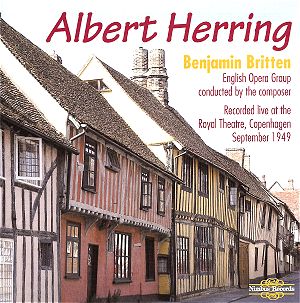
is a minor cavil. Even the cover artwork
is most attractive.
I have no hesitation
in saying that this is one of the most
important historical issues of this
year – or for quite some time, come
to that. It may not be a first choice
recording for the opera – historic recordings
rarely are library choices for the work
concerned. However, it’s an absolutely
essential supplement to whichever of
the modern recordings you have in your
collection. In addition it’s a potent
demonstration of the sheer vitality
and excellence of the work that Britten,
Pears and their key collaborators in
the English Opera Group were doing in
the early post-war period.
In issuing this set
Nimbus have performed a service to British
music that is every bit as valuable
as their work in restoring the Lyrita
catalogue to general circulation.
John Quinn
























 The English Opera Group Chamber Orchestra/Benjamin
Britten
The English Opera Group Chamber Orchestra/Benjamin
Britten 
