Tartini is one of
those late Baroque composers who conventionally attract ‘second
tier’ status and reputation. Yet, his music is consistently
better than such a ranking suggests: more profound, more original,
genuinely creative, more melodic and more skilfully orchestrated
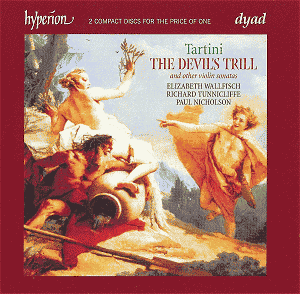
and arranged. This generous, two-CD re-issue from Hyperion/Dyad,
ought to help listeners new to Tartini to arrive at a fairer
assessment.
Not much is known
about Tartini’s early life and musical influences. But we do
know that he was brought up and became musically active in that
part of north-eastern Italy which is called ‘The Sacristy of
Italy’… puritan, conservative, unadventurous. Here, too, he
fell foul of the Church. The city of Padua - livelier than some
in the region – was Tartini’s home for years, although we know
he visited Assisi and Prague.
It seems likely
that innate wit, ability and drive coupled with real curiosity
brought out in Tartini the qualities necessary to build a, subsequently
renowned, violin school which attracted pupils from across Europe.
It was the same determination that compelled Tartini to write
extensively on acoustics and musical theory. It was also surely
Tartini’s temperament - a sensitivity to criticism - that caused
him to react in baffled, mildly combative and defensive ways
when attacked by more progressive figures later in his life.
Born just before the death of Purcell, Tartini died in Padua
in the year Beethoven was born; he composed more than 130 violin
concertos, the same number of violin sonatas, and a quarter
that number of trio sonatas.
On the first of
these two discs the music almost all comes from Sonate a
violino e violincello o cimballo, Op. 1, originally published
in 1732 in Amsterdam; that was a preferred location for Italian
composers because Italian publishing houses were in decline.
The set was reprinted in 1746 in London as XII Solos for
a Violin with Thorough Bass for the Harpsicord or Violoncello.
It must also be borne in mind that Tartini’s Op. numbers and
publishing history and sequences are complex and confusing at
best. In any case, this first group of sonatas comes from the
earlier period in the composer’s life when his style was more
intricate and difficult… double and triple stopping, ornate
passagework and florid ornamentation, not to mention scordatura
in the A Major Pastorale (tr.10), for example.
Of this Op. 1 set
the first six (following Corelli) are in da chiesa style
yet consist of three movements, slow-fast-fast, with the second
a fugue. The rest are in the da camera style with (also
three; also slow-fast-fast) binary dance movements. Another
feature of Tartini’s striking melodic and harmonic language
is their association with dramatic themes, and with dramatic
titles… Didone abbandonata; Il trillo del Diavolo.
This suggests the wish later expressed by Classical composers
to allude to an almost operatic substance in their instrumental
work. It’s a step in the direction of tone-painting, but in
ways less overt than those of Vivaldi.
The Devil’s Trill
is certainly the best known such programmatic violin sonata
from the whole century … Tartini dreamt he had made a pact with
the devil, handed him his violin and listened to his resulting
playing: it’s the trill at the end of the allegro assai (tr.18)
of the G Minor sonata. ‘Matter of Fact’ would be the wrong term
for the style with which the Locatellis play this passage. As
would ‘histrionic’. It’s at just the right place on the spectrum
of styles between these two inappropriate extremes to excite
and amaze without over-impressing the listener.
There are times
in other of the works (the final allegro of the F Major, Op.
1 Number 12, for example) when one might wish that a slightly
more animated speed had been adopted. But at the same time,
the players know the value of restraint and present every turn
of Tartini’s sinuous writing unpretentiously. They also offer
the music for what it is: sardonic in places and with a slight
(feigned?) passivity; the tuning of the B Flat Major allegro
(tr.14) is a good example.
For the music on
CD 2 the plainer and less extravagant style inspired by Corelli’s
Op. 5 solo chamber sonatas (of 1700) was the model. Of these
four sonatas three remained in manuscript during Tartini’s lifetime.
Only his Op. 5 (tr.s13,14,15) was published – in the late 1740s
in Paris. This Op. 5, Number 6 in B Flat, is probably the earliest
piece; it’s close in style to the 1732 Op. 1 on CD 1.
Here too there is
painting in sound … the Sonata in A Major ‘Sopra lo stile
che suona il Prette dalla Chitarra Portoghese’ (‘prete’
is misspelled) looks in the direction of Iberian (folk) music.
The D Major sonata has fanfares; both it and the B Flat employ
a variety of dance movements.
The task facing
Wallfisch, Tunnicliffe and Nicholson, then, was to infuse their
music-making with balance. To be effective the playing should
mix plain exposition of this original, sweet, simple yet spectacular
music on the one hand. And be forward-looking, colourful, expressive
on the other. And all that without making the music sound overly
demonstrative. Such a blend they achieve in three ways:
By meticulous, painstaking
attention to detail, idiomatic ornamentation, an obvious belief
in the nuances and force of the string writing in particular;
it’s obvious that the trio is fully but quietly persuaded by
the music.
By careful use of
contrasting, rather than conflicting, tempi.
And by allowing
the line of the melodic development to breathe and expand unhurriedly
– the first allegro (tr.14) of Op. 1 Number 12 is an excellent
example. Not quite ‘symphonic’ in scope. But certainly panoramic.
Since the virtuosity
of the players was taken for granted in the way Tartini wrote
his music, it must be made to express what it will - almost
without the ‘intervention’ of brashness or bravado. Such qualities
couldn’t be further from the Locatellis’ minds. The grace, elegance
and mellow beauty of Tartini’s invention wins out every time.
Movement after movement from these sonatas is made to sound
dulcet, gentle, delicately-articulated and almost crystalline.
It’s almost, at times, as though a precious piece of glassware
is being passed from player to player – for example in the A
Major’s minuet (tr.12) and the slow movements of the same sonata;
and the B Flat’s first movement (tr.13); the marking of the
latter is, after all, ‘affettuoso’!
The liner-notes
are clear and to the point, if not always perfectly proofed;
the recording crisp and produced with the right amount of presence
to support the musical world of these varied and delightful
sonatas.
Mark Sealey

























 The Locatelli
Trio: (Elizabeth Wallfisch (violin); Richard Tunnicliffe (cello);
Paul Nicholson (harpsichord))
The Locatelli
Trio: (Elizabeth Wallfisch (violin); Richard Tunnicliffe (cello);
Paul Nicholson (harpsichord))