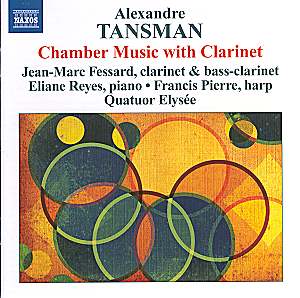
Tansman is beginning
to receive his due from record companies and in this respect
the symphonic cycle looms large. But Tansman wrote highly distinctively
for chamber forces as well and the fruits of his work for chamber
music with clarinet are presented here.
Actually that’s
not quite true. The disc’s title implies an all-clarinet recital
but perhaps the most well known of the works here, Triptyque,
a masterpiece, is written for string quartet.
Nevertheless the
performances of all the works here are most persuasive and make
a fine case for Tansman’s mastery of the chamber medium. Musique
for clarinet and string quartet is the most recent and dates
from 1982, four years before Tansman’s death. It’s rich in polyphony
and has a kind of crepuscular lyricism that fuses Franco-Polish
influences to rewarding effect. The central movement has a
lightly worn neo-classicism and feints toward fugato, or pizzicato
string lacing add colour and richness to the writing. The clarinet
lines are especially fertile, not least in the fluid and quiet
ending of the finale.
Musique à Six
was written for clarinet, string quartet and piano and dates
from 1977. This is a more directly wistful piece and the violins’
initially torpid expressivity promises rich rewards to come,
almost all realised. There are some fizzing things in the Intermezzo
– marked, of all things, Perpetuum pianissimo. The liquid
vitality of the writing, the trademark fugal feints, and the
tenor of the music perhaps suggest Prokofiev and maybe even
Martinů in its athletic vibrancy. The Notturno is
warmly moving, the lyric lines stretched wide and frequently
supported by the piano’s richly romantic and cushioned chording.
And the folkloric hues of the Cappriccio alla polacca are
immensely approachable. The finale’s wistful depth sounds strongly
reminiscent of the opening movement’s emotive remove and it
lends the work a satisfyingly cyclical shape.
Seven years earlier,
in 1970, Tansman wrote Trois Pièces for clarinet, harp,
and string quartet. Readers will note that Naxos programme all
these works in reverse chronological order. Once again Tansman
does nothing to challenge orthodoxies or to promote intellectualism,
academicism or any other dreaded –ism. He simply writes superbly
crafted, lyrically attractive, often technically demanding but
listener-sympathetic music. His Perpetuum mobile writing is
to the fore once again; the shifting lines and resonant, brilliant
contoured patterns ever exciting. This is a piece rich in contrast
and vitality and colour. There’s also a rather Martinů-like
ragtime element in the Lento cantabile finale.
The Triptyque
is by forty years the earliest work and was written in 1930.
It’s sometimes to be heard in the arrangement for string orchestra
though I always prefer the quartet version. It’s a brilliant
neo-classical work, exuberant, energetic, a little analogous
once again with Martinů. The sweet counter melodic statements
of the central Andante are full of warmth but this is
nevertheless a well argued and structured work. The central
lyric section of the finale, for example, is well balanced and
richly contrastive. Rhythmically Tansman is on top form. It’s
not a work that one could suggest bore any similarity with say,
Alan Bush’s Dialectic, another quartet masterpiece from
around the same time. Tansman is sunnier, less ambiguous, and
less intense. But he handles the form with confidence and the
results are life affirming.
An excellent disc
then – well played and well engineered and with good notes.
A feather in the cap for Tansman admirers.
Jonathan Woolf
see also Review
by David Blomenberg

























 Jean-Marc Fessard
(clarinet; bass clarinet)
Jean-Marc Fessard
(clarinet; bass clarinet)