Swerts’ Symphony
No.2 “Morgenrot” was commissioned by the Province of
Flemish Brabant to mark its fifth anniversary as well as the
new millennium. According to the composer’s words the symphony
deals with universal themes such as life, death, music and leave-taking.
The composer chose words from the Catholic Requiem mass as well
as three poems by Rainer Maria Rilke. The work is thus structured
into three or four parts depending on one’s appreciation of
the interlude’s function. It may or may not be considered a
long introduction to the final section. The symphony, however,
is articulated around the central movement, an a cappella
setting of Rilke’s An die Musik.
The first part consists
of three settings of texts drawn from the traditional Requiem:
Introitus, Kyrie and Dies Irae. The Introitus
for soprano and chorus opens with an arresting orchestral gesture
- a defiant glissando underpinned by pounding timpani. This
gesture, albeit with tolling bells this time, also introduces
the Kyrie, also shared by chorus and soprano. The Dies
Irae opens with piccolo trills and rumbling basses in a
tramping motion. Heavy ostinati underpin much of the music throughout,
and the whole is not unlike the Dies Irae section from
Britten’s War Requiem. Anguished trombone glissandi
are heard in the Tuba mirum. The music then briefly pauses
at Liber scriptus – again with tolling bells. A restatement
of the opening launches the final section moving relentlessly
towards its cataclysmic conclusion, the massive build-up being
then abruptly cut short.
The beautiful, peaceful
and deeply-felt setting for twelve-part unaccompanied chorus
of Rilke’s marvellous poem An die Musik is the crux of
the symphony. It provides contemplative meditation after the
turmoil of the preceding sections: “You, language where languages
end... You stranger, music. You, space of the heart that has
outgrown us ...” This magnificent setting contains some of the
most touching music that Swerts has ever penned. There follows
a long orchestral interlude with wordless chorus. The music
is often dark-hued, troubled and tonally ambiguous. A forceful
central episode harks back to the troubled world of the Requiem
sections. Ambiguity prevails again in the last stages of the
movement.
Abschied – Ende
des Herbstes is a beautiful song for soprano and orchestra
- wordless female voices joining in for the coda - setting another
deeply moving poem, in which fall (“Herbst”) symbolises parting.
The symphony ends
with Morgenrot, a large-scale, hymnic barcarolle steadily
unfolding wave-like before reaching its glowing, dazzling peroration
signalling a hard-won victory.
Piet Swerts’ Second
Symphony is a substantial large-scale work and is one of his most
personal achievements. It is undoubtedly music into which he put
much of his inner self, definitely deeply sincere and honest.
It is a work of great expressive strength that the composer describes
as “intimate chamber music for a hundred musicians”. Make no mistake:
this is a truly great piece of beautiful and gripping music that
deserves far wider exposure. All those who respond to Britten’s
War Requiem will certainly find much to admire in
this most moving piece, especially in such a committed reading
which is actually the work’s first performance recorded live but
in excellent sound. A splendid release.
Hubert Culot
























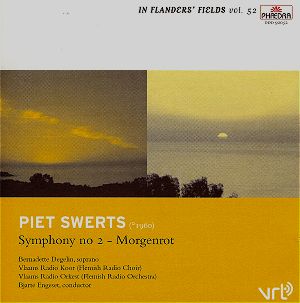

 Bernadette Degelin
(soprano); Vlaams Radio Koor
Bernadette Degelin
(soprano); Vlaams Radio Koor