Shostakovich’s 4th
Symphony starts in catastrophe and
ends in tragedy. In the 60-odd minutes
which separate these two events Shostakovich
takes us through a gamut of emotions
and styles with music ranging from desperate
fugue to comic circus music of the most
banal quality. But it isn’t banal; it’s
essential to the musical argument. And
what an argument Shostakovich gives
us.
By the time of composition,
Shostakovich had graduated from silent
cinema pianist to having three Symphonies
under his belt – the first, written
when he was a mere 19 years of age,
had gone round the world and alerted
musicians and public alike to the presence
of a major talent – as well as a wealth
of film and theatre incidental music
(including the wonderfully titled Hypothetically
Murdered (1931)), and the opera
The Nose, after a story by Gogol.
His most recent opera, Lady Macbeth
of the Mtsensk District was enjoying
a most satisfactory run of some 200
performances in Moscow and Leningrad
alone - not to mention a myriad international
productions - and having seen it on
its way, the composer turned his attention
to his new 4th Symphony.
Not many composers achieve so much before
their 30th birthday. And
things looked rosy for Shostakovich
until the evening of 27 January 1936,
when Stalin, the great Leader and Teacher
of the Russian people, went to the theatre
and experienced Lady Macbeth.
The following day Pravda, the official
Communist Party newspaper, carried an
article entitled Muddle instead of
music, and Lady Macbeth was
silenced on the Russian stage for 60
years! But the Symphony survived
and was set for première on 11
December 1936. But it wasn’t performed
in 1936 and Shostakovich withheld the
work from the public until 30 December
1961, when Kyril Kondrashin conducted
a very successful première.
I can well imagine
Shostakovich’s realisation that had
the 4th Symphony been
performed in the wake of the Pravda
article things could have been made
very uncomfortable for him and his family,
not to mention the musicians who were
to play the work. So he turned his attention
to the 5th Symphony,
described as A Soviet Artist’s Reply
to Just Criticism – although we
now know this work to be just as subversive
as its predecessor.
So what of the 4th
Symphony? It is scored for a gigantic
orchestra, has three movements – the
outer ones being as large as many complete
Symphonies – and the range of emotion
is staggering. I can just imagine Uncle
Joe’s response to this work. If Lady
Macbeth offended him, this work
would send him into meltdown!
The first movement
is a large-scale sonata movement which
encompasses a violent, relentless march,
an headlong, manic, fugue, snarling
brass, screeching woodwind, brutal (almost
sadistic) percussion and a slow, reflective
coda, which is not without the odd acidic
bite. There is more than sufficient
incident and passion to fill several
symphonies and it’s a tiring experience
to get through for the listener. What
must the poor orchestral musician feel
like when playing it? The middle movement
is a light and fleeting scherzo, ending
with the same weird percussion sounds
which reappear at the end of the 2nd
Cello Concerto. And then we are
plunged into the finale, if such it
is, for this is unlike any symphonic
finale I’ve ever heard. Starting with
a funeral march for bassoon and timpani,
and exploiting the tritone, the diabolus
in music, the temperature rises as the
tempo increases and we’re off again,
fighting our fears in hand to hand combat.
And just as suddenly as the music becomes
deadly serious, it turns into a polka-scherzo,
a galop and a waltz! Finally, the music
relaxes becoming quieter and easier,
and it is here that Shostakovich brings
in his coup de grace – two codas, the
first gigantic and loud, combining the
main themes of the outer movements in
utter desperation which dissipates into
the second coda, slow, grey, depressed,
a dead world, all hope gone. The tritone
reappears on muted trumpet and the music
gradually fades into nothingness. This
is the end. There is no more.
A masterpiece? Without
a doubt. This, for me, is Shostakovich’s
finest symphonic hour, but it takes
a conductor and orchestra of some stature
to make sense of this disparate score.
I have heard live broadcasts
of Roman Kofman, with the Beethoven
Orchestra, and been generally impressed
with his grasp of contemporary scores
so I was looking forward to this disk.
The score lends itself
to some freedom in interpretation, and
tempi can be viewed quite freely so
there is no one obvious way to perform
this work. Kofman allows himself quite
a lot of license and sometimes he makes
it work but there are times when a sudden
gear change makes you wonder what is
going on. Kofman obviously cares for
this music and he takes a very serious
approach, but that isn’t enough. This
music is wild and out of control – it
needs a free spirit to take control
then throw all caution to the wind and
let the music go its own way. Kofman
is far too polite and controlling. He
seems to be making apologies all the
time for the ferociousness of the music
and so he holds back when he should
be letting go. The orchestra responds
to his every thought and it plays well,
but it’s not enough. There was no sense
of danger, of being on the very edge
of life itself. This shouldn’t be the
kind of music you take home to meet
mum and dad.
The recording is splendid
and bright, but the orchestra seems
to be sitting in a large, empty hall,
and occasionally detail is lost. Most
unusual is the fugue in the first movement
– it starts with first violins then
one by one the other string sections
enter culminating in a fierce battle
with drums battering their way through
a very full orchestral texture – which
sounds as if the string section is woefully
under strength, the mere handful of
players involved seem stretched and
the effect is embarrassing. This section
should go off like a rocket, we’re on
the edge again, but with Kofman you
feel as if you’re standing, with an
handful of friends, some way from the
edge, in total safety behind a strong,
and sensibly placed, fence.
I’m sorry. I want much
more from this music than Kofman and
his players give me. Much, much more.
For real, thrilling and sometimes petrifying
and hair raising performances, where
all caution is thrown to the wind, listen
to André Previn with the Chicago
Symphony Orchestra (EMI 0094638867623
– coupled with Britten’s Sea Interludes
with the LSO) or Simon Rattle and his
Birmingham Orchestra (EMI CDC5554762
– coupled with Britten’s Russian
Funeral). Here are two conductors
who have the full measure of this music
and play it for all it is worth, both
intellectually and emotionally.
This MDG disk is good,
but it’s not the real Shostakovich 4th
Symphony, more Shostakovich 4
lite. However, full praise for Iosif
Raiskin’s excellent notes.
Bob Briggs
























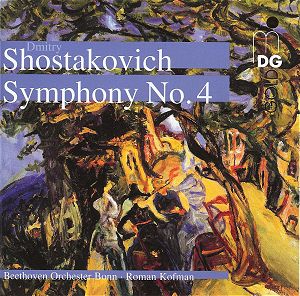

 Beethoven Orchestra Bonn/Roman Kofman