Editorial Board
MusicWeb International
Founding Editor Rob Barnett Editor in Chief
John Quinn Contributing Editor Ralph Moore Webmaster
David Barker Postmaster
Jonathan Woolf MusicWeb Founder Len Mullenger
Robert SCHUMANN (1810-1856)
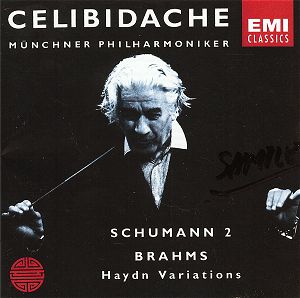
Symphony No. 2 in C major op. 61 [43:39] Johannes BRAHMS (1833-1897)
Variations on a Theme of Haydn op. 56a [21:49] Munich Philharmonic
Orchestra/Sergiu Celibidache
rec. live 29 November 1994, Philharmonie an Gasteig, Munich
(Schumann), 16 October 1980, Herkulessaal der Münchner Residenz
(Brahms)
Photocopied complete
original booklet EMI CLASSICS
5568492 [68:09]
I have off-the-air tapes of Celibidache conducting these
works with the Italian Radio orchestras of, respectively, Rome
and Naples.
I don’t have precise dates but presume they took place during
the 1960s.
In those days Celibidache’s Schumann 2 took 36:11, with individual
movements timed at 11:30, 06:43, 10:40 and 07:18. After a grave
opening the first movement has a leaping energy. Climaxes blaze
euphorically and it is difficult not to be caught up in the
sheer whirlwind of emotion. The scherzo again goes with fiery élan
while the Adagio is searching yet also passionate. A galvanizing
finale caps a performance which, had it been given by the Berlin
Philharmonic, might have been THE Schumann 2, rather as Furtwängler’s
is THE Schumann 4. Celibidache’s extensive rehearsing pays
off with the strings, which sound almost a match for the BPO,
not just in articulation and attack but in shading and expression.
No amount of rehearsal could duck the issue that the oboist,
a competent enough player in himself, simply needed a better
instrument. His acid tone compromises both his solos and the
wind choir generally. I leave open the question of how good
the recording might be if directly mastered from the original
tapes, though it has an excessive closeness that’s not likely
to change.
No complaints about either the orchestra or the recording in 1994.
The single movement timings have now expanded to 13:11, 08:11,
13:03 and 09:14. By this time Celibidache had developed into
a great and above all patient unfolder of Bruckner’s symphonic
canvases. If the opening of the Schumann does not sound all
that different from before, and its fires appear by no means
dimmed, the Allegro impresses by its sense of anticipation.
We feel that the music is a prelude to the following movements.
There is a marvellous sense of steadiness and inevitability
as the progress of the music is charted from climax to climax,
right across the whole symphony, each one adding a little to
the one before yet never becoming an end in itself.
Such an approach may risk sacrificing the sheer immediacy of impact
that strikes us in the Roman performance. Nevertheless, Celibidache
hones in on the smallest details along the way and ensures
that the performance never becomes heavy. The Scherzo now has
a Mendelssohnian lightness. Slowish performances of the Finale
generally end up sounding stolid and four-square, but this
one manages not to. The Adagio is not as overtly passionate
as before, but there is an aching beauty to its long-breathed
phrasing. Maybe one would ultimately find the later performance
the more deeply satisfying one, its sheer wholeness and overall
mastery compensating for any loss of fire. I’m afraid I haven’t
quite reached that stage yet. The Rome performance seems to
me to operate at a higher level of inspiration and this leads
me to prefer it, whatever the orchestral and sonic drawbacks.
However, I wouldn’t be without the later one either.
The Naples Brahms is a generally severe performance, yet luminous
and with finely chiselled phrasing and textures. Apart from
a missed horn entry in Variation 3 the response of the Naples
orchestra is really quite miraculous considering how badly
it could sometimes play. Perhaps the sheer effort of getting
such a result from a third-rate band accounts for the extraordinary
concentration and tension of the performance.
The Naples version comes in at 20:20, so tempi were not all that different
in 1980. The effect in Munich is more relaxed. Variation 3
actually flows a little more while Variation 4, already the
slowest I’ve heard in Naples, is slower still. This, though,
is a case where the Celibidache method produces a minor revelation
since he is able to underline the incidental dissonance of
Brahms’s contrapuntal writing. Slowish performances of Variation
6 usually sound pompous; this one sounds light and playful.
Variation 8 is fleet and mysterious both times and both performances
end with a presentation of the Finale which emphasizes its
steady chaconne basis rather than the jubilation other conductors
find in it.
I think I would still marginally prefer the Naples performance for
its concentration and immediacy. Once again, I find myself
querying the decision of Celibidache’s heirs to concentrate
on his sonically easier later period. His art in some ways
reached its apex in the 1950s and 1960s and I can only hope
that the RAI recordings will eventually be explored. However,
while I found Celibidache’s later self dispiriting in the coupling
of Beethoven 4 and 5 and in his Haydn 92, I have to admit that
there are compensations in this case. Those wishing to investigate
the Celibidache phenomenon may start here in the confidence
that they will find much to reward and fascinate them.
Christopher Howell
Please support our advertisers below by clicking on the logos for further information.

























 Munich Philharmonic
Orchestra/Sergiu Celibidache
Munich Philharmonic
Orchestra/Sergiu Celibidache  [68:09]