I have been living with this set for quite
a few weeks now, and must say I have been enjoying it hugely.
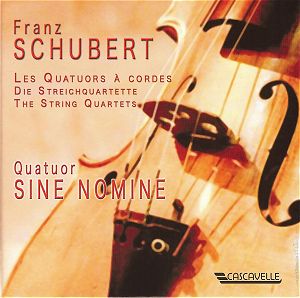
The Quatuor Sine Nomine, or ‘Quartet with
no name’ have been around since 1975, but are anything but anonymous
in the way they play these works. Their name is symbolic of
the players’ wish to be open to all composers and their works,
and is based in Lausanne.
The spread of dates
for the recordings of these works indicates a seriously considered
and long term project rather than a commercially conceived rush
job. With each of the later, greater quartets being distributed
throughout the box and being supplemented with the less well-known
works, we get a nice balance and mix of programmes. All are
recorded in an attractively resonant acoustic except for the
slightly drier museum setting of CD3, which nonetheless suits
well the relative intimacy of much of the music on that disc.
The slimline box is nicely presented, with good sturdy cardboard
sleeves for the discs, and useful if not truly extensive notes
by Brigitte Massin.
For comparisons,
I’ve unearthed a set which has been in my collection for an
improbably long time, and I was surprised to find it still available
– that of the Chilingirian Quartet on a Nimbus set of the last
three quartets from 1978. This is of course an analogue recording,
but it still has many fine qualities, and captures the quartet
when the viola player was Simon Rowland-Jones, part of the original
line-up. Listening to their Rosamunde, which also starts
the Sine Nomine set, there is a pleasant sense of freshness
in the playing, but the recording lacks a little in real contrast.
The players have a light enough touch, but in the final reckoning
there is an overall impression of greyness which may have something
to do with that mixed blessing, the Ambisonic technique used
for the original recording. One can listen ‘through’ such shortcomings
and still find much to enjoy, but the favourite which blew it
away for me was that of the Hagen Quartet on DG. Recorded in
1985 in a far more spacious acoustic, the sound quality and
separation of the instruments has a greater attraction and higher
impact, and the Hagens just seem to inhabit the music as if
it was engraved on their instruments by the maker. The balance
provides a greater sense of transparency as well, with melodies
allowed their simple grace without having the accompaniment
stamping too much character on the overall picture. The Quatuor
Sine Nomine makes clearly different choices, and at first one
has to become accustomed to some of the adjustments in balance
and weight. They have a more dramatic approach, and the inner
voices are layered in a way which sometimes favours a more showmanlike
quartet entity over the subtleties of solo balanced against
more restrained counter-melodies and accompaniment. These choices
result in a somewhat higher tension in general, and while there
are moments of repose and quieter reflection, there is an underlying
restlessness which points more towards the troubled Schubert
than the chocolate-box stereotype which some may still carry
as an image of the composer.
This is certainly
impressive playing, but it does have an ‘in your face’ quality
which some may not be looking for. Take the dramatic opening
of CD2, where Sine Nomine digs deep in the final String Quartet
in G minor D887. There is plenty of dynamic contrast, but
with high-octane playing of this kind there are likely to be
more rough edges as a payoff, and where the ‘difficult’ passages
kick in it is sometimes a fine balance between high drama and
sharp-edged hacking. No, the members of Sine Nomine are no hacks,
but if you prefer an easier ride in your Schubert it might be
wise to have a quick listen before parting with your hard-earned.
In fact it is more often something of a wonder as to how they
manage to keep it all together so well with such gritty interpretations,
and personally I found myself growing to appreciate these recordings
the more I listened to them. Take the narrative textures of
the second Andante con moto movement of D887: those sustained
high passages and restrained melodic figurations possess a quiet
intensity which is highly modern in character – almost minimalist,
and with glissando like portamenti which sometimes seem
almost to have leapt out of Tavener’s Protecting Veil.
Intensity is a quality
which other quartets show of course, and the renowned Busch
Quartet is often held up as an example in this regard. I only
have one example to hand, with a mono 1950 recording of the
String Quartet in B flat major D112 on a 1994 EMI 4 CD
compilation to accompany the major Beethoven quartet recordings.
The Sine Nomine Quartet go even further in terms of contrast,
with the door slammed shut on that lyrical opening in the first
movement even more firmly than with their predecessors. Many
of the aspects of these recordings are however comparable, with
articulation equally clear and detailed. Even taking the limitations
of the Busch Quartet’s old recordings into consideration, it
seems clear to me that Sine Nomine has taken on the Busch’s
baton and brought their muscular and unsentimental tradition
into an even more athletic modern age.
It seems a little
unfair to gloss over the earlier works, but rest assured that
these recordings show even the lowest D numbers to be works
undeserving of neglect. The String Quartet in B flat major
D18, the Schubert’s first in this genre, shows the composer
exploring the kinds of worlds he was already making his own
in the multitude of songs on which he had already started as
a precocious teenager. The earlier quartets have plenty of drama,
dissonance and daring in terms of modulation, and the Sine Nomine
Quartet relish every moment.
One of the highlights
of any such set has to be the ‘Death and the Maiden’ quartet
D810, and again I was able to re-acquaint myself with the Hagen
Quartet’s 1990 recording for DG, which is couple with the Op.135
quartet of Beethoven. Once again, the Hagens have the edge in
terms of refinement and subtlety, making their dramatic points
from a level of near-silence, something which tells most in
the chilling second movement, the original song (D531) from
which the quartet has its subtitle. Once again, the Sine Nomine
Quartet is more charged and restless, having a greater sense
of forward movement, despite coming in only 20 seconds slower
than the Hagens. Patrick Genet the first violinist has the measure
of the heights in the first variation, and Marc Jaermann manages
to make his cello sound like a viola in the second variation.
There is some roughness in the heavy bowing later on, but this
is all part of the idiom for which you’ll appreciate this set
either to a greater or lesser extent. The Hagen Quartet is lighter
and fleeter of foot in the final Presto - prestissimo,
and come in nearly a minute quicker, though not without some
evidence of crashing here and there, as one or two edits show.
Returning to the young Chilingirian Quartet I now find them
rather leaden-footed in this work in general, and can safely
say that this new Swiss recording stands head and shoulders
above the old Nimbus set, as it will many others.
As a complete set,
this has competition from the reissued set from DG with the Melos
quartet, and the more recently recorded Auryn quartet on CPO.
There is also the Kodály quartet on separate CDs from Naxos and
the Vienna quartet on the Camerata label, but most quartets have
concentrated on the ‘great’ quartets, so another complete set
of this standard has to be welcome. While the Quatuor Sine Nomine
may not represent the summit of all versions available in some
of these works, as a complete set this new release has a great
deal going for it. I wouldn’t want to be without the Hagen Quartet
in Schubert’s later works, but would now be very reluctant to
part with this new set. Its qualities are something akin to going
for a walk on the beach on a windy winter afternoon – occasionally
abrasive on the skin, but certainly bracing and definitely healthy:
you’ll certainly feel better after having gone for it!
Dominy Clements

























 Quatuor Sine
Nomine
Quatuor Sine
Nomine