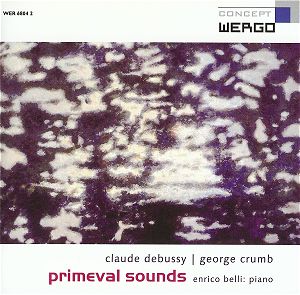
A note on the back
cover of this set states: "the
performance proceeds by alternating
single pieces from the two cycles, favoring
a spiral process of similitudes and
contrasts: an attempt to highlight the
connections between the two composers."
This bothers me. It’s
akin to going to a first performance
and the composer tells you that his
new piece is an attempt to write a symphony,
or a cantata or any piece of music.
What the hell has the composer been
doing with his time that he has been
unable to complete a finished piece
of work instead of delivering to us
an attempt at a composition? It seems
at the very least unfortunate that he
has not been able to give his time to
writing a rounded, satisfying work of
music. Likewise, before making this
recording didn’t pianist Enrico Belli
have some idea as to whether or not
the juxtaposition of Crumb’s and Debussy’s
pieces would highlight the connection
between the two composers? He must have
had some idea. I only needed to hear
these disks once to be able to make
that decision, so the time Belli spent
rehearsing the works was spent in a
vacuum, without thought for the different
aspects of the various musics under
his fingers and in his head.
Let’s look at the Debussy
Préludes first. For me,
these twelve pieces, much more than
the second book, contain everything
that is essential for piano playing
and composition in the next century.
The range of the pieces if phenomenal,
from playful (Les Collines d'Anacapri
and La danse de Puck) to petrifying
(Ce qu'a vu le vent d'Ouest),
impressionistic (Voiles and La
cathédrale engloutie) to
the music hall (Minstrels), pretty
(La fille aux cheveux de lin)
to end-of-the-world apocalyptic (Des
pas sur la niege). Debussy knew
exactly what he was doing when he wrote
these masterpieces and there isn’t an
ounce of fat in any of them – every
note, every silence, every comma, every
breath is essential. It takes a pianist
of great intellect and intelligence
to even come near to what the composer
wants us to know and understand on our
journey through his music. Enrico Belli
is most certainly not that pianist.
His biggest problem is that he refuses
to play any of the Préludes
at Debussy’s tempi and he seems happier
when he isn’t hamstrung by such petty
restrictions as metronome marks. As
soon as I heard the first two chords
of Danseuses de Delphes (the
first Prélude) I knew
something was wrong so after sampling
a couple I thought that I would see
just how far off the mark, in terms
of tempi, Belli is. Below I show Debussy’s
metronome markings, and I say again,
Debussy knew what he was doing, against
Belli’s chosen tempi.
1 Danseuses de Delphes
Debussy: crochet = 44
Belli: crochet = 18
2 Voiles
Debussy: quaver = 88
Belli: quaver = 72
3 Le Vent dans la plaine
Debussy: crochet = 126
Belli: crochet = 99
4 Les Sons et les parfums tournent dans
l'air du soir
Debussy: crochet = 84
Belli: crochet = 52
5 Les Collines d'Anacapri
Debussy: quaver = 184
Belli: quaver = 156
6 Des pas sur la niege
Debussy: crochet = 44
Belli: crochet = 31
7 Ce qu'a vu le vent d'Ouest
Debussy: no metronome mark (animé
et tumultueux)
Belli: crochet = 72
8 La fille aux cheveux de lin
Debussy: crochet = 66
Belli: crochet = 43
9 La Sérenade interrompue
Debussy: no metronome mark (Modérément
animé)
Belli: quaver = 162
10 La cathédrale engloutie
Debussy: no metronome mark (Profondément
calme)
Belli: crochet = 70
11 La danse de Puck
Debussy: quaver = 138
Belli: quaver = 128
12 Minstrels
Debussy: no metronome mark (Modéré)
Belli: crochet = 77
Belli is consistently
slow and uses rubato to such an extent
that in the first four bars of no.6
the music is simply grotesque, being
held back deliberately, and the triplet
in bar three isn’t even! And it’s like
this all the time. He’s best in the
pieces which don’t have metronome markings
as he can play more freely. However,
in bar 41 of no.7 he plays a chord which
Debussy didn’t write and certainly isn’t
in the score – and I have played this
to others who have heard it quite clearly.
And in no.9 he ignores bar 4, which
is important. I need not say any more.
If you want Book 1
of the Préludes buy either
Michaelangeli (coupled with both books
of Images Deutsche Grammophon
477 5345) – a magisterial performance
- or Roy Howat (coupled with six other
works including the première
recording of Les soirs illumines
par l'ardeur du charbon (1917) Tall
Poppies 164). Incidentally, Howat has
recorded Debussy’ complete piano works
for Tall Poppies and it’s a fine set,
well worth the investment. One simple
example of why these two pianists are
far superior to Belli. My favourite
Prélude has always been
Des pas sur la niege – a piece
of monumental simplicity which encapsulates
the whole world. With both Michelangeli
and Howat I feel myself to be in some
distant empty landscape in my bare feet,
thinking about my lot, my footprints
clearly seen in the snow. With Belli,
I’m in the middle of Wolverhampton in
wellies.
George Crumb has a
reputation as a composer of hauntingly
beautiful scores and I imagine that
most of us discovered his work with
the Nonesuch recording of Ancient
Voices of Children (1970) (originally
Nonesuch 71255 (LP - 1975), now Elektra
Nonesuch 9-79149-2 (CD)), quickly followed
by Vox Balaenae (Voice of the Whale)
(1971) for Three masked players (electric
flute, electric cello, and amplified
piano).
Makrokosmos I
was written for David Burge, who also
gave the première and recorded
the work two years later, in 1974 (Nonesuch
H-71293 (LP only)). Crumb has written
that "The title and format of my
Makrokosmos reflect my admiration
for two great 20th-century composers
of piano music -- Béla Bartók
and Claude Debussy. I was thinking,
of course, of Bartók's Mikrokosmos
and Debussy's 24 Préludes
(a second zodiacal set, Makrokosmos,
Volume II, was completed in
1973, thus forming a sequence of 24
"fantasy-pieces"). However, these are
purely external associations, and I
suspect that the "spiritual impulse"
of my music is more akin to the darker
side of Chopin, and even to the child-like
fantasy of early Schumann." In
light of this I think we can be assured
that the attempt described on the CD
inlay has failed – the only connection
between the Debussy Préludes
and the Makrokosmos cycle
is purely external, and the composer
should know.
Like the Debussy Préludes
these 12 Makrokosmos are miniatures
- they range in playing time from just
under two minutes to just over five.
In general the style is simple and straight
forward with the usual avant garde tricks
of loud, fast movement high on the keyboard,
the pianist shouting into the strings,
a chain placed on the piano strings,
but somehow Crumb makes what could be
a ragbag of clichés into something
rather beautiful, modern music which
appeals to the emotions. There’s not
much substance to these pieces but they
are enjoyable – and surely that’s what’s
important.
I have no idea as to
whether Belli plays these pieces well,
but in light of the poor performance
of the Debussy I cannot bring myself
to expect you to buy a double CD set
(and short measure in terms of playing
time at that) just for the Crumb. There
are at least seven other recordings
on CD of this work, and all of them
are coupled with Makrokosmos, Volume
II - Jo Boatright (Music and Arts
(1999)), Bojan Gorisek (Audiophile Classics
103301 (1997)), Emmy Henz-Diemand (Musiques
Suisses 6091-2 (1994)), Laurie Hudicek
(Furious Artisans FACD 6805 (2002)),
Jeffrey Jacob (Centaur 2050 (1990)),
Christiane Mathe (Koch Schwann 364092-2
(1997)) and Robert Nasveld (Attacca
Babel 9371/2 (1993) – a much better
bet all round - go for one of them.
Bob Briggs
























 Enrico Belli (piano)