From
the very outset this promises to be a very different – and thrilling
– Don Giovanni. The overture is dark and threatening
– telling us that this is exactly what Mozart and Da Ponte promises
us: a dramma giocoso. The giocoso is not underplayed
but tells us that this is indeed a dramma. That it is
an interpretation in authentic style is obvious at once. The
strings are playing without vibrato but with tremendous force
and the overall effect is luminously transparent. The woodwind,
so characteristic of any Mozartean score, is prominent and there
is a thrust to the music-making that is very “authentic”. Readers
familiar with the idiom will know what I mean. Readers who are
not so familiar will understand at once when hearing the first
chords. This is music closer to Bach – whom Mozart admired –
than Brahms.
Once
again René Jacobs has rethought a Mozart score and the results
do not primarily encompass the sound, important though that
is, but first and foremost are reflected in the contents. Confirmed
by the ‘interview’ with himself as printed in the lavish booklet
he has approached the drama without preconceptions. He has created
a personal and to a great extent new view of this endlessly
fascinatingly opera. Having loved this work for more than 45
years and lately reviewed half a dozen of recordings, old and
new, I thought I knew it fairly well; not so. Jacobs has come
up with a completely new and revolutionary version. When Arnold
Östman presented his view with forces from the Drottningholm
Theatre almost twenty years ago, it was a reading that in many
respects turned the established idea of the opera upside-down.
His was also an authentic-instrument concept with lighter voices
than those normally assigned and with tempos that at times felt
break-neck. Not so with Jacobs. Tempos are important to him
but most important is to give the singers scope to give meaning
to the text. We can hear that directly after the overture, where
Leporello has all the time in the world to articulate and even
embellish the musical line. This is an expressive reading. And
not least in the recitatives Jacobs allows his singers to take
time. There is one specific example towards the end of act 1
(CD2 tr. 1), where Leporello relates how he has taken care of
Masetto and his friends, while Don Giovanni has tried to seduce
Zerlina. There the dialogue is normally brought forward at a
rousing tempo but here Don Giovanni hesitates before his answers:
Who joined the party? - - - Zerlina! And who came with her?
- - - Donna Elvira! Don Giovanni has to think for a moment and
this is what we hear. He may be intelligent and we – the listeners
– know the answer but he doesn’t – at least not immediately.
As a whole the recitatives are the most lively, the most integrated
with the music I have ever heard. They are accompanied on a
fortepiano, enormously flexibly, extemporized (?) and sometimes
assisted by a continuo cello to heighten the tension. I can’t
remember a recording or a live performance where the secco recitatives
have been so engagingly performed. Another is that there are
sometimes dramatically effective pauses before an aria or a
recitative starts. There are so many recordings where this feels
like a longueur – with Jacobs it is to make a point,
to make the listener think.
This
is one distinctive feature of this recording. Another is the
active presence of the orchestra. This is no novelty. Everyone
with some knowledge of Mozart’s music knows the interplay between
the vocal lines and the comments of the orchestra. It is only
that Jacobs finds so much more to comment on, that the orchestra
is so much more present.
I
touched on tempi earlier and must return to this since again
Jacobs has gone to the sources to find ‘authenticity’. Mozart
gives tempo instructions in the conventional way: Andante,
adagio, allegro etc, but what does this imply? What did
Mozart expect when he wrote andante? One of the clues
is, according to René Jacobs, that so much of Mozart’s music
is based on dances of the day and that it is possible to know
what was the basic tempo of these dances in Mozart’s day. And
it is true: large portions of this score dances, even the champagne
aria, which is a ‘hidden’ contredanse. In fact the whole essay
by Jacobs, entitled “Burning Questions”, is a fascinating read
and more or less necessary to understand his interpretation.
When
it comes to the question of versions Jacobs has firmly opted
for the Vienna one but has included in an appendix the numbers
cut from the Prague edition. This means here that the rarely
heard Zerlina–Leporello duet in the second act is performed
in the opera proper.
I
can imagine many readers saying: this is interesting, this is
fascinating, but what about the singing? There isn’t a single
name I know. Be consoled. Neither did I – bar Kenneth Tarver.
I happened to catch Tarver in this role in the Aix-en-Provence
production in the late 1990s, where he sang Don Ottavio when
I saw it in Stockholm. I found him ideal then and he is one
of the strengths on this recording – lyrical and honeyed but
with heft enough to be a worthy counterpart to Donna Anna. Here
she is here sung by a lighter-of-voice soprano than one usually
encounters. Olga Pasichnyk has all the required power but is
more lyrical than many sopranos in this role. Impressive she
is, certainly, and those expecting a spinto singer need not
fear. Donna Elvira is often regarded as the opposite party to
Don Giovanni. Here she is thrillingly sung by Alexandrina Pendatchanska,
whose bright soprano tones superbly depict this ill-fated and
split character. Her Ah! fuggi il traditor throbs – and
no mistake.
Regular
readers may have seen my rave review
of the Naxos Die Schöpfung where I praised the bright
soprano of Sunhae Im. She is a delightful and bright Zerlina
here and her arias are little gems.
Many
recordings of this opera suffer from a lack of distinction between
Don Giovanni and Leporello. Not so here, where the young Norwegian
baritone Johannes Weissner can never be mistaken for the superb
Lorenzo Regazzo. Regazzo’s servant is as theatrical as any in
my memory. Weissner is a principally lyrical singer, one the
most elegant Don Giovannis one can hear and as a nobleman can’t
possibly be as coarse and blustery as some interpreters make
him. The likewise young Belarusian bass Nikolay Borchev is a
superb Masetto with really instinctive acting abilities. He
is fast advancing to the very top of the trade, as I predicted
when reviewing Simon Mayr’s L’Armonia on Naxos (review).
The other bass, Alessandro Guerzoni as Il Commendatore, could
ideally have been steadier and more thunderous but the character
is an old man. Checking old opera and concert programmes I found
that he also sang the role in the aforementioned Aix-en-Provence
production.
The
recording is superlative, the enclosed book (304 pages!) with
essays in three languages, sung texts and translations, biographies
and even a very extensive bibliography is a model of its kind
and the box is both practical and decorative.
For
a wholly engrossing performance of this eternal masterpiece
with swathes of cobweb blown away, this is a set that should
be in every collection irrespective of how many other versions
one already has. I would be very surprised if this doesn’t appear
at the top of my “Recordings of the Year 2008”.
Göran
Forsling
























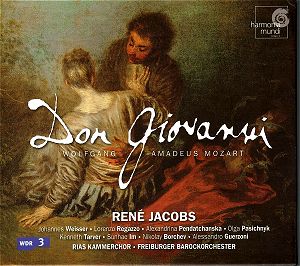

 Johannes Weisser (baritone) – Don Giovanni; Lorenzo Regazzo (bass-baritone)
– Leporello; Alexandrina Pendatchanska (soprano) – Donna Elvira; Olga
Pasichnyk (soprano) – Donna Anna; Kenneth Tarver (tenor) – Don Ottavio;
Sunhae Im (soprano) – Zerlina; Nikolay Borchev (bass) – Masetto; Alessandro
Guerzoni (bass) – Il Commendatore
Johannes Weisser (baritone) – Don Giovanni; Lorenzo Regazzo (bass-baritone)
– Leporello; Alexandrina Pendatchanska (soprano) – Donna Elvira; Olga
Pasichnyk (soprano) – Donna Anna; Kenneth Tarver (tenor) – Don Ottavio;
Sunhae Im (soprano) – Zerlina; Nikolay Borchev (bass) – Masetto; Alessandro
Guerzoni (bass) – Il Commendatore