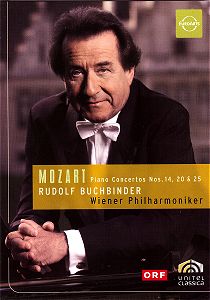
To celebrate his
60th birthday Rudolf Buchbinder played twelve Mozart
concertos with the Vienna Philharmonic – two concerts with no
fewer than six concertos in each. These three performances formed
one half of a concert which, as Jeremy Siepmann remarks in his
booklet notes, coincided with the Vienna City Marathon!
This DVD begins
with the wonderful E flat concerto K. 449, a work which has
always been relatively neglected but which is actually one of
the most consistently great of Mozart’s mature concertos. Even
in some of the most famous of these concertos, one movement
is slightly less inspired.
Among the disappointing
aspects of Buchbinder’s performance of the opening movement
is a shortage of bite or temperament in the trills. Also – and
this is a general feature of all these performances – there
is a rather workmanlike quality to his playing. Semiquaver passages,
often impatient-sounding, lack that degree of poise possessed
by the really great Mozart players such as Haskil, Brendel
or Uchida. In general these are reasonably enjoyable performances
- to damn with faint praise! – not least in the engaging, luxurious
accompaniments. There can however be so much more character
in these marvellously diverse concertos. Indeed, each concerto
occupies its own emotional world, but Buchbinder is too generalised,
too all-purpose. One editing fault – not long before the cadenza
there is a whole beat missing.
The second movement
is taken at a flowing tempo, but again the impression is slightly
perfunctory and short on pathos, with some of the ornamentation
sounding a little flippant - less lyrical than it might. Admittedly,
the ideal tempo of this Andantino is difficult to achieve, but
here the feeling is definitely two beats to the bar, whereas
four-in-a-bar ought to be at least subconscious. The finale,
one of Mozart’s most inventive, is more successful, but again
more grace and rhythmic point would have been welcome.
The next concerto
is the C major - not the D minor, as listed on the box-front
- in the opening movement of which Buchbinder misses the essential
maestoso aspect of the music’s character, the grandeur
of this most Beethovenian of the Mozart concertos. Some may
welcome his straightforward, more athletic approach and the
freedom from pomposity, but I feel more is lost than gained.
The entry of the piano – undemonstrative and almost coy – sadly
goes for nothing.
Dogmatism is usually
best avoided in matters of tempo, but both the remaining movements
do seem just slightly too hurried. The Andante tempo, again
difficult to judge, does not quite convince, and the Finale,
while technically terrific, is absolutely headlong at times.
The D minor Concerto
simply reinforces my overall view. In the opening movement rather
more than mere rhythmic drive is desirable. Some of the passage-work
has a bluntness which would be more appropriate in Beethoven.
This interpretation finds little room for inwardness, and at
times Buchbinder is over-emphatic – the result, I am sure, of
combining the roles of soloist and conductor. This same problem
leads to some less than perfect ensemble in the last movement,
the flute making fractionally early entries with the opening
figure of the movement.
It has to be said
that the idea of playing six Mozart concertos in one concert
is crazy. This kind of overkill does no service to Mozart, merely
diminishing the value of each successive masterpiece. Buchbinder
certainly has the stamina, but I can’t help wondering whether
he would have been a little more relaxed and flexible, or would
have given the music more time to breathe, had he chosen to
play only two or three concertos, and also to play with a conductor.
The camerawork is fine, allowing one to share in the obvious
enjoyment of soloist and orchestra.
Philip Borg-Wheeler
see also Review
by Michael Greenhalgh
























 Rudolf Buchbinder
(piano/conductor)
Rudolf Buchbinder
(piano/conductor)  [85:00]