Editorial Board
MusicWeb International
Founding Editor Rob Barnett Editor in Chief
John Quinn Contributing Editor Ralph Moore Webmaster
David Barker Postmaster
Jonathan Woolf MusicWeb Founder Len Mullenger
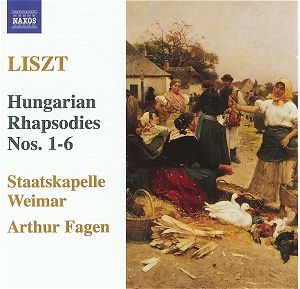
Franz LISZT (1811–1886) Hungarian Rhapsodies, S359/R441 (orch. comp.
and Doppler)
No. 1 in F minor (orig. No. 14) [11:33]
No. 2 in D minor (orig. No. 2 in C sharp minor [11:05]
No. 3 in D major (orig. No. 6 in D flat major [8:31]
No. 4 in D minor (orig. No. 12 in C sharp minor [12:02]
No. 5 in E minor [10:53]
No. 6 in D Major (orig. No. 9 in E flat major [13:50] Staatskapelle
Weimar/Arthur Fagen
rec. Weimarhalle, Weimar, Germany, 17-19 May 2006. NAXOS 8.570230 [67:53]
Once upon a time Liszt’s Hungarian Rhapsodies were very
popular, mostly in their orchestral garb. When I started to be
interested
in classical music around 1960 I found at my local library
a book entitled “Music on Records”. It was printed in 1951,
just when the LP records started to be produced but in the
main it was 78 rpms that were listed. At the end of the book
there were some lists to help beginners and one of them had
the header “The First Acquisitions”. Twenty-one titles were
listed, one of them was Rhapsody No. 2 and the recommended
recording was Ormandy with the Philadelphia Orchestra (Col.
LX 1045). Shortly after this I bought my first record player
and joined the Concert Hall Record Club, where members every
month were offered a specially selected recording at a special
price. My first offer was Franz Liszt’s Hungarian Rhapsodies with
the Vienna State Opera Orchestra conducted by Hans Swarowsky.
Not all six of them were included but No. 2 was and I invested
in it. The price was the equivalent of £2, which was a lot
of money for a poor student. This was my first classical LP
and since the rest of the collection was a handful of EPs,
I played the LP frequently – and so I did for quite some time.
The collection grew but this, my first love, had a special
place in my heart. Everyone knows what eventually happened:
new and fresher loves popped up and poor Liszt was tucked away
in some corner, sitting there like the old teddy-bear, worn
and threadbare.
After almost 45 years of oblivion the present disc appeared on a “discs
for review” list. I placed my bid, curious to see how I would
react after all these years. It was with a certain amount of
nostalgia but more a sense of joy and admiration for the melodies,
often from Hungarian folklore, and their orchestral treatment.
Originally they were composed for piano, 15 in all, and published
in 1850. Towards the end of his life Liszt produced another
four, but it was from the original 15 that he selected these
six for orchestration. Franz Liszt’s part in this project has
never been completely clarified. He stated in his will of 1860
that they were orchestrated by Franz Doppler and revised by
Liszt, and he added a compliment to Doppler on the work. It
is easy to understand why. The treatment is colourful, sometimes
like Liszt’s own orchestral works – Liszt came rather late
to writing for orchestra – with broad brush strokes and bright
colours. The brass, especially the trumpets, are frequently
exposed, but there are many examples of delicate scoring, such
as in No. 4. This was dedicated to the great Joseph Joachim,
and consequently includes a passage for solo violin, but the
harp is also prominent in this piece.
Structurally they go from a slow introduction to a lively finale but
within this frame there are many options, so there is scope
for a great deal of variety. The success of these rhapsodies
depends upon the conductor’s and the musicians’ ability to
convey the rhythms, to find the right lilt and that special
Hungarian tinge. Hans Swarowsky, possibly better known today
as teacher to a number of great conductors – Abbado, Mehta
and Sinopoli among them – was a prolific recorder, mostly on
minor labels. Hungarian-born but active most of his life in
Vienna, he had the right instinct for these rhapsodies – he
also recorded Brahms’ Hungarian dances. Traditionally
the Vienna orchestras have a lot of musicians with Hungarian
ancestry, and my recollection of his recording is one of grace
and strength in combination rhythmic abandon. Technically the
recording was at best workmanlike with one-dimensional sound,
rather congested at climaxes. I don’t know if Arthur Fagen
has any Hungarian connections – he was born and trained in
New York. His Weimar orchestra may have the credentials of
having had Liszt as their conductor between 1848 and 1861,
but that was quite some time ago and hardly affects the present
day players’ attitude to Liszt. They are however an excellent
body of players and have made a number of highly regarded recordings
in a wide field. Even though I can’t quite liberate myself
from the impact of Swarowsky’s recording, I have very little
reason to find fault with Fagen. With all six rhapsodies well
played this is a good and cheap way of getting to know these
entertaining works – even though the piano originals are first
priority.
Göran Forsling
Please support our advertisers below by clicking on the logos for further information.
























 Staatskapelle
Weimar/Arthur Fagen
Staatskapelle
Weimar/Arthur Fagen