After
Franz Lehár’s initial success with Die lustige Witwe
in 1905 – an operetta that harked back to the jolly 19th
century works of Johann Strauss II, Millöcker and Suppé – he
gradually changed direction. For him there were to be new dramaturgical
models including the “lyric operetta” where the focus is on
the ‘inner world of the figures’ as Doris Sennefelder puts it
in her perspective building notes to this issue. Paganini,
Der Zarewitsch and Friederike are all in this mould
and in Das Land des Lächelns a further aspect comes to
the fore, the cultural clash between East and West. The Viennese
Lisa falls in love with the Chinese Prince Sou-Chong but she
can’t accept the demands of Chinese values. As in every operetta
of the traditional kind act 2 ends in bitter conflict. So does
Die lustige Witwe but there everything is sorted out
in the third act as Hanna and Danilo dance away to eternal happiness
– or so we believe. In Das Land des Lächelns the conflict
is resolved insofar as Sou-Chong allows Lisa to leave China
and return to Vienna. He displays some humanity after all but
this does not really lead to increased understanding.
The
Chinese or ‘Oriental’ setting was by no means unique to opera
and operetta of the late 19th and the early 20th
century. Massenet’s Le roi de Lahore and Delibes’ Lakmé
are well-known examples. Mascagni’s Iris and Puccini’s
Madama Butterfly are others and even Gilbert and Sullivan
went Asian in The Mikado. Later Lehár and Puccini actually
worked in parallel on Chinese projects, Puccini with Turandot
and Lehár with Die gelbe Jacke which was premiered in
1923. It was later revised and presented in new guise in 1929
with Richard Tauber in the main lead. Then it was a tremendous
success. This was Das Land des Lächelns.
There
is no denying that Lehár was a tremendously skilful composer.
The Chinese allusions in the score are no less striking than
corresponding music in Turandot. The procession with
chorus at the beginning of act 2 could just as well have been
written by Puccini. It is followed by a highly attractive Chinese
ballet suite. Towards the end of the act the wedding procession
is colourful and powerful, also incorporating quotations from
Sou-Chong’s first act song Von Apfelblüten einen Kranz.
This
recording is the fourth of a Lehár operetta from CPO to have
come my way the last couple of years and it is in the main very
successful. Ulf Schirmer, who also conducted Schön ist die
Welt (review),
secures excellent playing from the Munich Radio Orchestra. His
choices of tempo seem unerringly right. He is very close to
Otto Ackermann in the historical 1953 recording now on Naxos
(review)
and that is my benchmark. The long overture, with quotations
from the music that follows, very clearly prepares the listener
for a largely serious, even tragic play and the ballet suite
in act 2 is excellently played. The chorus is also splendid.
For once in a recording with spoken dialogue between the musical
numbers the balance is such that one need not turn up the volume
every time to hear the dialogue properly. Recorded at three
live performances the technicians have succeeded in finding
the best of both worlds and there is hardly any evidence of
an audience. There is quite a lot of dialogue but it is separately
tracked and for repeated listening this leaves the choice open
for those who want to hear only the music numbers.
There
is a delightful but small-voiced second couple with Julia Bauer’s
Mi, who sings a charming dancing song in act 2, and Alexander
Kaimbacher’s Gustl, who is agreeably lyrical in the duet with
Mi in the same act. Finnish soprano Camilla Nylund as Lisa is
a bit uneven and her uppermost notes tend to be rather hard
and strained. She can also be lyrically appealing, not least
in duet, and in the dark-tinted and operatic finale to act 2
she delivers strong dramatic singing. Prince Sou-Chong is sung
by Polish tenor Piotr Beczala and he is plainly superb with
a good ring in the more outgoing music. Most of all though he
impresses through delicious lyric singing with carefully judged
nuances that cannot be taken for granted in operetta.
I
have complained in the past about sloppy presentation from CPO
but in this respect they have made amends. They give us both
a detailed track-list and a fairly good synopsis in three languages.
I still think that a full libretto would be useful – even for
German speakers.
I
am not fully au fait with all existing alternative versions.
Ackermann’s recording, mentioned above, with Schwarzkopf, Gedda,
Loose and Kunz is a classic and at Naxos price unbeatable. Gedda’s
stereo remake with Anneliese Rothenberger as Lisa is a splendid
alternative and EMI’s third offer, Boskovsky’s recording with
Jerusalem and Helen Donath, also has much to commend it. Robert
Stolz with Rudolf Schock and Margit Schramm will certainly give
pleasure, though I haven’t heard it, but for a brand new recording
in excellent sound and a Sou-Chong to challenge even the great
tenors on the other sets, this is well worth consideration.
Göran
Forsling
























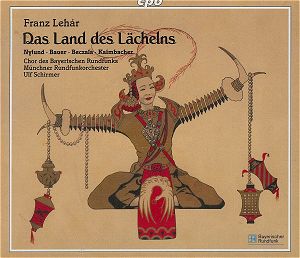

 Camilla Nylund (soprano) – Lisa; Julia Bauer (soprano) – Mi; Piotr
Beczala (tenor) – Prinz Sou-Chong; Alexander Kaimbacher (tenor) –
Graf Gustav von Pottenstein; Alfred Berg (baritone) – Graf Lichtenfels/Tschang;
Theodor Weimer (tenor) – Ein Diener; Henry Raudales (solo violin)
Camilla Nylund (soprano) – Lisa; Julia Bauer (soprano) – Mi; Piotr
Beczala (tenor) – Prinz Sou-Chong; Alexander Kaimbacher (tenor) –
Graf Gustav von Pottenstein; Alfred Berg (baritone) – Graf Lichtenfels/Tschang;
Theodor Weimer (tenor) – Ein Diener; Henry Raudales (solo violin)