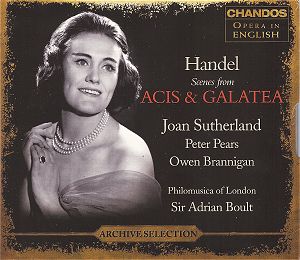
First impressions: the box has a “distressed”
look, its edges mottled, worn looking and yellowing, and so
too the booklet with notes and English text, untranslated. The
recording has been subjected to that process known as 24-bit/96
kHz digital remastering. And the whole shebang comes complete
on one disc lasting just under eighty minutes. The 1959 recording
was presided over by Adrian Boult and he had Thurston Dart as
a harpsichord continuo player. I wish I knew who was the cello
continuo from amongst the ranks of the Philomusica of London.
The cast boasts
three outstanding performances and one singer’s name is printed
in bigger type than any other musicians and that singer is Joan
Sutherland, the Galatea. Her Acis is Peter Pears and the Polyphemus
is stentorian Owen Brannigan. David Galliver is Damon.
At the helm then
is Boult, who leads an intelligent, poised performance. His
rhythms are pretty well sprung for the time though the recitatives
are slow, indeed sometimes too inert for their own good. One
feature that can’t escape note is the guillotining of a large
number of da capo sections; this is unfortunate and unbalances
arias especially with regard to the ritornello but it’s an unavoidable
feature of the recording. Another is the excision of the small
role of Coridon. The orchestra is clearly composed of some top-flight
London professionals and they respond with alacrity to Boult’s
direction. They’re especially good in the instrumental rusticities
underpinning Galatea’s Hush, ye pretty warbling quire!
The chorus however, the St Anthony Singers, are in unsettled
voice; they’re rather woolly around the edges and make up in
commitment what they lack in precision.
For most listeners
however the core of the matter lies in the singing. At the summit
stands Sutherland. Her trills in the aria just mentioned are
magnificent and her elegance and razor sharp articulation ensure
the smoothest of aural rides, with no bumps or vocal stalling.
Hers is not necessarily the creamiest voice to have essayed
the role, nor does she sound quite the maiden, but her As
when the dove is lovely irrespective of voice type. Maybe
her recitative ‘Tis done! Thus I exert my power divine
is a touch too imperious but its command is undeniable. She
matches Pears very rewardingly in their Act I duet Happy
we, where sufficient care has been taken to ensure ensemble
vitality. Now Pears is also not the first voice to come to mind
in this role. Of his English antecedents Heddle Nash is the
name that springs to mind, whose recordings of arias from the
work were – and are – so captivating. Pears proves as notable
a phraser of Handel’s melodic lines as his eminent predecessor.
Love in her eyes sits playing is spun with delightful
lyricism and ardour, breaths taken appositely, the line unbroken,
registral complications all well surmounted. It’s really only
the tightness of the voice that can limit unalloyed pleasure.
He certainly has the clarion edge for Love sounds th’alarm.
Owen Brannigan was
a much-admired bass and he proves a worthy successor to such
heavyweights as Peter Dawson and Malcolm McEarchen. He has the
voice, the personality and the power of projection. His gifts
of characterisation are to the fore here, but never over done.
The divisions of O ruddier than the cherry are full of
brio and in-character bluster.
The least well known
of the quartet is the Damon of David Galliver. He has an attractive
tenor voice, and from time to time sounds not unlike Heddle
Nash, especially in the upper register of the voice – try Act
I’s recitative Stay, shepherd, stay! Occasionally the
line veers a little toward unsteadiness but it’s not a material
problem.
The many more recent
recordings of course, Gardiner’s prominently, address technical
and stylistic matters rather more appropriately. But this Golden
Age Acis is a splendid example of technical and lyric superiority
in action.
Jonathan Woolf

























 Galatea – Joan
Sutherland (soprano)
Galatea – Joan
Sutherland (soprano)