Purchase Brilliant Classics from MusicWeb - "CLICK" here

Classical CD and DVD reviews. Make a regular donation(£1, £2, £5) here MusicWeb is not a subscription site and our advertisers help pay for it. Please visit their sites regularly to see if anything might interest you. Purchasing from them keeps MusicWeb free.

Classical Editor: Rob Barnett                               Founder Len Mullenger


CD REVIEW

Site Map

More Reviews

How to find a review

Classical CD Review Archive

Book Reviews

Film Music Reviews

Jazz CD Reviews

Nostalgia

Comment

Norman Lebrecht Weekly

Arthur Butterworth Writes

Phil Scowcroft's Garlands

Classical blogs

Reviewers Logs

Announcements

Don't Go Here!

Community

Bulletin Board

Web Ring

Reviewers

Helpers invited!

Resources

How Did I Miss That?

British Composers

British Light Music Composers

Other composers

Indexes
   Label
   Masterwork

Discographies

On-line Music
[Download sites]

Themed Review pages

Our Classic Classics

Online books
MWI Classical
     Encyclopaedia

Gilder Dictionary of
     Composers

MWI Pop
     Encyclopedia

Other Complete Books

Programme Notes


British Music Society
Performers
The BBC Proms
Musical WWW pages
Classical Music Online

Recording Companies and Retailers
Agents and Marketing
Publishers
Non-Classical Web pages
Orchestra Web Sites
Newsgroups
Web News sites etc


Editorial Board
Classical Editor
   
Rob Barnett
Seen & Heard
Editor and Webmaster
   Bill Kenny
MusicWeb Webmaster
   Len Mullenger
Assistant Webmasters
   Patrick Waller
   David Barker

PotPourri
A pot-pourri of articles

MW Listening Room
MW Office
Helping MusicWeb
Advice to Windows Vista users  
Questionnaire    
Site History  
What they say about us
What we say about us!
Where to get help on the Internet
CD orders By Special Request
Graphics archive
Currency Converter
Dictionary
Magazines
Newsfeed  
Web Ring
Translation Service

Rules for potential reviewers :-)
Do Not Go Here!
April Fools

Would you like a hyperlinked weekly summary of the CDs we have reviewed?
Click for further details

Sample: See what you will get


alternatively Crotchet   AmazonUK   AmazonUS

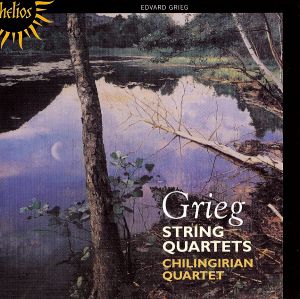
Edvard GRIEG (1841-1907)
String Quartet No. 1 in G minor Op. 17 (1877) [34.30]
String Quartet No. 2 in F major (comp. Levon Chilingirian) (1891) [29.46]
Chilingirian Quartet
rec. 8-10 December 1998, St.George’s, Brandon Hill, Bristol
HYPERION HELIOS CDH55299 [64.25]


A good coupling, the two Grieg Quartets. Really though, it’s only one and half quartets because the composer never managed to complete the second despite the fact that the first two movements date from sixteen years before his death. I suspect it was because he realised that in the First Quartet he had written an impassioned masterpiece and that he probably could not exceed his achievements and also not repeat the formula. It’s the opening, twelve minute movement that is especially remarkable, for a composer often associated with miniatures, or ‘bon-bons stuffed with snow’.
 
The inspiration in this work never wanes. The opening Allegro has an adagio introduction of considerable power. The movement is in sonata-form with a memorable first subject and a completely contrasting, meltingly tuneful second subject. These which constitute by far the longest section of the quartet are successfully woven into a convincing whole and remind us that Grieg is not just a pretty miniaturist and. There are several passages which remind me of melodies and indeed rhythms found in the finale of the famous piano concerto, completed only the year before. The second movement is marked ‘Romance’, but has contrasting tempi including an allegro agitato which reappears. The third is an Intermezzo marked Allegro and but which is also indicated as a scherzando. There’s also a delightful trio section. The finale is marked Presto al Salterello with a Lento introduction which comes back towards the end. A joyous coda rounds things off. It makes a decisive and ideal end to a strong work.
 
I was bowled over by this First Quartet coming to it for the first time and was expecting much from the Second. This latter was written in Copenhagen where Grieg lived for a while after 1891. In the accompanying essay by Erling Dahl, Grieg is quoted as having written the following to his friend Frants Beyer. He bemoans that “here there is nothing inspiring or stimulating” and he goes on “the music I settle on one day I tear out of my heart the next … The ideas are bloodless, just as I am …”. I have to admit that the music of the pastoral and easy-going first movement sounds just like it. It does not seem to have cried out to have been written; craftsman-like certainly, and pleasant enough but that’s it. With the second movement we are back in Norway. I hear a Hardanger fiddle melody and folk-like drones. The third movement is a song-like adagio and the fourth is a happy little Allegro. Both are quite short and have been reconstructed by Levon Chilingirian, as he writes in the booklet, from various sketches. His brief remarks are for me very frustrating as he fails to tell us exactly what his contribution was and nothing about the state of the originals. The fourth movement ends in a hopelessly abrupt manner to such a degree that the completed work is unperformable as it stands. Surely, in reconstructing a work a satisfactory ending should be ‘composed’ even if we have no idea what the composer intended. That is after all what makes Anthony Payne’s Elgar 3 so successful.
 
In recent years I have heard the Chilingirian Quartet live a few times and have not been as impressed as I might have expected. Back in 1998 they really hit the jackpot with this recording and are on superb form. They obviously have a deep feeling for the music and are captured in the lovely and easy-going acoustic of St. Georges in Bristol most naturally by Andrew Keener.
 
Now that Hyperion have released this disc on their inexpensive Helios label I can only suggest that it is well worth the outlay. Certainly the first quartet is a masterwork and deserves to be better known.
 
Gary Higginson


Advertising Rates
Visitor stats
MusicWeb International
has over 21,000 Classical CD reviews on offer


Gerard Hoffnung Concerts &
The Bricklayer Story

Naxos Classical

Purchase Brilliant Classics

Australian Eloquence CDs on Buywell.com


New Releases

Hyperion
New Releases


Guild Music


MusicWeb sells the Polish
catalogue CDAccord
£10.50 post free W-W


MusicWeb sells the
Arcodiva catalogue
£12.00 post free W-W


Price Reduction: £11.00
post-free
world-wide
Try it and see - Sale or Return


MusicWeb can now offer you discs from the following catalogues:
Prices include postage

[Acte Préalable £13.50]
[Arcodiva £12.00]
[Avie from £6.25]
Brilliant Classics
[British Music Society £13.49]
[CDACCORD from £10.50 ]
[ClassicO £12.50]
[Hallé from £11]
[Hortus £14.99 ]

[Lyrita ONLY £11.00 ]
LYRITA Sale or Return
[Onyx £12.00
]
ONYX Sale or Return
[REDCLIFFE £11 ]
[Tactus £11.50 ]
[Talent from £12.00 ]
[Toccata Classics £12.50 ]

MusicWeb Recommended Recordings 2008

DISCS OF THE YEAR 2007


Return to Review Index


Reviews from previous months
Join the mailing list and receive a hyperlinked weekly update on the discs reviewed. details
We welcome feedback on our reviews. Please use the Bulletin Board.  Please paste in the first line of your comments the URL of the review to which you refer..


You can purchase CDs and Save around 22% with these retailers: