Kate Van Winkle Keller,
the author of this book, is a well known
expert in early dance and music, with
a long and distinguished career as a
consultant for many organisations and
individuals such as composers, archivists,
scholars and collectors. She specialised
in early American music and dance manuscripts;
has written and published numerous articles
and books on these and related subjects,
and was a contributor to various high
profile publications, as, for example,
The American National Biography
and the Encyclopedia of the North
American Colonies. Her name is also
connected with important scholarly organisations,
like the Society for American Music
and projects such as The Performing
Arts in Colonial American Newspapers,
1690-1783, published in 1997 and
supported by the National Endowment
for the Humanities.
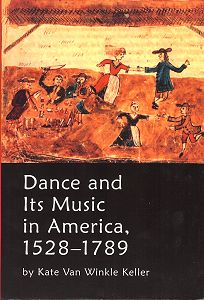
The present book, Dance
and its Music in America, 1528-1789,
comes therefore as no surprise and fits
well into Ms Van Winkle Keller’s distinguished
curriculum. This is a study of dance
and its music in America, beginning
in the early years of colonisation of
the New World and ending with the birth
and independence of the United States
of America in 1789. Before I began reading
the book, I mistakenly believed it dealt
with dance as an art-form but this is
not the case. This is, in fact, a very
well researched study of dance as a
social feature of everyday life, detailing
the various European influences, as
well as the dances of the Natives and
the traditions of the African slaves
and how it all came together.
The book is organised
geographically, first by region and
then by state, in chronological order
of discovery and settlement, which means
that once in a region the reader will
follow the history of each state up
to 1789, thus forming a true picture
of how dance and its music developed
locally, relevant to its various roots.
For example the first chapter is about
the Spanish Exploration and Settlement,
starting with Florida and then the Southwest,
i.e. New Mexico, Northern Arizona, Texas,
Louisiana and California.
The study begins with
a rather extensive introduction that
explains the purpose of the book, as
well as the reasons for its structure
and organisation and why it was written.
The narrative is fluent and pleasant
to read, even for a non-scholar who
might be interested in the early history
of the USA in general and of dance and
its music in particular. It explains
well the influences from the various
European nations that created the majority
of settlements and had the biggest impact
in the shaping of the nation, meaning
of course Spain, France and England,
and it successfully demonstrates the
link between social/cultural events
and historical developments. It clearly
brings across the point on how dance
was used (one may be tempted to say
"abused"!) to deliberately
eradicate the traditions of the natives
and to force their integration. All
European settlers recognised the psychological
power of dance and its music in religious
services, the Spanish in particular,
to help "educate" and convert
the natives. The native population was
always taught to play and sing European
music and brain-washed that their culture
was "uncivilised". Each European
nation carefully and consciously used
dance and its music as a form of recreation
for the people, in social gatherings,
but also as a powerful tool for political
purposes, to wipe out one culture in
favour of the supposedly superiority
of another and to impose Christianity
on natives and slaves. This makes fascinating
reading and will be of interest for
scholars as well as people who simply
have a desire to learn. What I mean
is that, to my mind, Kate Van Winkle
Keller’s brilliantly investigated, well
written study is aimed as a reference
book for researchers and historians
but it also makes an interesting, pleasant
reading for the amateur person of letters
or for the general reader, looking for
more than entertainment. The narrative
suitably finishes with a short epilogue,
stating the birth of the United States
as a nation, several crucial dates,
as for example the inauguration of George
Washington on 30th April
1789, and a brief summary of how dance
and music further developed in the country
from then on.
The objectives of the
book, as mentioned above, are well supported
by text extracts from historical documents,
local newspapers of the time, letters
from readers of these papers, dance
teachers’ pamphlets and brochures advertising
their skills, as well as facsimiles
of music sheets with the scores for
the various dances, which were published
during the years comprised in the study.
The many illustrations, drawings and
sheets with the dance steps, circulated
in those years, are also reproduced
in the book and contribute to a better
understanding of the importance of dance
and its music as social forces in the
daily life of the colonies and how they
impacted and shaped the various states.
The historical information
concerning the various European nations
is accurate and detailed, perhaps, in
my personal view, with one minor fault,
i.e. the naming of the Iberian Peninsula,
on page 42, as Spanish Peninsula. I
am not sure if this is the way that
it is generally referred to in America
or if the author called it "Spanish"
because she was writing about the influence
of the settlers from Spain, however,
she was also referring to an event on
the Peninsula and bearing in mind that
it is formed (and was already so in
the period dealt with in the book) of
two distinct countries (Spain and Portugal),
with different languages and culture,
I would have preferred to see it designated
as Iberian Peninsula or Iberia, rather
than Spanish Peninsula.
A very good feature
of the book is the wise and enlightened
idea of keeping all notes, as footnotes,
at the bottom of each page instead of
having them all numbered and then listed
at the end of the book. Personally,
I find very distracting, annoying even,
to have to go back and forward continuously
if I want to read the notes and understand
the text in full, which often causes
me to ignore the notes altogether. In
this manner, as simple footnotes, one
immediately refers to them, as one does
not lose the plot, or in this case,
the natural flow of the narrative.
To summarise, I found
this a very interesting, enriching historical
study, proving various important aspects
of the use of dance and its music as
a political and social weapon, well
documented and supported by original
images and texts of the period it details,
as well as making for enjoyable, fascinating
reading.
Margarida Mota-Bull