It would be fair to
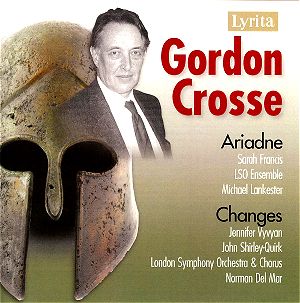
say that Gordon Crosse whose seventieth
birthday is being celebrated here has
not been at all generously treated by
record companies. These works were originally
issued on Argo, that pioneering label,
often helped by the British Council.
Although I have kept my ears and eyes
open over the years I have not encountered
much of Crosse’s music. Having heard
this disc it is clear that I should
soon attempt to make up for lost time
and find out more about him.
For now, we must concentrate
on these works. Let’s start with the
main piece, Changes, written
on a vast canvas, with its unique description
- a ‘nocturnal cycle’. In his book ‘Contemporary
British Music, 1945-1970’ (MacDonald,
London, 1972) Francis Routh gives a
list of then recent oratorios mostly
now forgotten; Crosse does not call
his piece ‘oratorio’, but you get the
idea. He comments that Crosse’s ‘Changes’
and many more "while in no way
perpetuating the old tradition, lacked
that urgency which would inspire a contemporary
audience". I think Routh means
that the overall plan of the work, and
possibly others alluded to, is amorphous.
In other words it is difficult to know
what the final aim of the composer actually
is. These works lack the encompassing
vision of say A Child of our Time
or the War Requiem. The texts
and their use need at least an attempt
at explanation.
Part I lasts for nine
minutes and is set for soprano solo,
chorus and children’s choir. It gives
the work its title in a way. Crosse
uses texts taken from inscriptions on
medieval bells like ‘Sancte Jacobi ora
pro nobis’ – hence bell Changes.
Perhaps it’s the composer’s use of the
children’s voices here and throughout
the work, but Britten never seems to
be too far away. It’s also the use of
the percussion and certain harmonies
which make me feel this. I must quickly
add however that Crosse has a richness
of harmony which is absent from Britten
and also deploys a wider palette of
orchestral colours.
Part II is divided
into four sections before a brief orchestral
interlude. A Prayer for baritone
solo with rather lugubrious words by
Sir Thomas Browne is followed by another
prayer for chorus God be in my head.
There’s then a third prayer for children’s
voices. It’s of a lively sort ‘Matthew,
Mark and John/Bless the bed that I lie
on’. Here I am reminded of Britten’s
Spring Symphony.
Part III is the longest
and divides into five continuous sections,
each for a different combination of
performers. The Bellman’s Song,
with words by Herrick is for chorus.
Epitaph, to words by Stephen
Hawes, an early Tudor poet, is set for
baritone solo. The women's voices lighten
the atmosphere with Hey nonny no
and the men follow with Davenant’s
words Wake all the dead. In the
final section they are all joined by
the children with Like the lightning
from the sky, anonymous words ending
‘So man that dies shall live again’.
Part IV has only two
sections. First a setting of Blake’s
The Door of Death for soprano
solo ending in joyous abandon in music
for the entire ensemble using another
anonymous poem ‘Here we bring new water
from the well’. You may recall that
this was set by Britten for boys’ voices
and called A New Year Carol.
How are all of these
texts connected and why were they chosen?
Well, I have absolutely no idea, except,
to quote the composer. To write a piece
for the Three Choirs Festival one must
"blow away the insufferable moral
earnestness of the (English) Oratorio".
He continues: "My chief conscious
aim … was to fashion something enjoyable
for listener and performer alike".
At the end of his notes the composer
reminds us that the piece was written
"with the aim of communicating
enjoyment".
The Concerto for oboe
and small orchestra, Ariadne
was partially composed in Crete hence
the title and its allusion to the famous
legend. Crosse says that he does not
try to illustrate the story and that
the title is purely in homage to source
of inspiration. It is a very fine and
moving work. The composer gives us a
useful and detailed note and mentions
how the work includes "clear echoes
of Cretan folksong". The plan is
slow and lyrical, then fast and virtuoso.
Finally it is slow and lyrical being
based on the opening theme which had
been played by solo oboe, dying away
to nothing
I find both performances
to be top-notch. How wonderful to have
Sarah Francis, Crosse’s wife, playing
what is probably the best British Oboe
Concerto of the twentieth century. The
story of how it was written in secret
is quite fun. As for Changes,
back in 1969 Shirley-Quirk and Jennifer
Vyvyan were undoubtedly at their peaks.
Music like this was just the kind of
repertoire in which Norman Del Mar could
excel. The orchestral playing is committed
and clean. The recordings are very good
considering their age and have been
superbly re-mastered in a very natural
acoustic.
I have to say, that
if I had seen this disc on the shelf
of my local shop then I might probably
have passed it by. Now I have it I shall
play it quite often and am delighted
to have made its acquaintance. I strongly
feel that the little known Ariadne
is a very fine work which needs
to be further promoted and heard.
Gary Higginson
See also reviews by
Dominy
Clements and Rob
Barnett






















 for details
 * Sarah Francis (oboe); London Symphony
Orchestra/Michael Lankester
* Sarah Francis (oboe); London Symphony
Orchestra/Michael Lankester