Editorial Board
MusicWeb International
Founding Editor Rob Barnett Editor in Chief
John Quinn Contributing Editor Ralph Moore Webmaster
David Barker Postmaster
Jonathan Woolf MusicWeb Founder Len Mullenger
Ludwig van
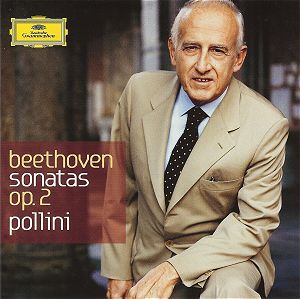
BEETHOVEN (1770-1827)
Piano Sonatas op. 2:
No. 1 in F minor [19:34]
No. 2 in A
major [22:06]
No. 3 in C major [23:33] Maurizio Pollini
(piano)
rec. September 2006, Herkulessaal, Munich DEUTSCHE
GRAMMOPHON 4776594 [65:27]
I suppose I was not the only teenager who, struck by the
F minor key and certain thematic resemblances to the “Egmont” Overture,
and fired up by a raucous Toscanini recording of that work,
plunged loudly and enthusiastically through the outer movements
of op.2 no. 1, much admired by my schoolmates who knew no better.
It was early days for a teacher to explain to me that fortissimo
in early Beethoven can’t mean what it does in Rachmaninov because
there just isn’t the pianistic sonority to support such a massive
sound, that you don’t cloud passage work and runs with the
pedal in early Beethoven any more than you do in Haydn. And
if those outer movements will yield something to a generalized
onslaught, the “Menuetto” is a movement whose delicate poise
calls for musical maturity. It is also a prime example of what
fortissimo can and can’t mean in these early works.
The A major Sonata is less tempting to excited teenagers. Unless,
that is, they have a teacher who can persuade them to put the
Symphonies on one side and listen the op. 18 String Quartets
if they want to hear the sort of transparency required in these
post-Haydn works. And also that the downward 32nd-note
motive and the upward triplets cannot be pedalled so they become
an indiscriminate whoosh. And that the Scherzo is marked only
Allegretto and if you do not rush it and over-pedal it, it
has grace and humour.
The C major Sonata yields more to an all-holds-barred approach. Still,
our teenager may mature to become a real artist. He may learn
to imbue the second subject of the first movement with humanity
and generosity of spirit rather than just tossing it off as
a lighter episode between the brilliant bits.
Pollini has, it seems to me, retained intact his early response to
this music. It’s all very vital and explosive, with jabbing
accents and powerful fortissimos. There’s some surprisingly
blurred pedalling at the points I mentioned in the A major
first movement. Up to a point it’s exciting. And of course,
Pollini can do all the things the teenager wants to but can’t.
He can take breakneck tempi and keep them under control – no
slackening of pace as he plunges into the Trio of op. 2/3 (iii)
for example. Those who listen on headphones will enjoy, or
at any rate hear, some heavy breathing, shouts and unmelodious
snatches of accompanying song. Yet for all that I find it a
bit wearing; dogged and unvaried rather than zestful.
The man who, more than any other, found the humanity in these early
Sonatas was Schnabel. His famous technical failings were not
much in evidence on this occasion and the 1930s recording sounds
remarkably well in Mark Obert-Thorn’s Naxos transfer. All the
same, I cannot offer readers a 70-year old recording as the
only alternative to this brand new one from DG. There are more
recordings of these Sonatas by now than any one person can
possibly know, but I re-sampled Perahia (Sony), whose versions
I have always admired. I was struck by how much more range
he finds in the music. When he really lets fly – as in the
Finale of op. 2/1 – it’s all the more exciting for the comparative
restraint of the preceding movements. He finds humour as well
as vitality in the A major work, also more restrained depth
in the slow movements. And he knows how to let the humanity
shine through in that second subject of the Finale of no. 3.
In short, without suggesting that Perahia is the only successful
interpreter of this trio of Sonatas, the reader who does not
know the music yet can go to him with confidence. Pollini is
regrettably too one-sided to offer real competition.
Christopher Howell
Please support our advertisers below by clicking on the logos for further information.

























 Maurizio Pollini
(piano)
Maurizio Pollini
(piano)