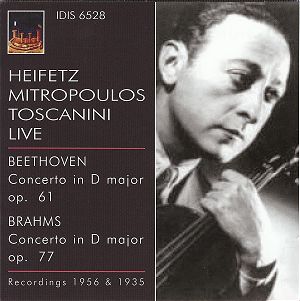
Few
people would disagree if I were to say that Jascha Heifetz was
the greatest violinist of the 20th century. He had
a flawless technique, which he always put at the service of
the composer and an ability to communicate directly with his
audience. However, sometimes there appears to be a coldness
to his playing and a detaching of his intellect from interpretation.
All these elements of his character are in these two performances
in abundance.
When listening to his studio recordings it’s easy to hear which works
he felt especial sympathy with – concertos by Sibelius, Walton,
Korngold, Tchaikovsky, Glazunov, chamber works by Dohnanyi,
Schubert, miniatures by Saint-Saëns,
his own arrangements of Gershwin and others and, possibly the
best of all, his unaccompanied Bach. Please forgive me for any
of your favourites which I have failed to mention; these are,
literally, the first recordings which sprang to mind. In a recording
career which stretched from 1917 to 1972 there weren’t many
major works he didn’t record. It’s an amazing legacy. Whilst
there are some of his recordings which don’t readily speak to
me, some of the recordings of the classical repertoire, for
instance, I am always conscious of the intelligence of his approach.
Here
are two concertos which, to be honest, I wouldn’t put in my
top ten Heifetz interpretations list. However, these live performances
do have that something special, which is usually missing in
the recording studio. There’s an electricity and fire, the sheer
joy of making music before the public.
The
recordings are of their time and age (50 and 70 years old) but
have been cleaned up as best they could. Obviously the Beethoven
is the better of the two. What strikes one first about this
interpretation is that once Mitropoulos sets his tempo it never
wavers, except for some subtle rubato. The orchestra is excellent;
attentive to the soloist at all times, but coming into its own
in the tuttis. The first movement cadenza is, perhaps,
too big and modern for the classical era, not really sitting
comfortably with the rest of the work but what wonders Heifetz
makes of it. He relaxes for the slow movement and is joyous
and playful in the finale. It’s also most satisfying that the
tempi chosen are faster than we have come to expect and how
well they work. I do sometimes feel that these days the direction
moderato has been added to lots of tempo indications.
The music soars. It’s easy to understand the spontaneous applause
at the end of the first movement. The audience needs that release
after such a superb performance.
My
one reservation is that because of the balance I sometimes feel
that Heifetz is sitting in my lap. Once you get over that feeling
you’ll settle back and allow him to weave his magic. This is
Beethoven according to Heifetz, but none the worse for that.
The
recording of the Brahms is a different matter entirely. The
big problem is that it sounds as if it was recorded with a condenser
microphone - the kind you used to get with a Walkman. Here the
sound recedes into the distance after a loud passage and gradually
makes its way back towards you. Therefore the start is quiet
- obviously it follows the applause as soloist and conductor
walked onto the platform - but soon becomes clear. The first
tutti is thrilling and full then away goes the sound
and so on. Like Mitropoulos, once Toscanini sets a tempo it
never wavers, except for rubato. Heifetz is more mellow, and
more comfortable, in this music; after all, he was a violinist
of the romantic school. All I can really say is that like the
Beethoven the first movement is full of drama - with a cadenza
at odds with the surrounding music. The slow movement is gorgeous
but with a backwardly placed oboe. The finale full of fun.
For
Heifetz fans this is a must-have disk. I urge all students of
the violin, and professionals as well, to listen to some of
the very best violin playing you’ll ever hear. For the general
listening public these are very special interpretations. If
you can overcome the sound there is much to enjoy and admire,
especially that frisson you get from a live performance.
This
might not be the Beethoven and Brahms we are used to, but it
is the fiddling we desire.
Nowadays
we have the vision of Heifetz as being able to play anything
without any fear because of his supreme technique but there
is one story which puts our perceptions into a different light.
When Louis Gruenberg was writing his concerto for Heifetz the
two men worked closely together on the intricate solo part.
The story goes that at one point the violinist complained that
the solo part was becoming too complicated – to which the composer
simply said, “You’re Heifetz, aren’t you?”
Enjoy.
Bob Briggs